
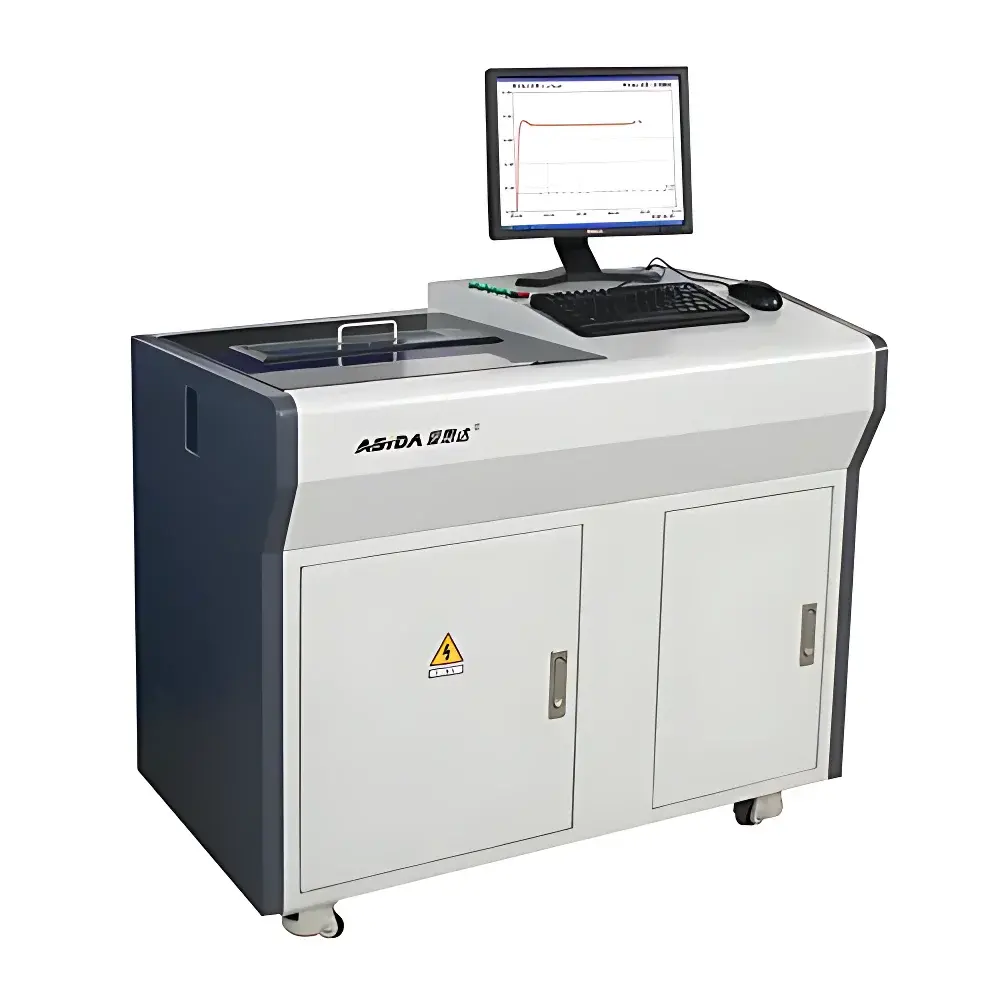
ASIDA LZ21 Dynamic Ionic Contamination Tester
| Brand | ASIDA |
|---|---|
| Model | LZ21 |
| Type | Sodium Ion–Specific Dynamic Conductivity-Based Ionic Contamination Tester for Printed Circuit Boards |
| Measurement Principle | Dynamic Extraction + Conductivity Monitoring per IPC-TM-650 2.3.25.1 & J-STD-001 |
| Operating Temperature | 40 °C ± 0.3 °C |
| Extractant Volume Options | 17 L (standard), 30 L (enlarged) |
| PCB Test Area Range | 1200–8712 cm² |
| Conductivity Resolution | 0.0001 µS/cm² |
| Accuracy | ±5% |
| Power | 1700 W |
| Dimensions (enlarged) | 1401 × 600 × 1000 mm |
| Weight (enlarged) | ~150 kg |
| Compliance | IPC-TM-650, J-STD-001, ISO 9001-aligned test environment control |
Overview
The ASIDA LZ21 Dynamic Ionic Contamination Tester is an engineered solution for quantitative assessment of ionic residues on printed circuit board (PCB) surfaces—designed in strict alignment with IPC-TM-650 Method 2.3.25.1 (Dynamic Ionic Contamination Test) and supporting J-STD-001 requirements for cleanliness validation in electronics manufacturing. Unlike static extraction systems, the LZ21 implements continuous recirculation of deionized water extractant across the PCB surface under controlled thermal and hydraulic conditions, enabling real-time conductivity monitoring and kinetic profiling of ion leaching behavior. This dynamic methodology provides higher sensitivity to low-solubility, slow-diffusing ionic species—including chloride, bromide, sodium, and ammonium—and delivers statistically robust data for process qualification, cleaning validation, and failure root-cause analysis. The system maintains a stabilized extraction temperature of 40 °C ± 0.3 °C via integrated PID-controlled heating and insulated fluid path architecture, minimizing thermal drift and ensuring reproducibility across shifts and laboratories.
Key Features
- Automated dynamic extraction cycle with programmable duration (1–60 minutes), including optional manual interruption and result preservation
- Dual-mode operation: supports both dynamic (IPC-compliant) and static (reference) testing protocols within a single platform
- High-resolution conductivity detection: 0.0001 µS/cm² resolution with auto-ranging electrode system calibrated per ASTM D1125
- Integrated mixed-bed ion exchange resin column for in-line extractant purification between tests—reducing carryover risk and extending calibration stability
- Temperature-regulated extraction chamber with ±0.3 °C precision at 40 °C, verified by NIST-traceable RTD sensor and closed-loop feedback
- Multi-level user authentication (administrator, operator, viewer) with password protection and session logging per GLP audit requirements
- Native USB and RS-232 interface support for seamless integration with LIMS or MES platforms; no proprietary drivers required
- Real-time graphical display of conductivity vs. time curves, with overlay capability for comparative batch analysis
Sample Compatibility & Compliance
The LZ21 accommodates PCBs up to 660 mm × 660 mm (8712 cm² total area), with full active surface coverage and uniform flow distribution across the test zone. It accepts bare boards, solder-masked assemblies, and conformally coated substrates—provided surface topography permits consistent fluid film formation. All operational parameters—including flow rate, temperature setpoint, and conductivity threshold alarms—are configurable to meet internal quality standards or customer-specific release criteria. The instrument conforms to IPC-TM-650 2.3.25.1 for dynamic testing and supports traceability documentation aligned with ISO/IEC 17025 clause 7.7 (uncertainty of measurement) when used with certified reference solutions. Data integrity safeguards include electronic signature-capable report generation and immutable timestamping compliant with FDA 21 CFR Part 11 Annex 11 principles.
Software & Data Management
The embedded Windows-based control software provides intuitive workflow navigation, multi-language UI (English and Simplified Chinese), and native Excel (.xlsx) export functionality for all raw and processed datasets—including conductivity time-series, calculated µg NaCl-equivalent values, and pass/fail status per IPC Class 2 or Class 3 thresholds. Audit trails record operator ID, test start/end timestamps, parameter modifications, and calibration events. Exported reports include instrument ID, firmware version, environmental logs (chamber temp, ambient humidity), and digital signatures where enabled. No cloud dependency: all data resides locally unless explicitly exported; optional OPC UA server module available for factory-wide SCADA integration.
Applications
- Validation of aqueous cleaning processes for solder paste residue removal post-reflow
- Qualification of no-clean flux formulations under accelerated aging and thermal cycling
- Root-cause investigation of electrochemical migration (ECM), dendritic growth, or field failures linked to ionic contamination
- Supplier incoming inspection for bare PCBs, connectors, and passive components
- Process capability studies (Cp/Cpk) for inline cleaning equipment using statistical process control (SPC) dashboards
- Supporting ISO 14001 environmental compliance through quantifiable reduction of rinse water conductivity prior to wastewater discharge
FAQ
What standards does the LZ21 comply with for dynamic ionic contamination testing?
It implements IPC-TM-650 Method 2.3.25.1 verbatim, including specified flow rate (≥1.5 L/min), temperature (40 °C ± 2 °C), and electrode geometry. Full traceability documentation is provided for method verification.
Can the system be validated for GMP environments?
Yes—when deployed with IQ/OQ documentation packages, electronic signature modules, and periodic performance verification using KCl standard solutions, it meets core elements of FDA 21 CFR Part 11 and EU Annex 11 for regulated manufacturing.
How is extractant purity maintained between tests?
An integrated mixed-bed anion/cation exchange cartridge continuously regenerates conductivity baseline; cartridge life is monitored via pressure differential and conductivity drift alerts.
Is offline data analysis supported?
Raw conductivity time-series files (.csv) retain full temporal resolution (1 Hz sampling); third-party tools (e.g., MATLAB, Python pandas) can import and reprocess data using documented scaling algorithms.
What maintenance intervals are recommended?
Resin cartridge replacement every 200 tests or quarterly (whichever occurs first); electrode polishing and calibration every 30 days; full system verification against NIST-traceable standards annually.
Related Products







