
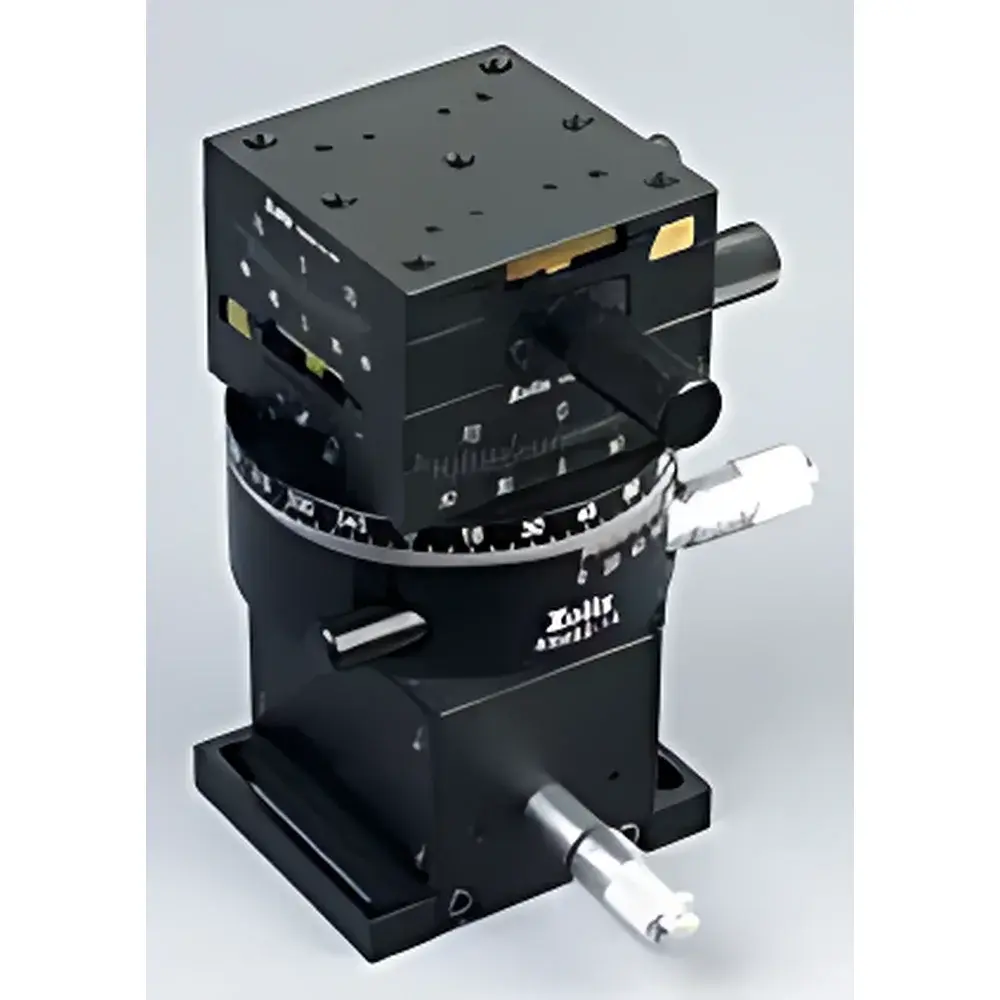
ASM-VRG2 Four-Axis Combined Translation and Rotation Stage by ZOLIX
| Brand | ZOLIX |
|---|---|
| Origin | Beijing, China |
| Manufacturer Type | Direct Manufacturer |
| Product Origin | Domestic (China) |
| Model | ASM-VRG2 |
| Pricing | Available Upon Request |
| Adjustment Axes | Z, θx, θy, θz |
| Vertical Translation Range (Tz) | 5 mm |
| Rotational Range (θz) | 360° continuous |
| Tilt Angles (θx, θy) | ±10° |
| Integrated Components | One TSMV5-1A Vertical Lift Stage, One TSMG10-1W Precision Angular Positioning Stage, One TSMG10-2W Precision Angular Positioning Stage |
Overview
The ASM-VRG2 Four-Axis Combined Translation and Rotation Stage is an engineered optomechanical positioning system designed for high-stability alignment tasks in precision optical laboratories. Built upon a modular architecture, it integrates linear vertical translation with three orthogonal rotational degrees of freedom—namely pitch (θx), yaw (θy), and azimuthal rotation (θz)—enabling full spatial orientation control of optical components within a compact footprint. Its operational principle relies on differential micrometer-driven kinematic coupling and preloaded angular bearing interfaces to minimize hysteresis and ensure repeatable sub-arcminute angular positioning. The stage is optimized for applications requiring simultaneous fine-tuning of beam height, incidence angle, and rotational symmetry—such as laser cavity alignment, interferometer setup, fiber coupling optimization, and multi-axis calibration of imaging sensors.
Key Features
- Four independent adjustment axes: Z-axis linear translation (±2.5 mm from center, 5 mm total travel), θz continuous 360° rotation, and bidirectional tilt adjustments of ±10° in both θx (pitch) and θy (yaw) planes.
- Modular integration design: Pre-assembled configuration includes one TSMV5-1A vertical lift stage (5 mm stroke, 1 µm resolution via micrometer drive), one TSMG10-1W precision angular stage (±10° range, <3 arcsec repeatability), and one TSMG10-2W angular stage (identical angular specification, enhanced moment rigidity).
- Machined aluminum alloy base and top plates with black anodized finish for dimensional stability, thermal consistency, and ESD-safe surface properties.
- Integrated locking mechanism per axis: Dual-stage clamping (coarse lock + fine lock) prevents drift during vibration-sensitive measurements or long-duration experiments.
- Standard M6 and 1/4″-20 threaded mounting holes across all platforms for compatibility with industry-standard optical posts, cage systems, and lens mounts.
- No internal electronics or motorization—designed for manual, tactile alignment workflows where deterministic control and zero electromagnetic interference are critical.
Sample Compatibility & Compliance
The ASM-VRG2 accommodates optical elements up to Ø50 mm in diameter and 2 kg in mass when centrally loaded. Its mechanical interface complies with ISO 10110–7 surface flatness tolerances for mounting surfaces (<0.5 µm deviation over 100 mm). While the stage itself does not carry CE, UKCA, or FDA certification (as it contains no active electronics or radiation sources), its construction adheres to ISO 9001:2015 quality management practices throughout ZOLIX’s Beijing manufacturing facility. All materials meet RoHS Directive 2011/65/EU restrictions on hazardous substances. For GLP/GMP-aligned laboratories, mechanical traceability is supported through serialized unit labeling and factory calibration reports (available upon request), documenting angular repeatability and axial orthogonality verification per ANSI/ASME B89.3.7 standards.
Software & Data Management
As a purely manual, non-motorized positioning platform, the ASM-VRG2 does not require firmware, drivers, or software integration. It operates independently of digital control systems, eliminating dependencies on operating systems, USB protocols, or network configurations. This architecture ensures immunity to electromagnetic noise, timing jitter, or software-induced latency—critical for ultrafast optics, quantum optics, and low-light-level detection setups where electronic artifacts must be excluded from the signal path. Documentation includes bilingual (English/Chinese) mechanical drawings, assembly schematics, and torque specifications for all locking screws—provided in PDF format compliant with ISO 128-30 technical product documentation standards.
Applications
- Laser resonator alignment: Precise co-alignment of high-finesse mirrors in ring or linear cavities, especially where thermal drift compensation requires iterative repositioning.
- Fiber-to-waveguide coupling: Angular and axial fine-tuning to maximize mode overlap efficiency between single-mode fibers and planar lightwave circuits.
- Interferometric metrology: Adjustment of reference and measurement arms in Michelson, Mach–Zehnder, or Twyman–Green configurations to achieve optimal fringe contrast and phase stability.
- Optical coherence tomography (OCT) source alignment: Optimization of collimation and dispersion matching in broadband superluminescent diode (SLD) or swept-source modules.
- Calibration of goniometric stages: Use as a master reference platform for verifying angular accuracy and crosstalk performance of automated rotation stages.
- Education and training: Hands-on instruction in coordinate transformation, Euler angle decomposition, and six-degree-of-freedom alignment theory in undergraduate and graduate photonics labs.
FAQ
Is the ASM-VRG2 compatible with vacuum environments?
No—standard configuration uses lubricated micrometer threads and polymer-based anti-rotation bushings unsuitable for UHV or HV conditions. Custom dry-lubricated variants with stainless steel components and vacuum-rated seals are available under OEM agreement.
What is the typical angular repeatability for θx and θy adjustments?
Under controlled lab conditions (23 ± 1°C, no external vibration), measured repeatability is ≤5 arcseconds over 10 consecutive cycles at mid-range positions, verified using autocollimator traceable to NIST standards.
Can additional linear axes (e.g., X or Y) be added to this stage?
Yes—the base plate features standardized mounting patterns that accept ZOLIX’s TSM series translation stages (e.g., TSM13-1A, TSM25-1A) via adapter plates; full 6-DOF integration requires custom mechanical interface design.
Does ZOLIX provide calibration certificates with each unit?
Factory calibration data (axial orthogonality, angular hysteresis, and Tz linearity) is included in the shipping documentation. NIST-traceable calibration certificates are available as a paid add-on service.
What is the maximum load capacity at full angular extension?
2 kg at center of rotation; load capacity reduces to 1.2 kg when θx or θy is set beyond ±7° due to increased moment arm and bearing loading constraints.





