
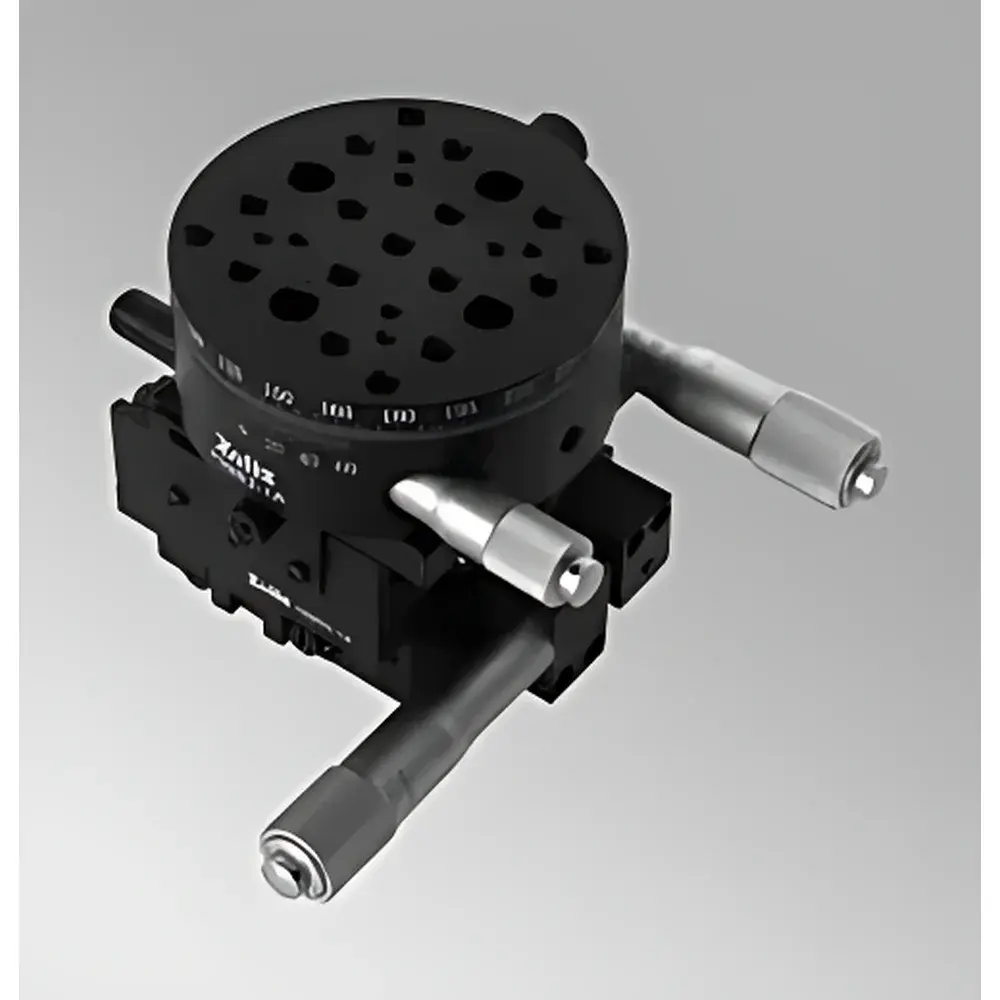
ASM-XYθ-1A Three-Axis Precision Translation and Rotation Stage by ZOLIX
| Brand | ZOLIX |
|---|---|
| Origin | Beijing, China |
| Manufacturer Type | Direct Manufacturer |
| Country of Origin | China |
| Model | ASM-XYθ-1A |
| Pricing | Available Upon Request |
| Translation Axes | X, Y, θ (rotation about Z-axis) |
| Linear Travel Range (X/Y) | ±12.5 mm (25 mm total stroke) |
| Angular Rotation Range (θz) | 0–360° continuous |
| Base Platform Compatibility | Designed for integration with TSM25-1A linear stages and RSM82-1A rotary stages |
Overview
The ASM-XYθ-1A is a high-precision, manually operated three-axis positioning stage engineered for demanding optical alignment, laser beam steering, interferometric setup configuration, and micro-optical component adjustment in research and industrial metrology laboratories. Its architecture integrates two orthogonal linear translation axes (X and Y) with a coaxial rotational axis (θz) to enable full planar positioning and orientation control within a compact, rigid mechanical envelope. The stage operates on precision-ground stainless steel dovetail guides and uses differential micrometer drives with 10 µm resolution per division, ensuring repeatable sub-20 µm positional accuracy under typical loading conditions (≤2 kg). Unlike motorized alternatives, this manual stage prioritizes mechanical stability, zero-backlash kinematics, and thermal drift minimization—critical attributes for long-duration interferometry, cavity alignment, or polarization-sensitive experiments where electronic noise or actuator hysteresis must be excluded.
Key Features
- Three independent, orthogonally decoupled motion axes: X and Y linear translation (25 mm total travel each), plus continuous 360° rotation about the vertical (Z) axis
- Modular design based on standardized ZOLIX mechanical interfaces: compatible with TSM25-1A linear stages (for extended X/Y range) and RSM82-1A angular stages (for cascaded multi-degree-of-freedom setups)
- Hard-anodized aluminum body with black oxide-treated steel components for dimensional stability, corrosion resistance, and low thermal expansion coefficient (α ≈ 23 × 10−6 /°C)
- Differential micrometer actuators with engraved vernier scales—no electrical power or controller required; ideal for EMI-sensitive environments including ultra-low-noise cryogenic or vacuum-compatible optical tables
- Center-mounted rotation axis aligned to the intersection point of X/Y motion planes, minimizing Abbe error during off-center sample manipulation
- Mounting pattern compliant with standard 1/4″-20 and M6 threaded holes on top and base surfaces for universal integration with lens tubes, kinematic mounts, and optical rails
Sample Compatibility & Compliance
The ASM-XYθ-1A accommodates optical elements up to Ø75 mm diameter or rectangular substrates measuring 70 mm × 70 mm, with a maximum recommended load of 2.0 kg distributed evenly across the top platform. It is routinely deployed in ISO 14644 Class 5 cleanrooms and supports optional vacuum-compatible variants (base model rated for ambient pressure only). While not certified to specific regulatory standards (e.g., FDA 21 CFR Part 11), its passive mechanical construction ensures full compatibility with GLP/GMP-aligned optical alignment workflows where traceability of manual adjustments is maintained via lab notebook documentation or integrated digital caliper readouts. All materials comply with RoHS Directive 2011/65/EU and REACH Annex XIV restrictions.
Software & Data Management
As a purely manual mechanical stage, the ASM-XYθ-1A does not incorporate embedded electronics, firmware, or software interfaces. Positional data is recorded externally using calibrated dial indicators, capacitive displacement sensors, or laser interferometers connected to third-party DAQ systems (e.g., National Instruments PXI, Thorlabs Kinesis-compatible controllers via add-on motorization kits). Users maintain full audit trails through manual logbooks or LIMS-integrated spreadsheet templates—ensuring compliance with ISO/IEC 17025 documentation requirements for calibration-critical optical assembly procedures.
Applications
- Precision alignment of fiber collimators, grating compressors, and spatial light modulators in ultrafast laser systems
- Iterative optimization of cavity mirror angles and beam path lengths in Fabry–Pérot and ring resonator characterization
- Multi-angle reflectance and transmittance mapping of photonic crystal slabs and metasurface samples
- Registration and fine-tuning of multi-spectral imaging optics in remote sensing prototype development
- Calibration reference stage for verifying the linearity and orthogonality of automated motion systems prior to closed-loop operation
- Teaching platform for undergraduate optics labs demonstrating coordinate transformations, gimbal lock avoidance, and error budget analysis in multi-axis positioning
FAQ
Is motorized actuation available for the ASM-XYθ-1A?
No—the base model is strictly manual. However, ZOLIX offers optional retrofit kits (e.g., stepper motor + encoder modules) that preserve mechanical integrity while enabling computer-controlled operation under custom LabVIEW or Python scripts.
What is the typical bidirectional repeatability over full travel?
Under controlled lab conditions (23 ± 1°C, no vibration), measured repeatability is ≤ ±3 µm for X/Y axes and ≤ ±15 arcseconds for θz, verified using HeNe laser interferometry and autocollimator traceable to NIM (National Institute of Metrology, China).
Can this stage be used in vacuum environments?
The standard version is rated for ambient air only. Vacuum-compatible variants (with stainless steel fasteners, dry-lubricated bearings, and outgassing-tested adhesives) are available upon request with lead time extension.
Does ZOLIX provide calibration certificates with purchase?
Yes—NIST-traceable as-built performance reports (including travel linearity, orthogonality deviation, and wobble measurement) can be supplied at additional cost and require 5 business days for generation post-shipment.
How is thermal drift managed during extended experiments?
The monolithic aluminum structure features symmetric geometry and low mass-to-stiffness ratio, limiting thermally induced positional shift to <0.8 µm/°C over the central 10 mm of X/Y travel—validated via 12-hour soak testing at ±2°C ambient fluctuation.




