
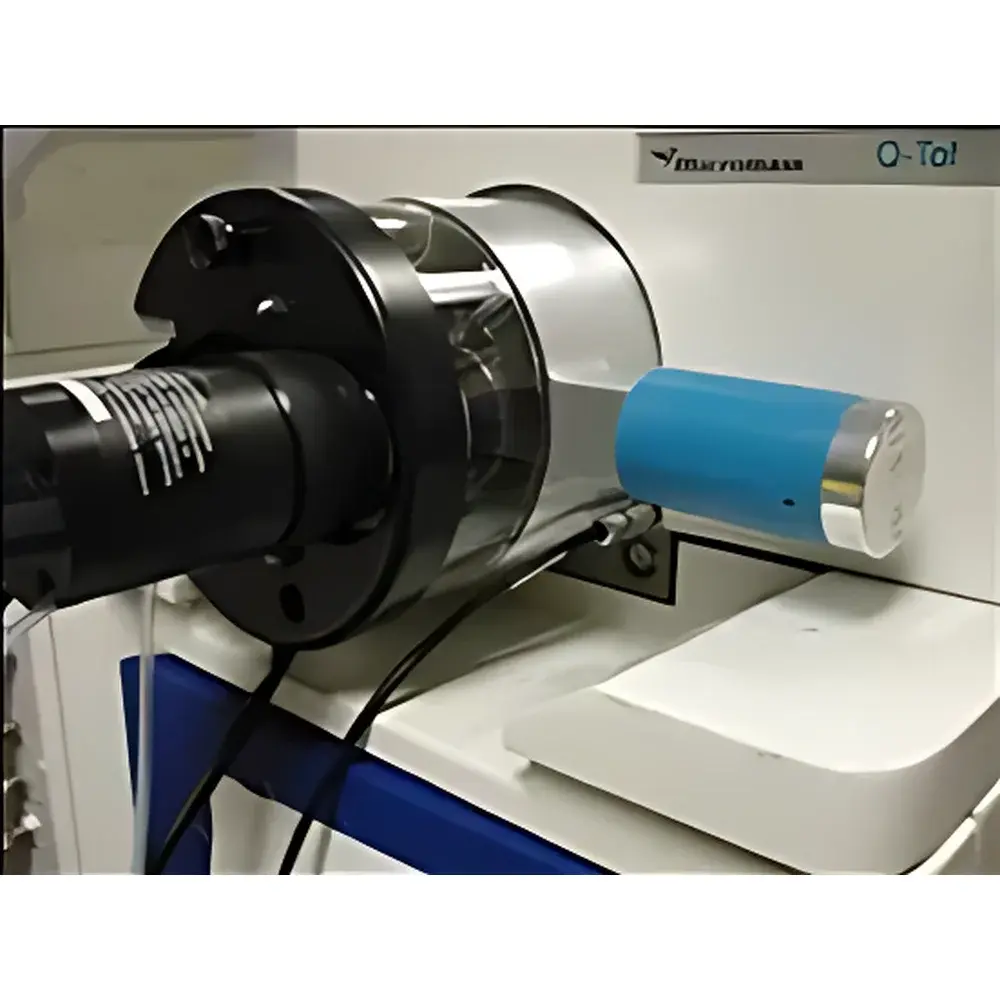
ASPEC ASAP Atmospheric Pressure Solid Analysis Probe
| Brand | ASPEC |
|---|---|
| Origin | USA |
| Manufacturer | IonSense, Inc. |
| Model | ASAP |
| Instrument Type | Atmospheric Pressure Ionization Source |
| Mass Range | 5–3000 amu |
| Sensitivity | pg-level (dependent on coupled mass spectrometer) |
| Resolution | Determined by host MS platform |
| Accurate Mass Capability | Enabled via compatible high-resolution MS (e.g., Orbitrap, FT-ICR, QTOF) |
Overview
The ASPEC ASAP (Atmospheric Pressure Solid Analysis Probe) is a robust, vendor-neutral atmospheric pressure ionization source designed for direct, rapid, and solvent-free analysis of solid, semi-solid, liquid, and tissue samples by mass spectrometry. Engineered to retrofit seamlessly into the ion source compartment of commercial LC-MS platforms—including ESI and APCI source housings—the ASAP probe operates under ambient pressure without vacuum interruption or mechanical modification to the host instrument. It leverages thermally assisted desorption coupled with corona discharge ionization to generate protonated ([M+H]⁺) or deprotonated ([M−H]⁻) ions directly from untreated samples. Unlike traditional electron ionization (EI) or chemical ionization (CI) probes requiring high vacuum and extensive sample preparation, ASAP enables real-time, in-situ analysis with sub-30-second turnaround per sample. Its design preserves full compatibility with the host mass spectrometer’s native performance—retaining high mass accuracy, resolution, and tandem MS (MS/MS or MSⁿ) capabilities—making it especially suited for high-end platforms such as Thermo Orbitrap, Bruker FT-ICR, Waters SYNAPT HDMS, and SCIEX QTOF systems.
Key Features
- Direct ambient-pressure analysis of solids, powders, gels, tissues, and viscous liquids—no derivatization, extraction, or chromatographic separation required
- Fully retrofittable into existing ESI or APCI source modules; no hardware modification or downtime needed
- Plug-and-play integration with major LC-MS platforms (Thermo, Waters, Bruker, SCIEX, Agilent)
- Nitrogen gas–based desorption (2.0–6.0 L/min), eliminating organic solvents and associated hazardous waste
- Thermal control range: 25–500 °C (leveraging host source heater electronics)
- Corona discharge voltage supplied via host APCI/ESI high-voltage circuitry—no external power supply required
- Adjustable probe extension for fine-tuning desorption efficiency and signal intensity
- Zero vacuum interruption: all operations conducted at atmospheric pressure
- Minimal user-adjustable parameters—optimized for routine laboratory use by QC analysts and research scientists alike
- Co-installed operation with ESI or APCI sources permitted; rapid switching (<1 min) between ionization modes
Sample Compatibility & Compliance
The ASAP probe accommodates diverse sample formats—including polymer additives, plant tissues, pharmaceutical tablets, forensic trace evidence (e.g., drug residues on currency), environmental PAHs in soil extracts, and biofluids (urine, serum). Its solvent-free workflow aligns with green analytical chemistry principles (ICH Q5C, ISO 14001). While ASAP itself is not a regulated medical device, its use in regulated environments supports GLP and GMP workflows when paired with 21 CFR Part 11–compliant data systems. Method validation adheres to ICH M10 and ASTM E2987–22 guidelines for direct analysis techniques. No radioactive components are employed; the system complies with FCC Part 15 and CE electromagnetic compatibility standards.
Software & Data Management
ASAP requires no dedicated software—full control and data acquisition are managed through the host mass spectrometer’s native platform (e.g., Thermo Xcalibur, Waters MassLynx, Bruker Compass). All acquired spectra retain full metadata (temperature, gas flow, polarity, dwell time) and are exportable in standard formats (.raw, .mzML, .mzXML) for downstream processing in open-source tools (MS-DIAL, OpenMS) or commercial packages (Compound Discoverer, Progenesis QI). Audit trails, electronic signatures, and raw data integrity are maintained per FDA 21 CFR Part 11 requirements when deployed with validated instrument control software.
Applications
- Rapid screening of polymer stabilizers, plasticizers, and flame retardants without pyrolysis or solvent dissolution
- In situ metabolite profiling of plant leaves under abiotic stress (e.g., cold/dark exposure) with minimal handling artifacts
- Forensic toxicology: direct detection of illicit drugs or poisons on surfaces or in biological matrices
- Environmental analysis: quantification of polycyclic aromatic hydrocarbons (PAHs) and heavy distillates in crude oil fractions
- Pharmaceutical quality control: identification of excipient degradation products in solid dosage forms
- Complementary use with non-volatile mobile phases (e.g., phosphate buffers) where conventional LC-MS fails due to column fouling or ion suppression
FAQ
Is ASAP compatible with triple quadrupole (QqQ) instruments for quantitative analysis?
Yes—ASAP delivers pg-level absolute detection limits when coupled to SRM-optimized QqQ systems, supporting validated bioanalytical assays per FDA Bioanalytical Method Validation Guidance.
Can ASAP be used with non-ESI/APCI-capable mass spectrometers?
No—it requires a host source housing with compatible gas delivery, heating, and high-voltage infrastructure (i.e., instruments equipped with APCI or ESI sources).
Does ASAP require method revalidation when switching between sample types?
While matrix effects must be assessed case-by-case, the absence of chromatographic variables simplifies method transfer; typical validation includes specificity, LOD/LOQ, linearity, and precision per ICH Q2(R2).
What maintenance does the ASAP probe require?
Routine cleaning of the stainless-steel sample tube with methanol or acetone; no consumables, no replacement parts, and no scheduled recalibration.
Is ASAP suitable for regulatory submission data generation?
Yes—when integrated into a validated LC-MS platform with compliant data handling, ASAP-generated data meet evidentiary standards for FDA, EMA, and PMDA submissions.




