
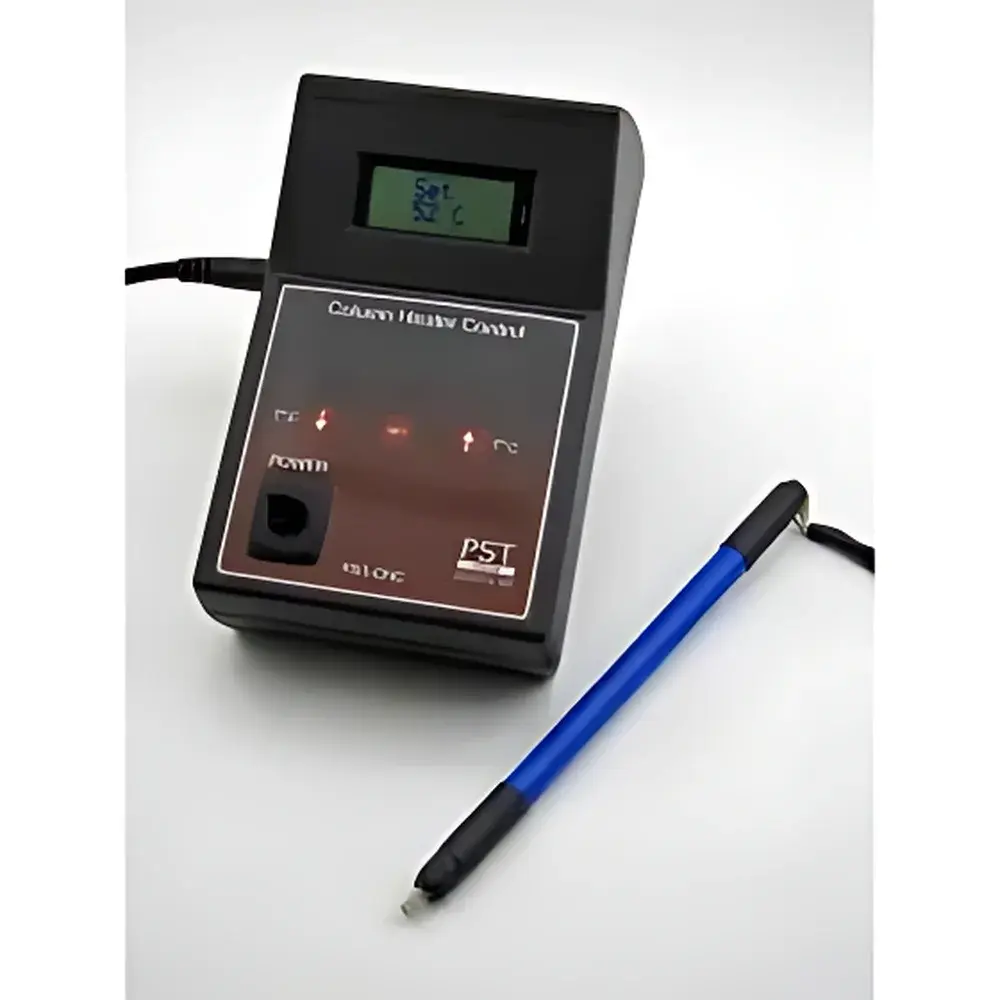
ASPEC PST Nano-Column Heaters
| Brand | ASPEC |
|---|---|
| Origin | USA |
| Model | PST Nano-Column Heaters |
| Temperature Range | Ambient to 100°C (for heating variants) / –5°C to 60°C (PST-CHC-LT+), ±0.2°C stability |
| Heating Configurations | Butterfly-style (PST-BPH-15, PST-BPH-20), Sleeve-type (PST-CH-xxU, PST-CH-30-50U), Partial-column (PST-BCH-15, PST-BCH-30), Extended-box (PST-CH-LT-20, PST-CH-LT), Cryogenic (PST-CC, PST-CHC-LT+) |
| Compatible Column Formats | PicoFrit®, eFrit®, integrated nanoLC columns (C4, C8, C18), trap columns, emitter tips, and associated capillary tubing and fittings |
| Controller | PST-CHC-RC universal temperature controller with PID regulation and digital display |
Overview
The ASPEC PST Nano-Column Heaters are engineered thermal management systems designed for nanoflow liquid chromatography (nanoLC) platforms interfaced with mass spectrometry (MS). These devices operate on the principle of precise, localized column and emitter temperature control—leveraging conductive and convective heat transfer within thermally insulated enclosures—to modulate retention behavior, peak shape, and elution kinetics of thermally sensitive biomolecules. By maintaining stable temperatures from ambient to 100°C (or down to –5°C in cryogenic variants), the heaters mitigate band broadening, reduce analyte adsorption, suppress post-column pressure fluctuations, and enhance signal-to-noise ratio during nanoLC-MS/MS analysis of peptides, intact proteins, lipids, and post-translationally modified species. Unlike ambient-air ovens or non-contact heating methods, the PST system ensures uniform thermal coupling across the entire separation path—including trap columns, analytical columns, fused-silica capillaries, union fittings, and electrospray emitters—thereby improving inter-run reproducibility and chromatographic robustness under low-flow (50–500 nL/min) conditions.
Key Features
- High-stability thermal control with ±0.2°C accuracy across all operating ranges, achieved via PID-regulated heating elements and high-resolution thermistor feedback loops
- Modular mechanical design supporting five distinct thermal enclosure architectures: butterfly-style (multi-column parallel heating), sleeve-type (full-length PicoFrit® column coverage), partial-column (targeted heating of analytical segment only), extended-box (optimized for longer monolithic or packed-bed columns), and cryogenic (for hydrogen/deuterium exchange (HDX) workflows)
- Universal PST-CHC-RC controller with intuitive LED interface, programmable ramp profiles, real-time temperature logging, and RS-232/USB connectivity for external system integration
- Thermally optimized insulation materials minimizing radial heat loss and enabling rapid thermal equilibration (<5 min to setpoint)
- Chemically inert internal surfaces compatible with aggressive mobile phases (e.g., 0.1% formic acid, 80% acetonitrile, TFA-containing solvents) and high-salt buffers
- No electrical interference with MS signal acquisition; fully grounded metal housing and EMI-shielded cabling ensure compatibility with high-resolution time-of-flight (TOF), Orbitrap, and triple quadrupole platforms
Sample Compatibility & Compliance
The PST Nano-Column Heaters support standard nanoLC configurations used in bottom-up and top-down proteomics, lipidomics, and glycomics workflows. They accommodate columns packed with C4, C8, C18, and specialty phases (e.g., porous graphitic carbon, HILIC), as well as trap-and-elute assemblies and integrated emitter columns (e.g., New Objective PicoFrit®, Proxeon/eFrit®). The system is validated for use under Good Laboratory Practice (GLP) and Good Manufacturing Practice (GMP) environments where traceable temperature calibration and audit-ready operation are required. While not a regulated medical device, its thermal performance aligns with ASTM E2927-21 (Standard Practice for Calibration of Thermal Analyzers) and supports compliance with FDA 21 CFR Part 11 when paired with compliant data acquisition software that enforces electronic signatures and audit trails.
Software & Data Management
The PST-CHC-RC controller operates independently but supports bidirectional communication via ASCII-based serial protocol. Third-party LC control software (e.g., Thermo Chromeleon™, Waters UNIFI®, Bruker Compass™) can integrate temperature setpoints and status reporting through custom scripting or OEM API extensions. Raw temperature logs (timestamped, 0.1-second resolution) are exportable in CSV format for post-acquisition correlation with chromatographic retention times and MS peak intensities. No proprietary software installation is required; configuration and monitoring are performed via front-panel controls or terminal emulation.
Applications
- Improving chromatographic resolution and peak capacity in deep-proteome profiling using long-gradient nanoLC separations
- Stabilizing retention times for quantitative label-free or TMT-labeled proteomics across multi-day acquisition batches
- Reducing carryover and improving recovery of hydrophobic lipids and membrane proteins on reversed-phase columns
- Enabling reproducible HDX-MS experiments by maintaining sub-zero temperatures during quench and digestion steps (using PST-CHC-LT+ or PST-CC)
- Minimizing spray instability and current fluctuation in nanoESI sources through controlled emitter tip temperature
- Extending column lifetime by reducing thermal stress gradients across packed beds during method development
FAQ
What temperature stability is guaranteed across the column length?
The system maintains ±0.2°C spatial uniformity along the heated zone, verified by embedded thermocouple mapping at multiple axial positions.
Can the PST heater be used with electrospray ionization sources from different vendors?
Yes—it is mechanically and electrically agnostic; no vendor-specific mounting hardware or firmware dependencies are required.
Is calibration documentation provided with each unit?
Each PST-CHC-RC controller ships with a NIST-traceable calibration certificate covering the full operational range.
Does the system support gradient temperature programming during a run?
No—temperature is held constant per method; dynamic ramping is not implemented to preserve chromatographic orthogonality and MS duty cycle integrity.
How is heat dissipation managed in enclosed MS source compartments?
The heater’s low-power design (max 8 W) and passive convection cooling eliminate need for active ventilation, preventing airflow disruption inside source housings.




