
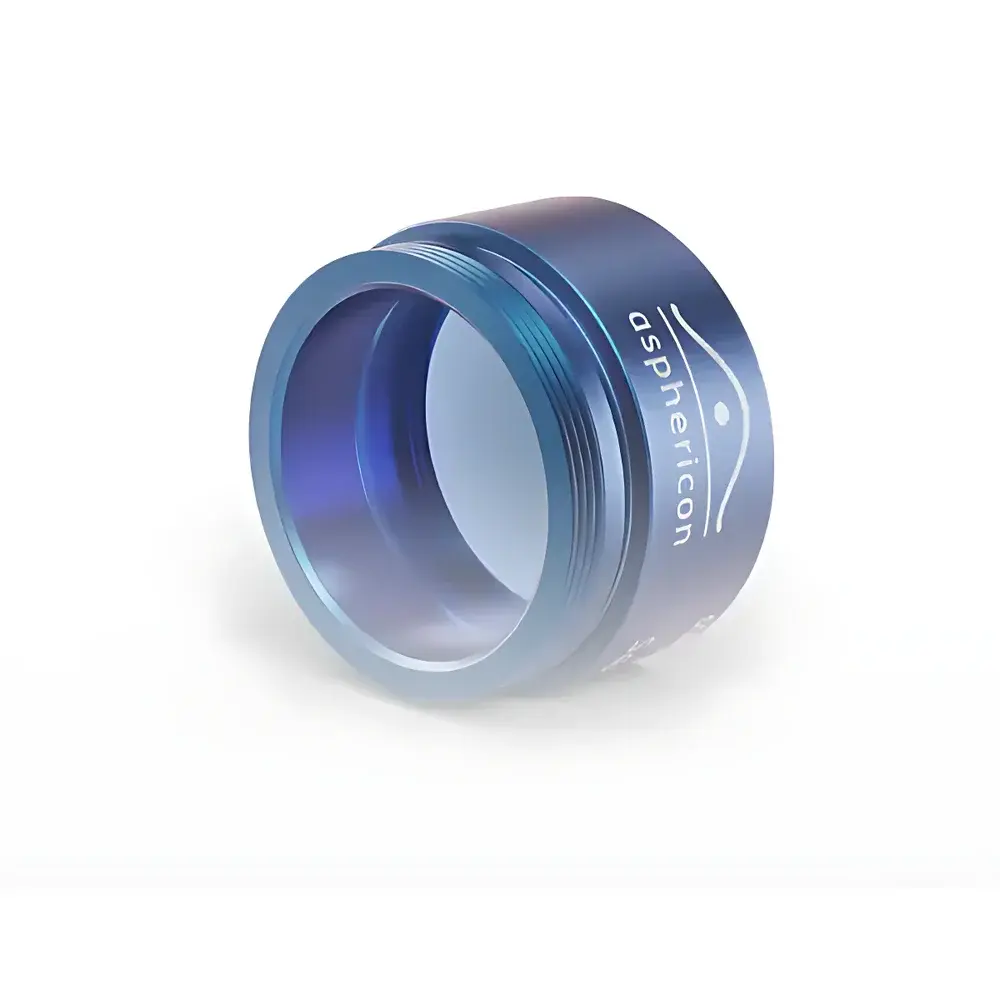
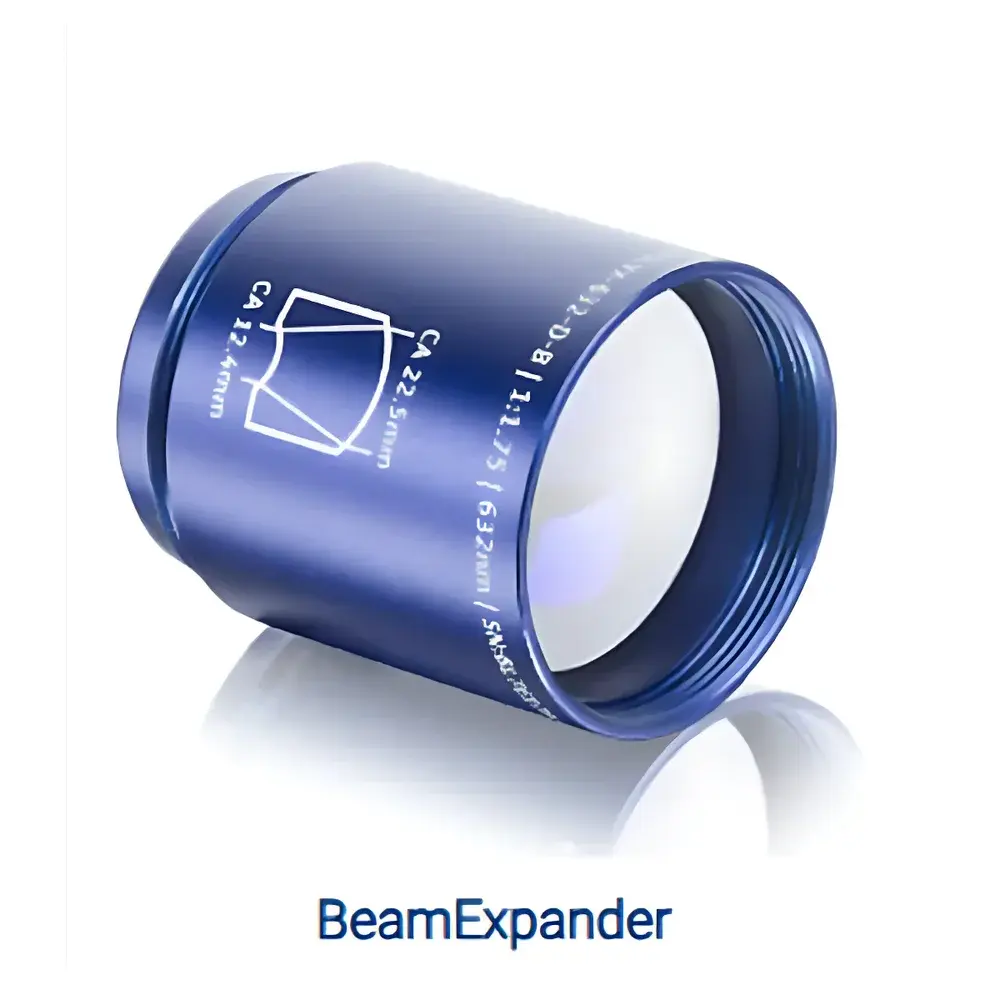
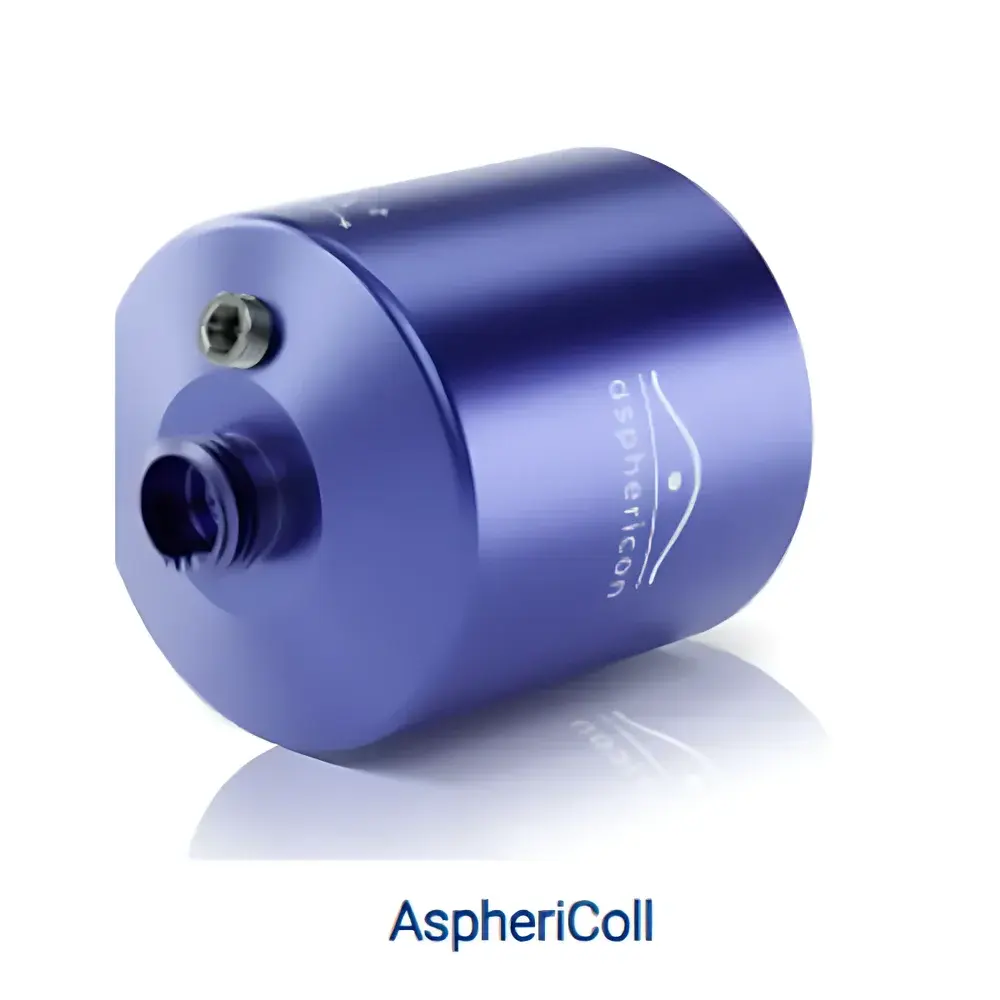
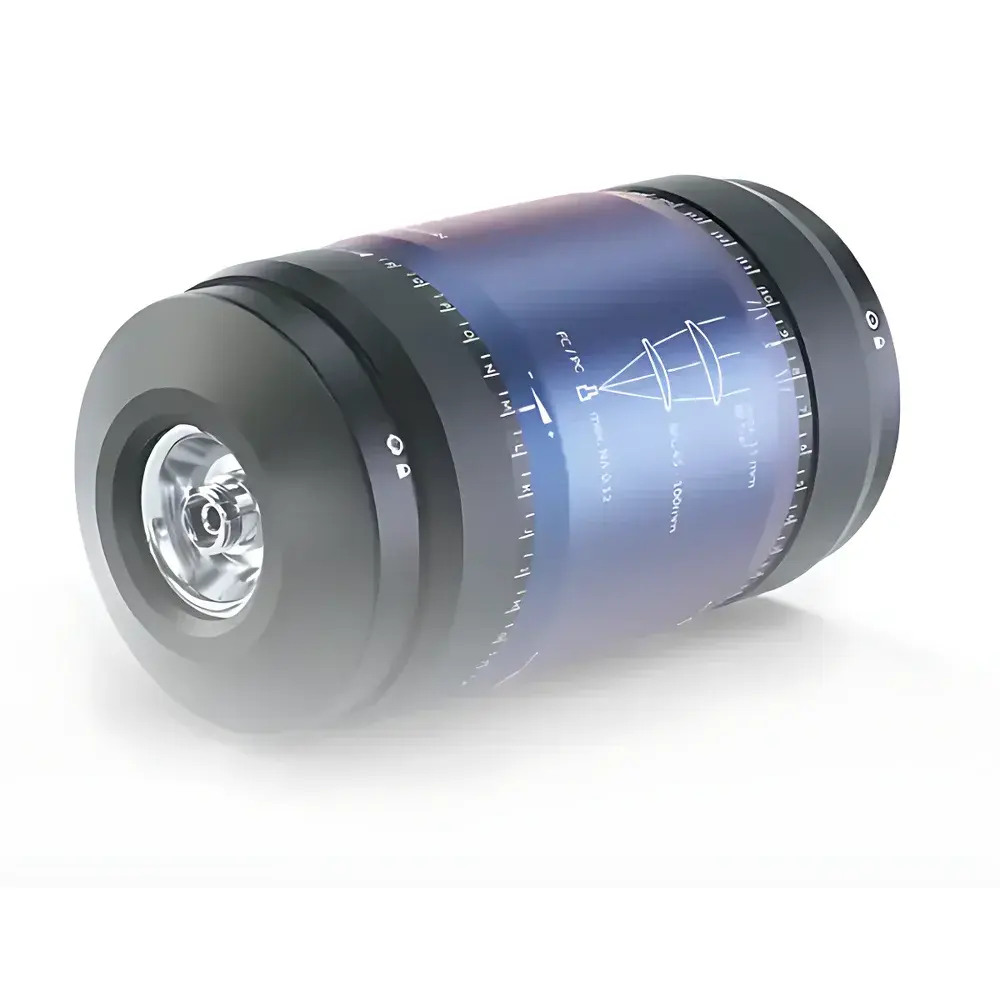
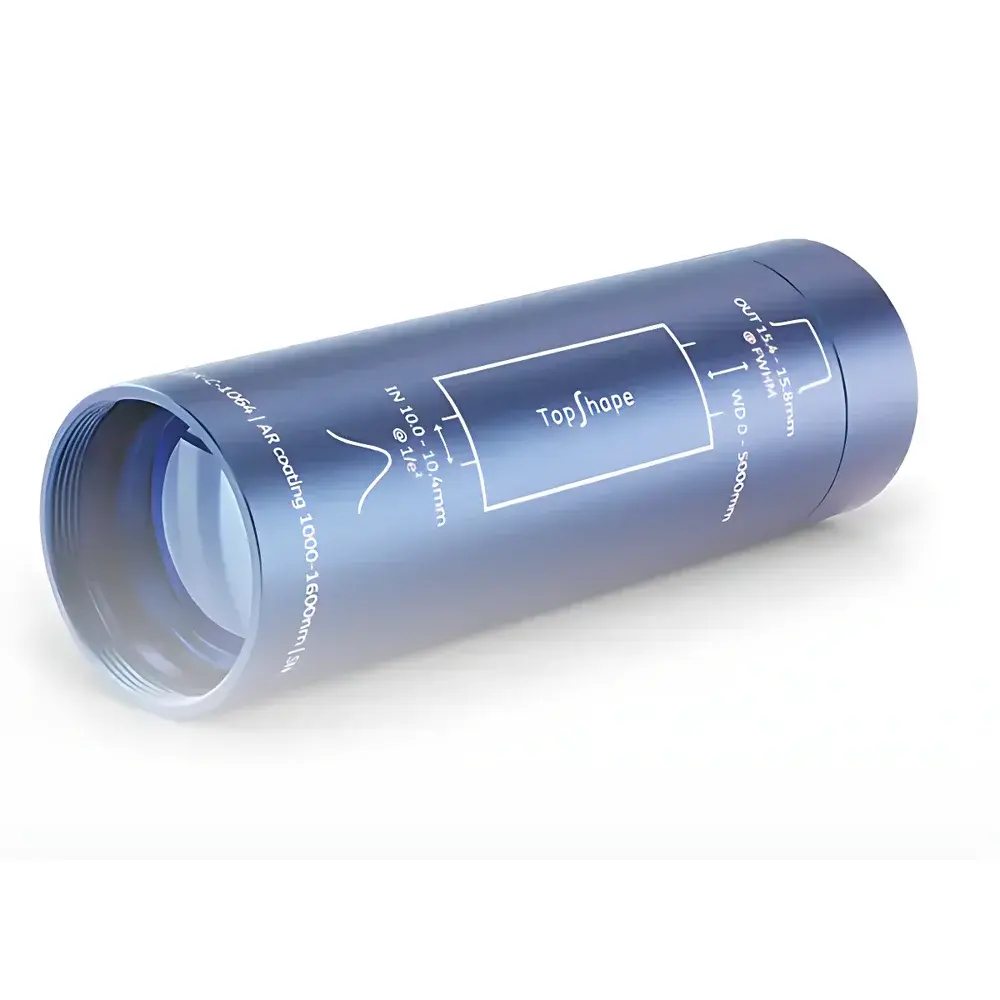
Asphericon ASM25-10-C-1064 a|AiryShape Focused Circular Beam Shaping Optic
| Brand | Asphericon |
|---|---|
| Origin | Germany |
| Model | ASM25-10-C-1064 |
| Thread | M28×0.75 mm |
| Outer Diameter Mount | 30 mm |
| Length | 17.3 mm |
| Input Beam Diameter @1/e² | 10 mm |
| Output Beam Diameter (dAiry) | 10 mm |
| Design Wavelength | 1064 nm |
| Wavelength Range | 1000–1500 nm |
| Laser Damage Threshold | 12 J/cm², 100 Hz, 6 ns @ 532 nm |
Overview
The Asphericon ASM25-10-C-1064 is a high-precision a|AiryShape beam shaping optic engineered to transform collimated Gaussian laser beams into focused circular intensity profiles—specifically top-hat (flat-top) or donut-shaped (ring-shaped) distributions—at the focal plane. Based on advanced aspheric phase modulation and diffraction-controlled wavefront engineering, this optic operates within the near-infrared spectrum (1000–1500 nm), with optimal performance calibrated at 1064 nm. It is designed for integration downstream of a focusing lens, where it reshapes the converging beam without requiring complex alignment or additional optical relays. Unlike conventional diffractive optical elements (DOEs), the a|AiryShape family leverages monolithic fused silica substrates with ultra-precise aspheric surface topographies—fabricated via deterministic single-point diamond turning and sub-nanometer metrology—to deliver high Strehl ratio transmission and minimal wavefront error (< λ/10 RMS over clear aperture). Its compact form factor (30 mm outer diameter, 17.3 mm length) and standardized M28×0.75 mounting thread enable drop-in compatibility with commercial optomechanical systems used in laser material processing, biomedical imaging, and quantum optics laboratories.
Key Features
- Engineered for high-fidelity focused beam shaping: generates diffraction-limited top-hat or donut profiles at the focal plane with >90% intensity uniformity across the central region
- Optimized for 1064 nm operation with broadband usability from 1000 nm to 1500 nm—ideal for Nd:YAG, Yb:fiber, and OPO-based laser systems
- Input beam specification: collimated Gaussian input with 1/e² diameter of 10 mm ±10%, enabling robust tolerance to minor beam size fluctuations
- Monolithic fused silica construction with super-polished surfaces (scratch-dig 60–40) and high-LIDT V-coating options available for demanding pulsed laser applications
- Laser-induced damage threshold certified at 12 J/cm² (100 Hz, 6 ns pulses @ 532 nm); scaling to higher fluences possible with custom V-coating variants
- Integrated mechanical design features precision-machined M28×0.75 external thread and reference surfaces for repeatable, alignment-insensitive mounting
Sample Compatibility & Compliance
The ASM25-10-C-1064 is compatible with standard collimated Gaussian beams delivered by TEM₀₀ solid-state or fiber lasers operating in the NIR band. It requires pairing with an external focusing lens (e.g., f = 100–300 mm) to define the final spot size and working distance; focal spot diameter scales linearly with lens focal length. The optic complies with ISO 10110-7 (surface imperfections), ISO 10110-5 (transmitted wavefront error), and DIN EN 60825-1 (laser product safety classification). For regulated environments—including ISO 13485-certified medical device manufacturing or FDA-regulated phototherapeutic platforms—the component supports full traceability documentation (including interferometric test reports and coating spectral data) and can be supplied with calibration certificates compliant with ISO/IEC 17025 requirements. Its passive, alignment-free architecture ensures long-term stability under thermal cycling (−10 °C to +60 °C) and mechanical vibration per MIL-STD-810G.
Software & Data Management
While the ASM25-10-C-1064 is a passive optical element and does not incorporate embedded firmware or digital interfaces, Asphericon provides comprehensive digital support assets for system integration. Zemax OpticStudio (.ZOS), CODE V (.CVX), and VirtualLab Fusion (.VLF) design files are available upon request—enabling accurate physical optics modeling of beam propagation, diffraction effects, and intensity distribution prediction. All optical drawings include GD&T annotations per ISO 1101, surface metrology maps (PSD, PV, RMSi), and coating spectral reflectance/transmittance curves (250–2000 nm). For GxP-aligned workflows, Asphericon offers optional audit-ready documentation packages including raw interferogram exports, batch-specific LIDT test records, and material certification (e.g., Schott N-BK7 or Corning 7980 compliance statements), supporting 21 CFR Part 11-compliant electronic record retention when hosted on validated laboratory information management systems (LIMS).
Applications
- Laser micromachining: uniform energy delivery for ablation, drilling, and surface texturing of metals, ceramics, and polymers—reducing thermal stress gradients and improving edge quality
- Biomedical instrumentation: illumination homogenization in confocal microscopy, flow cytometry, and optogenetic stimulation systems requiring spatially controlled NIR excitation
- Quantum technology: mode conditioning for cold atom trapping, optical lattice generation, and cavity-enhanced spectroscopy setups demanding precise radial intensity control
- Industrial sensing: structured light projection in triangulation-based 3D metrology and laser line profiling where consistent axial irradiance improves signal-to-noise ratio
- Scientific research: fundamental studies of nonlinear optical processes (e.g., harmonic generation, parametric amplification) where beam profile symmetry directly influences conversion efficiency
FAQ
What is the difference between a|AiryShape and a|TopShape?
a|AiryShape is optimized for focused (convergent) beam shaping—producing top-hat or donut profiles at the focal plane—whereas a|TopShape is designed for collimated beam shaping, delivering uniform intensity over extended working distances (up to 3 m with LDX variants).
Can the ASM25-10-C-1064 be used with femtosecond lasers?
Yes—when paired with appropriate dispersion-compensated focusing optics and anti-reflection coatings optimized for ultrashort pulses, it maintains phase fidelity for pulses ≥100 fs. Consult Asphericon for group delay dispersion (GDD) characterization reports.
Is custom wavelength optimization available?
Yes—Asphericon offers bespoke a|AiryShape designs for wavelengths outside the standard catalog range (e.g., 1550 nm, 2050 nm), including multi-wavelength variants with hybrid phase profiles.
How is alignment performed during integration?
The optic features kinematic mounting surfaces and a centered through-hole for pilot-beam alignment; no iterative centering is required due to its inherent rotational symmetry and low sensitivity to lateral decentering (<±50 µm tolerance).
Does this optic introduce chromatic aberration?
No—its phase function is achromatic within the specified bandwidth (1000–1500 nm); however, focal shift across wavelength must be compensated by adjusting the focusing lens position per standard Gaussian beam optics principles.



