
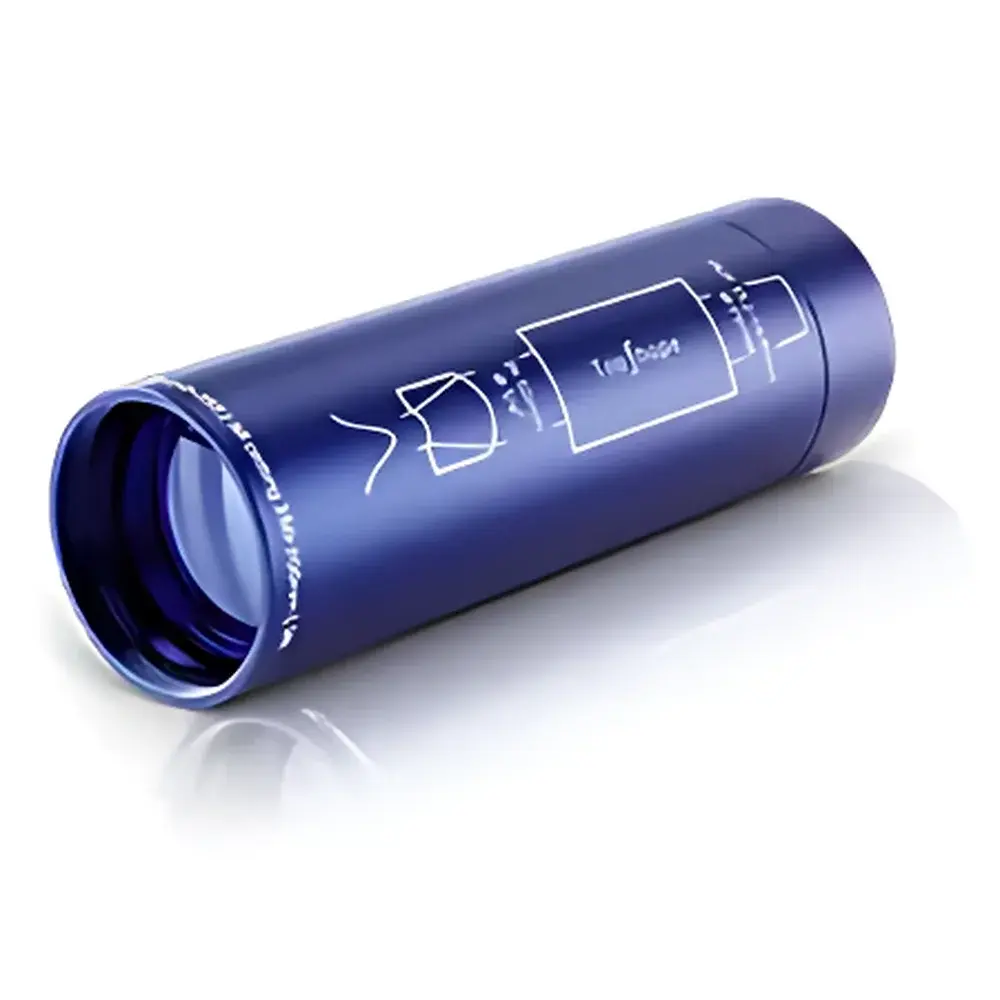
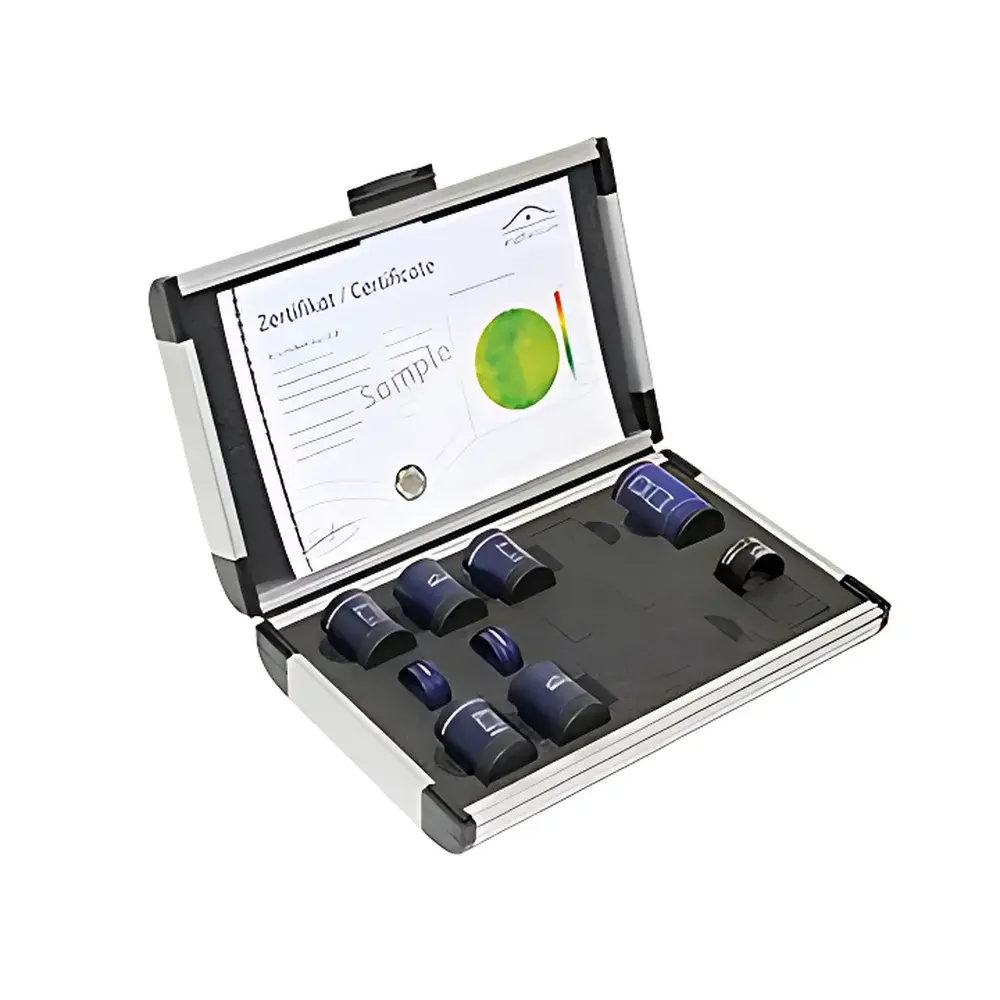
Asphericon a|TopShape Aspheric Beam Shaping Lens (Top-Hat Homogenizer)
| Brand | Asphericon |
|---|---|
| Origin | Germany |
| Model | a |
| Spectral Range | 350–2500 nm |
| Input Beam Diameter (1/e²) | 10 mm ±10% |
| Output Beam Diameter (FWHM) | 15.2–15.7 mm |
| Uniformity | >90% (RMS non-uniformity <10%) |
| Working Distance | ≥300 mm (a |
| Total Length | 89.6–93.6 mm |
| Wavefront Error (RMS) | 0.05λ @ design wavelength |
| Strehl Ratio | 0.9 |
| ISO Edge Steepness | 0.4 |
| Laser-Induced Damage Threshold (LIDT) | 12 J/cm², 100 Hz, 6 ns, 532 nm |
| Coating | Custom high-LIDT AR coatings available on request |
Overview
The Asphericon a|TopShape is a monolithic, all-refractive aspheric beam shaper engineered to transform collimated Gaussian laser beams into highly uniform, collimated top-hat (flat-top) intensity profiles with minimal wavefront distortion and zero inherent power loss. Unlike diffractive optical elements (DOEs) or microlens arrays, the a|TopShape employs a precisely optimized multi-surface aspheric architecture—comprising up to seven aspheric surfaces in its standard configuration—to achieve near-diffraction-limited performance via deterministic ray mapping. This principle ensures deterministic energy redistribution without spectral dispersion, polarization sensitivity, or zero-order artifacts. Designed for demanding industrial and scientific applications—including laser material processing, precision metrology, confocal microscopy, and structured illumination—the a|TopShape delivers stable, reproducible top-hat profiles over extended working distances while maintaining high transmission (>99.5% per surface with optimized AR coatings) and exceptional thermal stability.
Key Features
- Optical uniformity exceeding 90% (RMS non-uniformity <10%), verified across full operational working distance range
- Broad spectral coverage from 350 nm to 2500 nm; standard versions optimized for 355 nm, 405 nm, 632 nm, 780 nm, and 1064 nm
- Input beam tolerance of ±10% around nominal 10 mm (1/e²), enabling compatibility with common TEM₀₀ laser sources and fiber-coupled systems
- Compact form factor: total optical length between 89.6 mm and 93.6 mm, facilitating integration into space-constrained optical benches and OEM laser modules
- Two configurations: standard a|TopShape (≥300 mm working distance) and long-distance variant a|TopShape LD (≥1000 mm, up to 3000 mm with maintained ISO uniformity ≤0.1)
- Wavefront error 0.9 at design wavelength—certified via interferometric measurement per ISO 10110-5
- High laser damage resistance: LIDT of 12 J/cm² (100 Hz, 6 ns, 532 nm), scalable with custom high-threshold coatings for kW-class CW or pulsed lasers
- Monolithic fused silica or N-BK7 substrate construction with optional ion-beam-sputtered broadband AR coatings (R<0.25% per surface)
Sample Compatibility & Compliance
The a|TopShape is compatible with continuous-wave (CW) and nanosecond-pulsed laser sources operating within its specified spectral and fluence limits. Its all-refractive design eliminates concerns associated with grating efficiency roll-off, polarization-dependent loss (PDL), or chromatic aberration typical of diffractive homogenizers. The device complies with ISO 10110 optical component manufacturing standards for surface figure, roughness, and coating specifications. For regulated environments—including medical laser system integration and aerospace-grade instrumentation—the a|TopShape supports traceable calibration documentation and can be supplied with full MTF, PSF, and beam profile validation reports. While not inherently FDA-certified, it meets functional requirements for Class 4 laser system components under IEC 60825-1:2014 and supports GMP-aligned optical assembly protocols when integrated into validated manufacturing lines.
Software & Data Management
The a|TopShape operates as a passive optical component and requires no embedded firmware, drivers, or real-time control software. However, Asphericon provides comprehensive technical documentation—including Zemax-compatible .ZAR files, measured point-spread function (PSF) datasets, and ISO 13694-compliant beam profile characterization reports—for seamless integration into optical design workflows (Zemax OpticStudio, CODE V, FRED). Beam profiling data (intensity cross-sections, encircled energy plots, M²-equivalent divergence metrics) are delivered in standardized ASCII and CSV formats, enabling direct import into MATLAB, Python (SciPy/NumPy), or LabVIEW for automated QA/QC analysis. All metrology data adhere to ISO/IEC 17025-accredited laboratory practices, ensuring audit readiness for GLP and ISO 9001 quality management systems.
Applications
- Laser micromachining: uniform ablation thresholds for clean edge definition in PCB drilling, thin-film scribing, and semiconductor patterning
- Confocal and light-sheet fluorescence microscopy: artifact-free illumination minimizing photobleaching gradients across FOV
- Optical trapping and holographic tweezers: stable intensity plateau enabling precise force calibration and particle manipulation
- Industrial inspection systems: consistent illumination for high-dynamic-range imaging of reflective or translucent surfaces
- UV lithography and maskless direct-write systems: diffraction-limited flat-top delivery supporting sub-micron feature resolution
- Quantum optics experiments: spatial mode conditioning for high-fidelity atom cooling and optical lattice loading
FAQ
What is the difference between a|TopShape and a diffractive beam shaper?
Diffractive optical elements rely on interference and introduce wavelength dependence, polarization sensitivity, and zero-order leakage. The a|TopShape uses refractive aspheric surfaces for achromatic, polarization-insensitive, and zero-loss transformation.
Can a|TopShape be used with femtosecond lasers?
Yes—when equipped with custom low-GDD (group delay dispersion) coatings and fused silica substrates, it maintains temporal pulse integrity for pulses down to ~100 fs; consult Asphericon for GDD specifications per wavelength.
Is mounting hardware included?
Standard a|TopShape units ship with kinematic SM1-threaded mounts and alignment adapters compatible with Thorlabs and Newport cage systems; OEM flange options available upon request.
How is beam uniformity measured and validated?
Uniformity is defined per ISO 13694 as (Imax – Imin) / (Imax + Imin) within the 90% intensity contour; all units undergo full-field CCD-based profiling at multiple working distances pre-shipment.
Does a|TopShape require beam expansion prior to use?
No—it accepts 10 mm (1/e²) input beams directly; optional pre-collimation or beam expansion stages may be needed only for non-ideal input M² or divergence conditions.





