
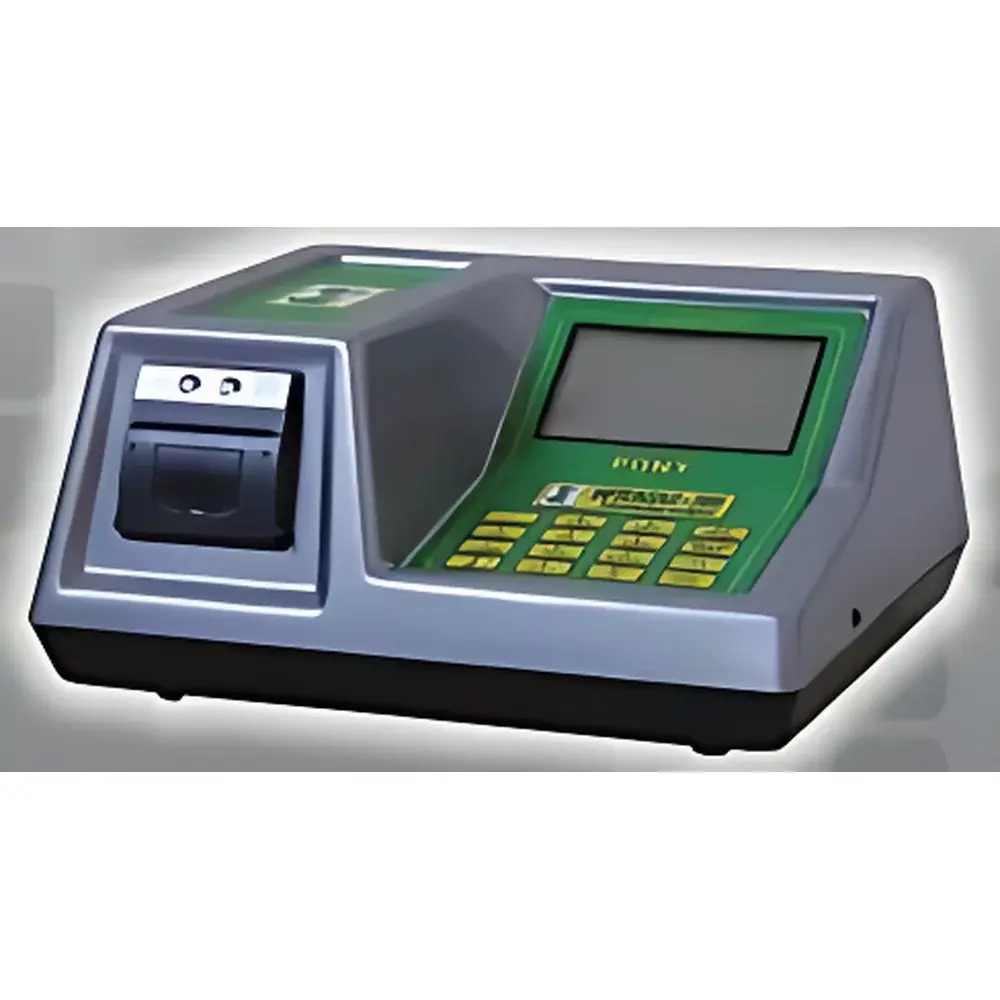
Assemblad INFRAGAS205 Portable Automotive Exhaust Gas Analyzer
| Brand | Assemblad |
|---|---|
| Origin | Italy |
| Model | INFRAGAS205 |
| Instrument Type | Portable |
| Detection Principle | Non-Dispersive Infrared (NDIR) Absorption |
| Maximum Permissible Error | ±10% of full scale |
| Zero Drift | ±1% FS/8h |
| Span Drift | ±3% FS/8h |
| Repeatability | ±2% FS |
| CO Range | 0–10 vol% (resolution: 0.001 vol%) |
| CO₂ Range | 0–20 vol% (0.01 vol%) |
| HC Range | 0–15,000 ppm (1 ppm) |
| O₂ Range | 0–25 vol% (0.01 vol%) |
| True CO Range | 0–15 vol% (0.01 vol%) |
| NOₓ Range | 0–5,000 ppm (1 ppm) |
| AFR | 7–23 (0.1) |
| λ | 0.5–1.5 (0.01) |
| RPM | 0–9,999 rpm (1 rpm) |
| Oil Temperature | 0–150 °C (0.1 °C) |
| Internal Temperature | 0–50 °C (0.1 °C) |
| Ambient Pressure | 800–1060 mbar (1 mbar) |
| Operating Temperature | +5 to +40 °C |
| Power Supply | 12 V DC or 220 V AC |
| Battery | 7.2 Ah integrated |
| Dimensions | 344 × 160 × 270 mm |
| Net Weight | 3 kg |
| Compliance | OIML R99:2008 Class 00 |
| Interface | RS-232 serial output |
| Software Support | Windows-based configuration & calibration suite |
| Condensate Management | Automatic drainage system |
| Diagnostic Support | OBD-II and e-OBD protocol compatibility |
Overview
The Assemblad INFRAGAS205 is a field-deployable, NDIR-based automotive exhaust gas analyzer engineered for precision emissions verification in vehicle inspection, maintenance, and regulatory compliance testing. Designed and manufactured in Italy, the instrument applies dual-wavelength non-dispersive infrared absorption spectroscopy to simultaneously quantify CO, CO₂, HC (as propane-equivalent), O₂, NOₓ, and derived parameters—including true CO concentration, air-fuel ratio (AFR), equivalence ratio (λ), engine RPM (via inductive pickup), oil temperature, internal unit temperature, and ambient barometric pressure. Its optical architecture incorporates thermally stabilized detectors and reference cells to minimize thermal drift, while its gas sampling path integrates heated lines and automatic condensate removal—critical for maintaining measurement integrity during high-humidity or cold-start exhaust sampling. The analyzer meets the stringent metrological requirements of OIML R99:2008 Class 00, certifying its suitability for official periodic technical inspections (PTI) and statutory roadside enforcement across EU member states and other R99-adopting jurisdictions.
Key Features
- Automated zero and span calibration routines with user-initiated or time-scheduled execution
- Backlit alphanumeric LCD display (128 × 64 pixels) with intuitive menu navigation via 16-key membrane keypad
- Integrated thermal printer (model OM00620EST003c/NET) supporting on-site report generation with timestamp, operator ID, and test metadata
- Robust condensate management system featuring automatic drainage and heated sample line (optional) to prevent water interference in NDIR cells
- Dual power operation: 12 V DC (vehicle battery compatible) or 220 V AC mains input; onboard 7.2 Ah rechargeable battery enables >4 hours continuous operation
- OBD-II and extended OBD (e-OBD) protocol support for bidirectional communication with modern ECUs, enabling real-time fault code retrieval and live parameter streaming alongside exhaust measurements
- RS-232 serial interface for direct data export to PCs or central inspection databases; Windows-compatible configuration and calibration software included
Sample Compatibility & Compliance
The INFRAGAS205 is validated for use with gasoline, LPG, CNG, and ethanol-blended fuel exhaust streams under transient and steady-state conditions. Its NDIR sensors are immune to cross-sensitivity from common combustion byproducts such as SO₂ and H₂O vapor—within specified operating humidity limits (≤90% RH, non-condensing). All measurement channels undergo factory traceable calibration against certified gas standards accredited to ISO/IEC 17025. The device complies fully with OIML R99:2008 Class 00 for accuracy, repeatability, and environmental stability. It supports GLP-aligned audit trails when used with optional PC software logging, including operator authentication, calibration history, and raw sensor output timestamps—facilitating FDA 21 CFR Part 11 readiness where required for quality assurance documentation.
Software & Data Management
The bundled Windows application provides secure, role-based access to instrument configuration, calibration coefficient editing, and firmware updates. Data logging captures all primary and derived parameters at user-selectable intervals (1–10 s), storing up to 10,000 test records internally. Export formats include CSV and XML, compatible with laboratory information management systems (LIMS) and national vehicle inspection databases. Calibration logs retain full traceability: date/time, standard gas lot numbers, operator ID, and pass/fail status per channel. Audit mode enforces electronic signatures and immutable record retention—supporting ISO 17020 and EN 45011 accreditation requirements for inspection bodies.
Applications
- Periodic Technical Inspection (PTI) centers performing mandatory vehicle roadworthiness testing
- Automotive repair workshops conducting pre- and post-repair emission diagnostics
- Fleet maintenance depots monitoring tailpipe emissions trends across vehicle groups
- Regulatory agencies executing roadside emissions enforcement campaigns
- Research institutions evaluating aftertreatment system performance (e.g., catalytic converters, GPFs) under real-world driving cycles
- Training facilities for automotive technician certification programs aligned with ECE Regulation 83 and EU Directive 2014/45/EU
FAQ
Does the INFRAGAS205 require annual recalibration by an accredited lab?
Yes—per OIML R99:2008 Clause 7.3, Class 00 instruments must undergo metrological verification at least once per year by a body accredited to ISO/IEC 17025.
Can the device measure NO and NO₂ separately?
No—the NOₓ channel reports total nitric oxide equivalents (NO + NO₂) using a single NDIR band centered at 5.3 µm; speciation requires chemiluminescence or electrochemical methods.
Is the thermal printer compatible with standard replacement paper rolls?
Yes—it accepts 57 mm wide thermal paper rolls with 12.7 mm core diameter and ≤30 m length.
What is the warm-up time before first measurement?
Optimal stability is achieved within 15 minutes of power-on at ambient temperatures ≥15 °C; full specification compliance requires 30 minutes at lower temperatures (+5 to +10 °C).
Does the unit support Bluetooth or USB connectivity?
No—only RS-232 serial communication is provided; USB-to-serial adapters may be used with driver-enabled host systems.







