
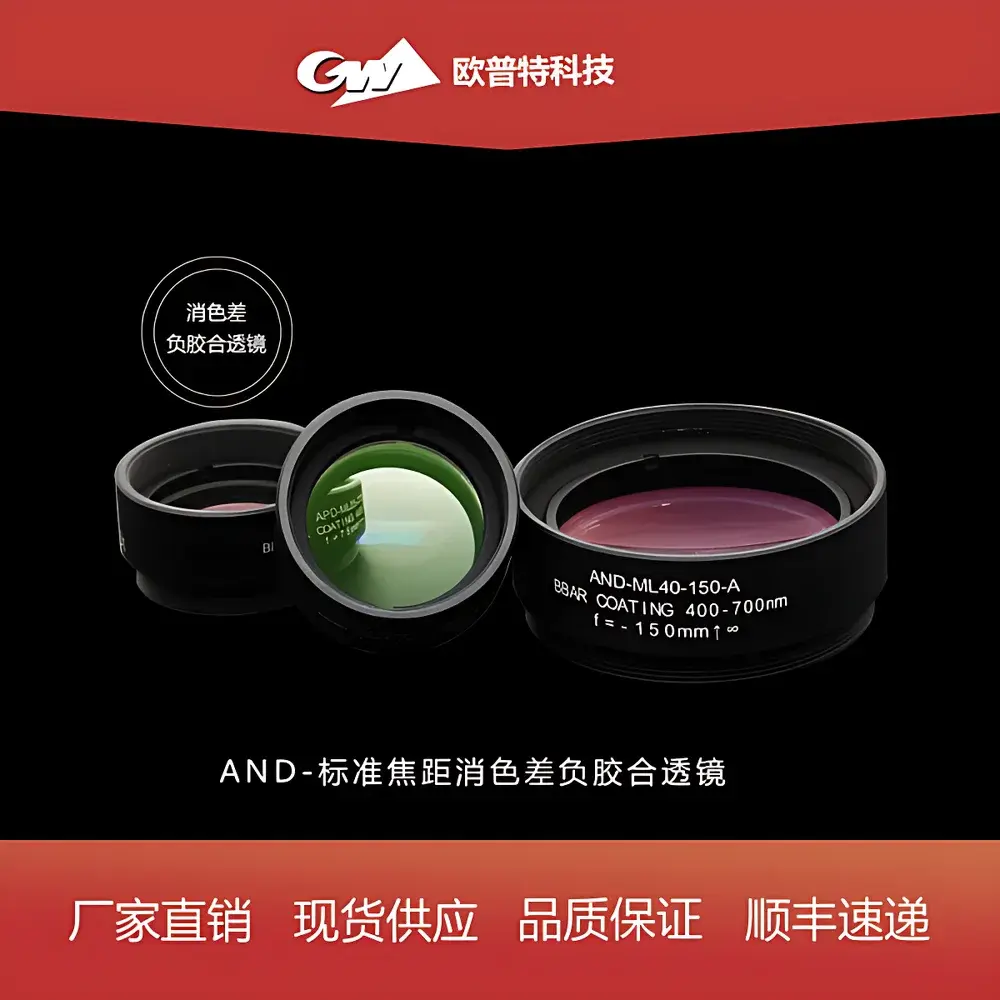
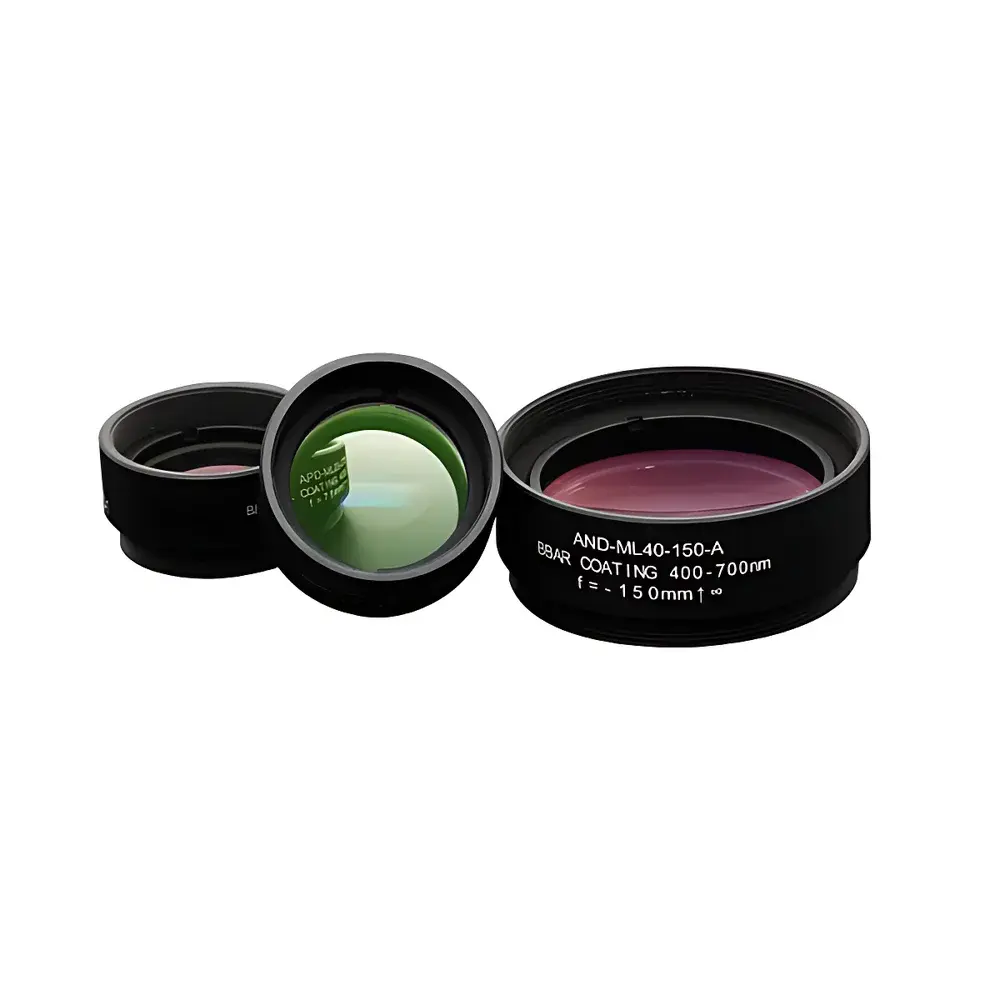
AND Assembled Achromatic Negative Cemented Lens
| Origin | Beijing |
|---|---|
| Manufacturer Type | Distributor |
| Origin Category | Domestic |
| Model | AND |
| Price Range | USD 0.15–75.00 |
| Component Category | Optical Element |
Overview
The AND Assembled Achromatic Negative Cemented Lens is a precision optical component engineered for high-fidelity beam expansion, collimation correction, and divergent light manipulation in visible-wavelength optical systems. Based on the principles of achromatic doublet design, this lens combines two optical glasses—typically BK7 and SF2 or equivalent low-dispersion/high-refractive-index materials—cemented into a single mechanical unit to minimize axial chromatic aberration across the 400–700 nm spectral band. Unlike singlet negative lenses, the cemented achromat delivers significantly improved spot size stability and wavefront fidelity when used in relay optics, laser cavity mode matching, or Fourier transform imaging setups. Its pre-assembled configuration eliminates alignment uncertainty during integration, ensuring repeatable focal plane positioning and mechanical stability under thermal cycling and vibration typical in laboratory and OEM instrumentation environments.
Key Features
- Pre-mounted in precision-machined aluminum lens cells with standardized metric threading (M28.5×0.6, M40×0.75, M42×0.75, M44×0.75, M48×0.75), enabling direct integration into commercial optomechanical platforms including Thorlabs, Newport, and Standa-compatible cages and lens tubes.
- Effective focal lengths ranging from –30 mm to –200 mm, with corresponding back focal lengths (BFL) tightly controlled to ±0.3 mm tolerance per batch, verified via interferometric focal length measurement per ISO 10110-2.
- Clear aperture (CA) maintained at ≥90% of nominal diameter (25.4 mm or 40 mm variants), with surface quality specified to 40–20 scratch-dig per MIL-PRF-13830B and λ/4 RMS wavefront error over full CA at 632.8 nm.
- Anti-reflection coating optimized for VIS spectrum (Ravg < 0.5% per surface, 400–700 nm), applied via ion-assisted e-beam evaporation; coating durability meets ISO 9211-3 Class 2 adhesion and abrasion resistance requirements.
- Each lens carries a unique part number (e.g., P/N35002-LM250-D2) traceable to manufacturing lot, coating run, and interferometric verification report—supporting GLP-compliant documentation workflows.
Sample Compatibility & Compliance
These lenses are compatible with standard optomechanical interfaces used in research-grade optical benches, spectroscopic instrumentation, and industrial machine vision subsystems. They comply with dimensional and material specifications referenced in ISO 10110 (optical element drawing standards), ISO 9211 (coating requirements), and RoHS 2015/863/EU for restricted substances. While not certified as medical or aerospace-grade components, their manufacturing process adheres to ISO 9001:2015 quality management practices. No FDA, CE, or UL certification applies, as these are passive optical components exempt from such directives under EU Machinery Directive Annex IV and 21 CFR §1040.10.
Software & Data Management
No embedded firmware or software is associated with this passive optical component. However, each lens model is fully supported in common optical design software libraries—including Zemax OpticStudio (via built-in “AND-MLxx” catalog entries), Code V, and FRED—as paraxial and sequential ray-trace models with measured dispersion data (Sellmeier coefficients) and surface irregularity maps available upon request for licensed customers. Traceability data—including BFL, CA, and coating reflectance curves—is delivered in CSV and PDF formats compliant with 21 CFR Part 11 audit trail requirements when ordered under formal procurement contracts.
Applications
- Laser beam expanders requiring divergence control without introducing chromatic shift (e.g., Ti:sapphire oscillator cavities, ultrafast amplifier front-ends).
- Negative relay lenses in multi-element imaging systems where field curvature and lateral color must be suppressed (e.g., fluorescence microscopy tube lenses, hyperspectral line-scan optics).
- Collimator correction elements in fiber-coupled spectrometers and OCT reference arms.
- Alignment aids in interferometric metrology setups, leveraging stable focal geometry for retroreflector positioning.
- OEM integration into portable Raman probes, handheld NIR analyzers, and compact lidar receiver modules where space-constrained negative power is required.
FAQ
Are custom focal lengths or coatings available?
Yes—custom effective focal lengths (±5 mm increments), extended AR coatings (VIS-NIR, UV-VIS), and alternate mounting threads (e.g., SM1, RMS) can be quoted with lead times of 6–8 weeks.
What is the damage threshold for pulsed laser use?
Uncoated fused silica variants achieve >5 J/cm² at 1064 nm, 10 ns, 10 Hz; coated versions are rated to 2.5 J/cm² under identical conditions. LIDT testing reports are available per ISO 21254-1.
Do you provide mounting hardware or retaining rings?
Standard aluminum retaining rings (e.g., TR13M for M28.5, TR25M for M42) are included with each lens cell; custom kinematic mounts require separate ordering.
Is there thermal drift data for focal length vs. temperature?
All models exhibit dn/dT ≤ 2.5 × 10⁻⁶ /°C and mechanical CTE-matched cell design yields focal shift < ±0.02% per °C over 15–35°C ambient range.
Can these lenses be used in vacuum environments?
Yes—cell materials are vacuum-compatible aluminum alloys; outgassing rates meet ASTM E595 TML < 1.0% and CVCM < 0.10%, verified per NASA SP-R-0022A.





