
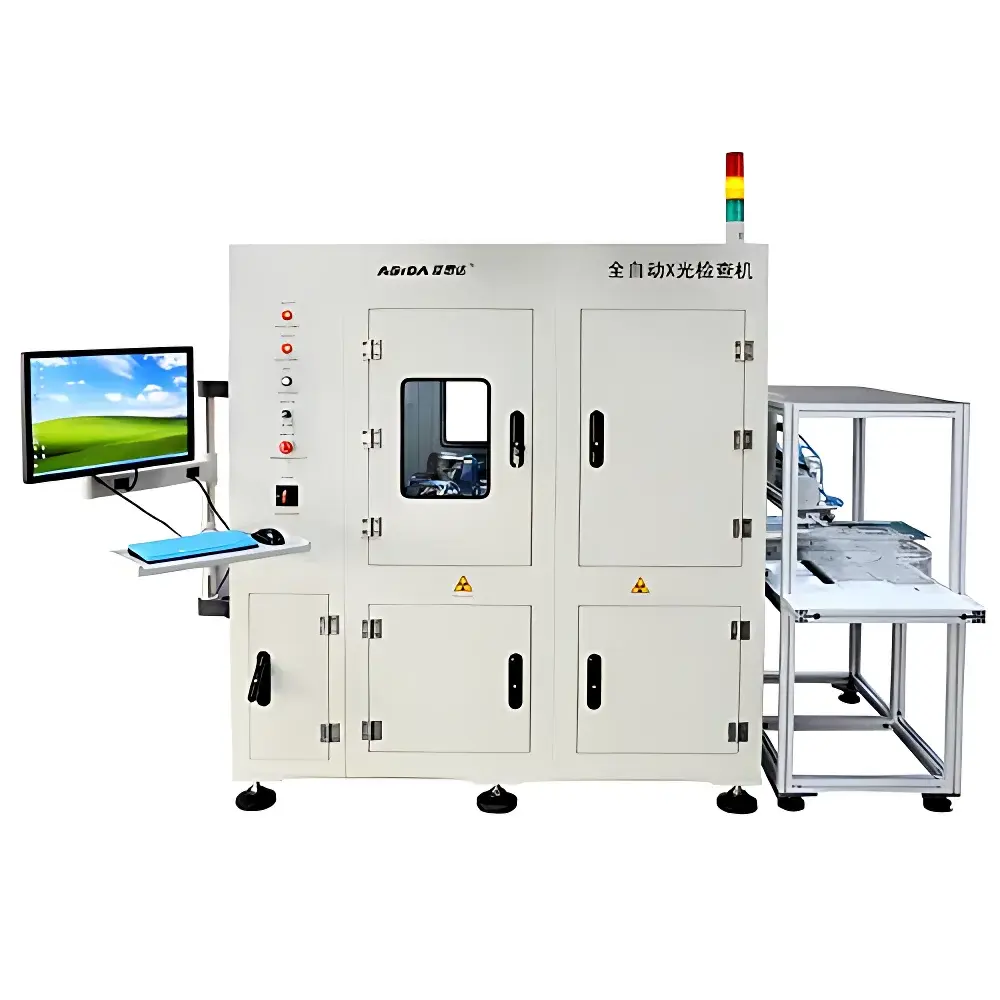
Astera XG5120/XG5130 Fully Automated X-ray Inspection System for Lithium-ion Battery Manufacturing
| Brand | Astera |
|---|---|
| Origin | Guangdong, China |
| Model | XG5120 / XG5130 |
| X-ray Tube Voltage | 90 kV |
| X-ray Tube Current (Software-Limited) | 89 µA |
| Focal Spot Size | 5 µm |
| Cooling Method | Forced Air Cooling |
| Field of View | 2″ / 4″ |
| Spatial Resolution | 75 / 110 lp/cm |
| X-CCD Resolution | 1024 × 1024 pixels |
| Geometric Magnification | 12×–48× |
| Repeatability Accuracy | ±40 µm |
| Radiation Dose Rate | ≤1 µSv/hr (at any accessible surface) |
| System Dimensions | 2800 × 1550 × 1850 mm |
| Weight | ~2000 kg |
| Power Supply | AC 220 V, 10 A |
| Operating Environment | 22 ± 3 °C, 50 ± 10% RH |
| Computing Platform | 22″ widescreen LCD, Intel Core i3, 2 GB RAM, 500 GB HDD |
Overview
The Astera XG5120 and XG5130 are fully integrated, high-throughput X-ray radiographic inspection systems engineered specifically for inline quality assurance in lithium-ion battery manufacturing. These systems operate on the principle of transmission X-ray imaging—where a microfocus X-ray source emits a collimated beam that penetrates battery cells, and differential attenuation generates contrast in the resulting projection image. Dual independent X-ray imaging channels enable simultaneous top- and side-view acquisition, supporting precise geometric metrology of electrode stack alignment—including anode/cathode height offset, foil edge integrity, tab positioning, and internal defect detection (e.g., wrinkles, misalignments, foreign particles, or separator folds). Designed for seamless integration into automated production lines, the XG5120/XG5130 delivers deterministic pass/fail classification per predefined acceptance criteria, feeding real-time results to upstream process control systems and downstream sorting mechanisms.
Key Features
- Dual-channel microfocus X-ray imaging architecture with independent 2″ and 4″ field-of-view detectors, enabling concurrent multi-angle analysis without mechanical repositioning.
- High-stability 90 kV/89 µA (software-limited) X-ray tube with <5 µm focal spot size, optimized for fine-feature resolution and low geometric unsharpness in thin-film battery structures.
- Real-time image acquisition at full 1024 × 1024 pixel resolution with adjustable geometric magnification (12×–48×), supporting sub-40 µm measurement repeatability across repeated scans.
- Fully automated material handling: motorized conveyor interface, dual-axis robotic pick-and-place arms with programmable path planning, and synchronized trigger logic between imaging exposure and motion control.
- Radiation safety-compliant enclosure meeting IEC 61000-6-4, IEC 61000-6-2, and ISO 15085-2 requirements; includes interlocked photoelectric curtains, auto-shutdown after configurable idle time (default 20 min), and tri-color status indicator for fault reporting.
- Modular software architecture supporting rapid model changeover—typical reconfiguration for new cell formats (pouch, prismatic, or stacked configurations) completed within 30–120 minutes via stored parameter sets and vision-based auto-alignment routines.
Sample Compatibility & Compliance
The XG5120/XG5130 accommodates standard lithium-ion pouch cells (up to 300 mm × 200 mm), prismatic modules, and pre-assembled battery packs with thickness up to 25 mm. Its open-conveyor design permits direct integration with existing SMT-style conveyors, AGV transfer points, or automated guided carts. All system firmware and data logging workflows adhere to principles aligned with ISO 9001:2015 quality management systems and support audit-ready documentation for GLP/GMP environments. While not FDA-cleared as a medical device, its radiation shielding performance complies with international occupational exposure limits defined in ICRP Publication 103 and national regulations (e.g., CNCA-C11-01:2020 for China, 21 CFR 1020.40 for U.S. equipment). Image metadata—including timestamp, exposure parameters, operator ID, and measurement traceability—is embedded and exportable in DICOM 3.0 or TIFF+XML format.
Software & Data Management
The proprietary Astera VisionInsight™ software suite provides deterministic image processing pipelines based on calibrated edge-detection algorithms, morphological filtering, and sub-pixel centroid interpolation. Core functions include automated electrode edge localization, angular deviation quantification (e.g., foil tilt >±1.5°), and statistical process monitoring (SPC) with real-time Cp/Cpk calculation per batch. Measurement logs are stored locally with SHA-256 hashing for integrity verification and support optional network backup to NAS or SQL-based MES databases. Audit trails record all user actions—including parameter edits, calibration events, and result overrides—with timestamps and role-based access control. The software is compatible with standard industrial communication protocols (Modbus TCP, OPC UA) for bidirectional data exchange with factory-level SCADA or QMS platforms.
Applications
- Electrode stack height offset measurement in pouch cells (anode-to-cathode vertical displacement tolerance ±25 µm).
- Detection of internal structural anomalies: separator folding, jelly-roll eccentricity, tab weld voids, and metallic particle contamination (>30 µm equivalent sphere diameter).
- Tab positioning verification relative to terminal cutouts and sealing margins in final assembly.
- Automated rejection of cells failing dimensional, alignment, or defect-based criteria prior to formation or module assembly.
- Statistical trending of electrode alignment drift over time to support predictive maintenance of slitting or stacking equipment.
FAQ
What is the maximum throughput achievable with the XG5120/XG5130?
Under standard operating conditions (pouch cell, 200 mm × 150 mm, 4 mm thickness), the system achieves sustained throughput exceeding 30,000 units per 24-hour shift, assuming continuous feed and minimal dwell time per unit.
Does the system support custom measurement algorithms beyond the default battery metrics?
Yes—VisionInsight™ exposes a Python-based scripting interface compliant with OpenCV 4.x and NumPy, enabling qualified users to deploy validated custom feature extractors or classification models, subject to firmware version compatibility and safety review.
How is radiation safety verified during installation and periodic maintenance?
Each unit undergoes third-party radiation survey prior to shipment (certified by CNAS-accredited laboratories); on-site verification is performed using calibrated ionization chamber survey meters (e.g., RadEye PRD-ER) per ANSI N43.3 guidelines, with reports archived in the system’s compliance dossier.
Can the system be integrated with existing MES or ERP platforms?
Yes—via native Modbus TCP server mode or optional OPC UA companion specification (IEC 62541 Part 100), supporting structured data export of inspection results, uptime metrics, and alarm history in JSON or XML schema.
Is remote diagnostics and software update capability available?
Remote secure access is supported through TLS-encrypted VNC tunneling with two-factor authentication; firmware updates require signed packages validated against embedded public-key certificates and are applied during scheduled maintenance windows only.



