
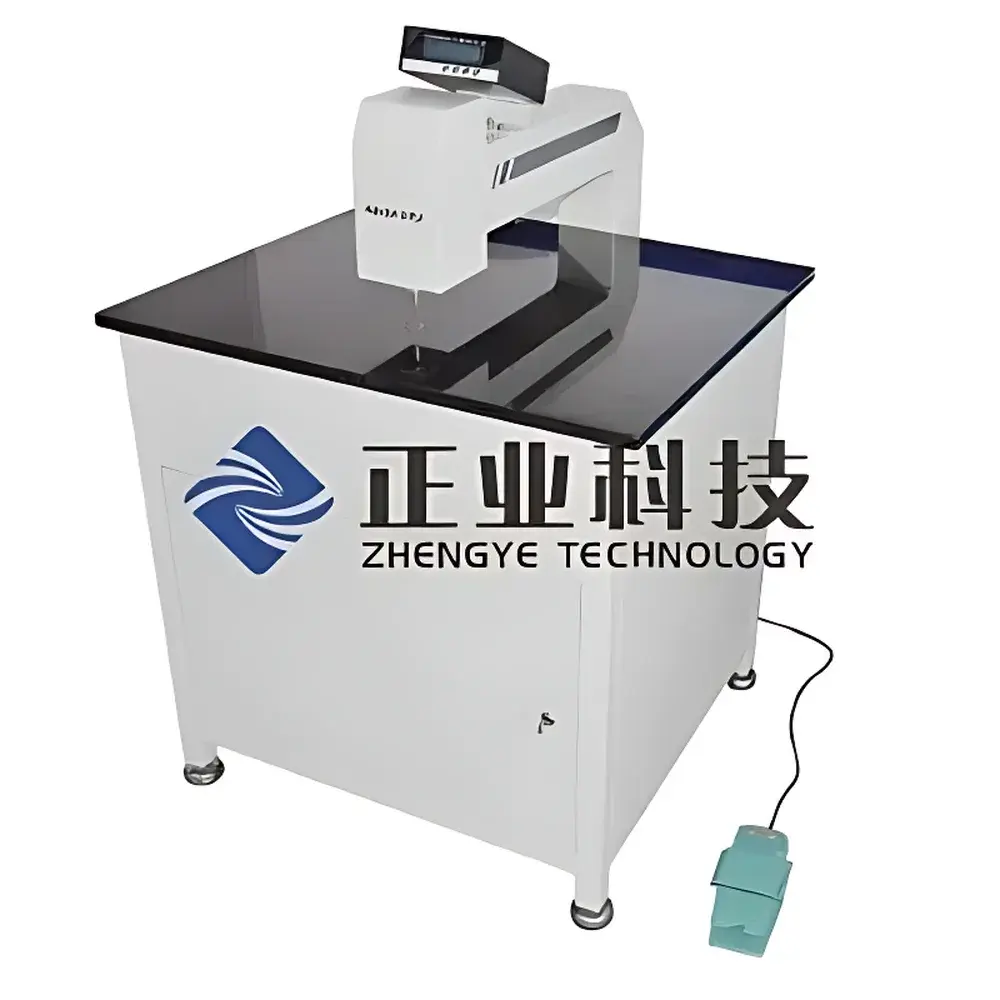
Astroda CB11 Long-Throat PCB Thickness Gauge
| Brand | Astroda |
|---|---|
| Origin | Guangdong, China |
| Manufacturer Type | Authorized Distributor |
| Country of Origin | China |
| Model | CB11 |
| Quotation | Upon Request |
| Throat Depth | 530 mm |
| Thickness Measurement Range | 0–25 mm |
| Stroke | 25 mm |
| Tabletop Dimensions | 900 × 870 mm |
| Accuracy | ±0.003 mm |
| Display | LCD (mm/inch switchable) |
| Zeroing Function | Arbitrary Position |
| Tabletop Material | Phenolic Resin (Electrical Insulating Board) |
| Power Supply | 220 V AC, 50 Hz / 100 W |
| Net Weight | 120 kg |
Overview
The Astroda CB11 Long-Throat PCB Thickness Gauge is a precision mechanical thickness measurement instrument engineered specifically for the printed circuit board (PCB) manufacturing and laminated substrate processing industries. It operates on the principle of high-resolution linear displacement sensing via a calibrated micrometer-driven anvil system, delivering repeatable, contact-based thickness readings without deformation or surface damage to delicate copper-clad laminates, prepreg stacks, or multilayer board assemblies post-lamination. Designed for metrological integrity in high-volume production environments, the CB11 complies with foundational dimensional metrology practices aligned with ISO/IEC 17025–referenced calibration traceability protocols. Its long-throat architecture enables non-peripheral access to central regions of large-format substrates—critical for verifying uniformity across panelized PCBs up to 900 mm wide—thereby supporting process validation in accordance with IPC-4101 (Specification for Base Materials for Rigid and Multilayer Printed Boards) and IPC-TM-650 (Test Methods Manual).
Key Features
- Extended throat depth of 530 mm ensures unobstructed access to the geometric center of oversized PCB panels and laminated sheets, eliminating edge bias in thickness evaluation.
- High-precision mechanical micrometer mechanism with ±0.003 mm accuracy over a full 25 mm stroke, validated per ISO 9001 internal calibration procedures.
- Switchable metric (mm) and imperial (inch) display units on integrated backlit LCD screen, facilitating cross-regional engineering documentation compliance.
- Arbitrary zero-point setting function allows rapid relative measurements—essential for assessing layer stack-up tolerances or detecting localized delamination-induced thickness deviations.
- Phenolic resin (electrical-grade bakelite) tabletop provides dielectric isolation, surface hardness ≥110 HB, and zero risk of marring copper foil or solder mask finishes during repeated loading cycles.
- Statically balanced structural frame (120 kg mass) minimizes vibration-induced drift; base-mounted leveling feet ensure stability on standard ISO-classified cleanroom workbenches.
Sample Compatibility & Compliance
The CB11 accommodates rigid and semi-rigid substrates including FR-4, polyimide, metal-core (MCPCB), and high-frequency laminates (e.g., Rogers RO4000® series) with nominal dimensions up to 900 × 870 mm. It is routinely deployed in QA/QC labs for incoming material inspection (IMI), in-process lamination verification, and final board release testing. The instrument supports adherence to IPC-A-600 (Acceptability of Printed Boards), IPC-6012 (Qualification and Performance Specification for Rigid Printed Boards), and internal GMP-aligned SOPs requiring documented measurement uncertainty budgets. While not an automated CMM, its manual operation satisfies GLP-compliant recordkeeping when paired with controlled logbooks or LIMS-integrated data capture workflows.
Software & Data Management
The CB11 is a standalone analog-digital hybrid gauge with no embedded firmware or proprietary software. All measurement data are displayed in real time on its monochrome LCD interface. For digital traceability, users may integrate external USB or RS-232 digital calipers (optional accessories) into existing SPC platforms such as Minitab, JMP, or custom MES modules. Raw readings support CSV export via third-party data loggers compliant with FDA 21 CFR Part 11 requirements when configured with electronic signature and audit trail capabilities. Calibration certificates issued by accredited metrology labs (e.g., CNAS-certified providers) include uncertainty values at k=2, ensuring conformity with ISO/IEC 17025 Clause 6.5.
Applications
- Verification of copper-clad laminate thickness pre- and post-etching to confirm etch compensation allowances.
- Stack-up validation of multilayer press cycles—including core/prepreg combinations—to detect resin flow inconsistencies or void formation.
- Thickness profiling across large-format HDI boards to identify warpage-related gradients prior to drilling or routing.
- Quality gate check for rigid-flex PCBs at the lamination interface between rigid and flexible sections.
- Supplier qualification audits where thickness deviation beyond ±0.01 mm triggers non-conformance reporting under AS9100 or IATF 16949 frameworks.
FAQ
Is the CB11 suitable for measuring warped or bowed PCBs?
Yes—the adjustable anvil height and low-force contact design allow stable measurement even on substrates exhibiting ≤1.5 mm total indicator reading (TIR) bow, provided the sample is fully supported on the phenolic tabletop.
Does the instrument require periodic recalibration?
Yes—recommended annually or after 500 operational hours, using traceable gauge blocks certified to ISO 3650 standards; calibration intervals must be defined in your site’s metrology control plan.
Can the CB11 measure through solder mask or silkscreen layers?
Yes—its mechanical contact method measures total substrate thickness inclusive of all surface finishes; however, for bare-copper thickness analysis, separate eddy-current or XRF instruments are required.
Is the tabletop resistant to common PCB cleaning solvents?
Yes—phenolic resin exhibits chemical resistance to isopropyl alcohol (IPA), acetone, and flux removers per ASTM D543, with no dimensional swelling observed after 72-hour immersion testing.
What environmental conditions are recommended for optimal performance?
Operate within 20–25 °C ±1 °C, 40–60% RH, and away from direct airflow or vibration sources; temperature gradients >0.5 °C/hour may affect thermal drift compensation in the micrometer assembly.



