
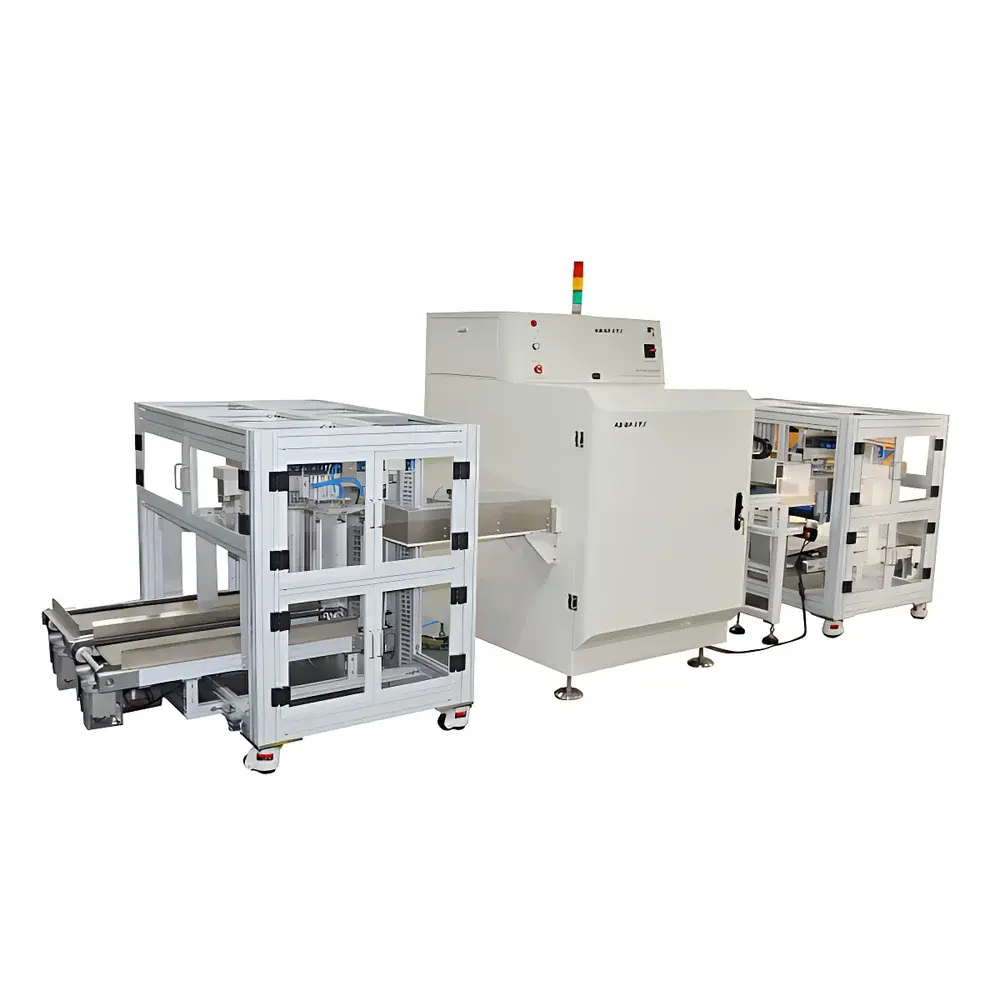
Astroda XG5100 Automated In-Line X-ray Inspection System for Polymer Pouch Cells and Finished Lithium Batteries
| Brand | Astroda |
|---|---|
| Model | XG5100 |
| Application | In-line/Off-line Automated Radiographic Inspection of Polymer Pouch-Type Li-ion Cells and Sealed Battery Packs |
| X-ray Tube Voltage | Up to 110 kV |
| X-ray Tube Current | Up to 450 µA |
| Focal Spot Size | 5 µm |
| Detector Type | Line-Scan CCD/CMOS Array |
| Sensitive Area | 235 mm × 13 mm |
| Repeatability Accuracy | ±60 µm |
| Throughput | ≥25 parts per minute (ppm) |
| False Positive Rate | ≤2% |
| Miss Detection Rate | 0.0% |
| Overall Yield Compliance Rate | ≥99.5% |
| Radiation Leakage | ≤1 µSv/hr at any accessible surface |
| Cooling Method | Forced-Air Cooled X-ray Source |
| Safety Certification | Compliant with IEC 61000-6-4, IEC 61000-6-2, and GBZ 126–2011 (China National Standard for Radiation Protection in Industrial X-ray Equipment) |
Overview
The Astroda XG5100 is an industrial-grade, fully automated in-line X-ray radiographic inspection system engineered for high-throughput quality assurance in lithium-ion battery manufacturing. It employs transmission-based X-ray imaging with a micro-focus sealed-tube source (≤5 µm focal spot) and a high-resolution line-scan detector array to deliver consistent, quantitative internal structural analysis of polymer pouch cells and finished battery modules. Unlike manual or semi-automated systems, the XG5100 integrates seamlessly into conveyor-based production lines—supporting real-time defect identification including electrode misalignment, tab weld voids, foil wrinkling, foreign metallic particles, separator folding, and electrolyte distribution anomalies. Its design adheres to fundamental radiographic principles defined in ASTM E94/E1742 and ISO 17636-2, ensuring geometric unsharpness remains within acceptable limits for sub-100 µm feature resolution under standard operating conditions.
Key Features
- Fully automated material handling: Integrated servo-driven conveyor, robotic pick-and-place (optional), pneumatic indexing, and dual-station loading/unloading support continuous 24/7 operation.
- Real-time system health monitoring: All mechanical actuators, X-ray generator parameters, detector signal integrity, and safety interlock states are continuously logged and visualized on the HMI interface with color-coded status indicators.
- Synchronized multi-angle imaging: Configurable dual-source/dual-detector layout enables orthogonal or oblique projection acquisition per part—critical for detecting planar defects invisible in single-axis views.
- Radiation-hardened enclosure: Triple-layer shielding (lead-lined steel frame, borosilicate glass viewport, and interlocked access doors) ensures compliance with national and international radiation exposure limits (≤1 µSv/hr at 5 cm from any external surface).
- Embedded image processing engine: On-board FPGA-accelerated algorithms perform real-time contrast enhancement, noise suppression, edge detection, and dimensional metrology without reliance on external workstations.
Sample Compatibility & Compliance
The XG5100 accommodates standard polymer pouch cell formats (L: 80–250 mm, W: 40–120 mm, T: 3–15 mm) and finished prismatic battery modules up to 300 mm × 180 mm × 25 mm. Fixturing is modular and tooling-free, enabling rapid changeover between product families. The system meets electromagnetic compatibility requirements per IEC 61000-6-2 (immunity) and IEC 61000-6-4 (emissions), and its radiation safety architecture conforms to GBZ 126–2011 and aligns with ALARA (As Low As Reasonably Achievable) principles. For regulated environments, audit trails, user access control, and electronic signature capabilities can be enabled to support GLP/GMP-aligned workflows compliant with FDA 21 CFR Part 11 when integrated with validated MES/QMS platforms.
Software & Data Management
Control and analysis are managed via Astroda’s proprietary RadiographIQ software suite, built on a deterministic real-time OS kernel. The interface supports synchronized display of raw projection images, reconstructed cross-sections (via back-projection), annotated defect maps, and statistical process control (SPC) dashboards—all time-stamped and linked to individual part IDs. All image metadata—including kV/mA settings, exposure duration, detector gain, and calibration coefficients—are embedded in DICOM-compliant headers. Raw data export options include TIFF (16-bit), HDF5, and CSV; historical logs are retained for ≥18 months and support SQL-based querying for root cause analysis. Software validation documentation (IQ/OQ/PQ protocols) is available upon request for pharmaceutical or automotive-tier-1 supplier qualification.
Applications
Primary deployment use cases include incoming material inspection of electrode stacks, in-process verification after hot-pressing and tab welding, final acceptance testing of sealed pouch cells prior to formation cycling, and post-formation screening for internal short-circuit precursors. Secondary applications extend to R&D labs conducting failure mode analysis (FMEA), comparative studies of electrode coating uniformity, and validation of new cell designs under thermal-mechanical stress protocols. The system is widely adopted by Tier-1 battery manufacturers supplying EV OEMs and energy storage system integrators where zero-defect tolerance and full traceability are contractually mandated.
FAQ
Does the XG5100 support integration with existing factory MES or SCADA systems?
Yes—via OPC UA, Modbus TCP, or RESTful API interfaces; custom protocol adapters are available for legacy ERP platforms.
What is the typical lead time for installation and validation?
Standard delivery is 12–14 weeks from PO; FAT/SAT and IQ/OQ execution require an additional 3–4 weeks depending on site readiness.
Can the system detect non-metallic contaminants such as silicone gel or dried electrolyte residue?
Detection sensitivity depends on atomic number contrast and thickness; organic residues are visible if ≥50 µm thick and positioned against high-Z substrates (e.g., aluminum casing).
Is remote diagnostics and firmware update capability included?
Yes—secure TLS-encrypted remote access is enabled by default, with role-based permissions and session logging for cybersecurity compliance.
How often does the X-ray tube require replacement or recalibration?
The micro-focus tube has a rated service life of ≥8,000 hours; annual calibration using NIST-traceable step wedges is recommended for metrological continuity.



