
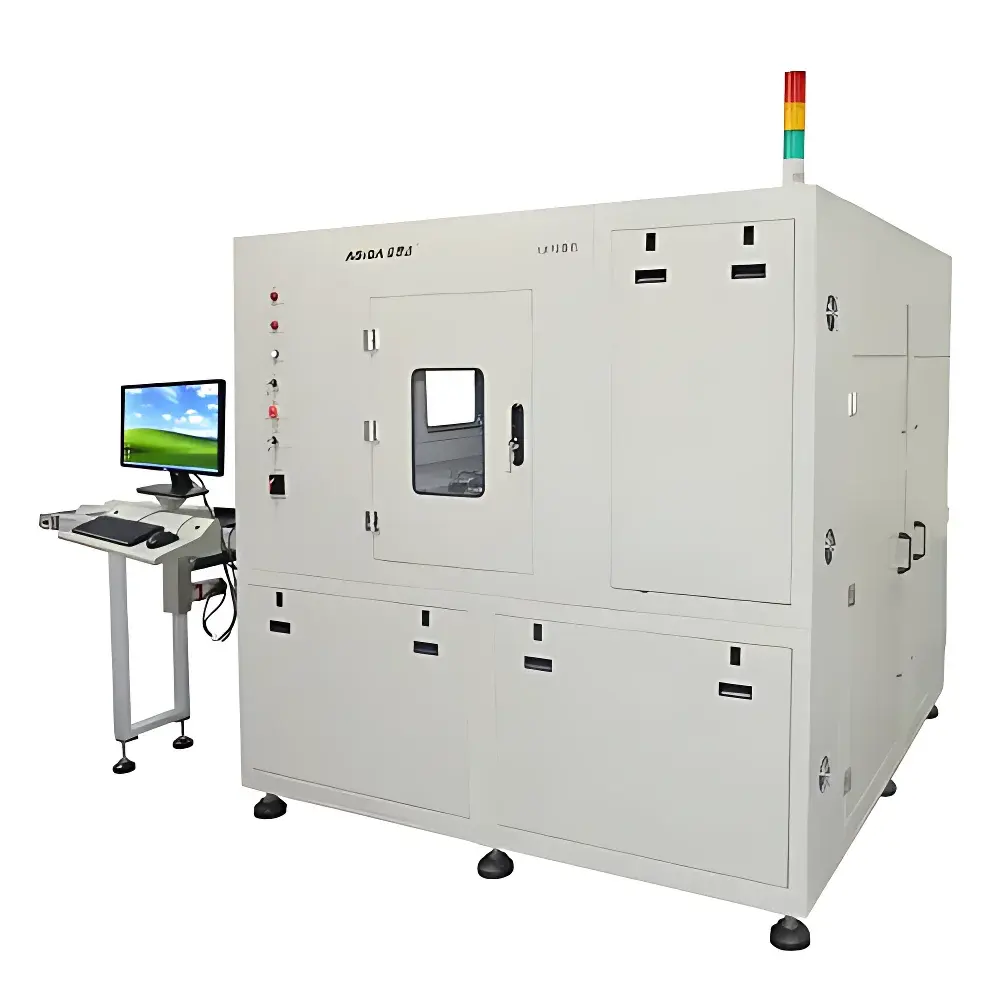
Astroda XG5300/XG5310 Online Fully Automated X-ray Inspection System
| Brand | Astroda |
|---|---|
| Model | XG5300/XG5310 |
| X-ray Tube Voltage | 90 kV |
| X-ray Tube Current | 200 µA (software-limited to 89 µA) |
| Focal Spot Size | 5 µm |
| Cooling Method | Forced Air Cooling |
| Field of View | 2″ / 4″ |
| Spatial Resolution | 75 / 110 lp/cm |
| X-CCD Resolution | 1024 × 1024 pixels |
| Repeatability Accuracy | ±40 µm |
| Throughput | ≥60 PPM |
| False Positive Rate | ≤2% |
| False Negative Rate | 0.0% |
| Overall Yield Rate | ≥99.5% |
| Radiation Dose Rate | ≤1 µSv/hr (at any accessible surface) |
| Host Dimensions | 2500 × 1500 × 1700 mm |
| Power Supply | AC 380 V, 50 Hz |
| Operating Environment | 23 ±5 °C, ≤80% RH |
| Display | 22″ widescreen LCD |
| CPU | Intel Core i3 |
| RAM | 2 GB |
| Storage | 500 GB HDD |
Overview
The Astroda XG5300/XG5310 is an industrial-grade, online fully automated X-ray inspection system engineered for high-throughput, non-destructive evaluation of lithium-ion battery assemblies in real time. Based on transmission X-ray imaging principles, the system generates high-contrast radiographic projections by directing a collimated 90 kV X-ray beam through battery cells—penetrating aluminum casings or flexible pouch structures—to resolve internal features including electrode tab geometry, anode/cathode foil alignment, and foil coverage uniformity. Unlike offline benchtop systems, the XG5300/XG5310 integrates seamlessly into production lines, performing continuous, contactless inspection without interrupting conveyor flow. Its dual-image acquisition architecture—comprising two synchronized X-CCD detectors with 1024 × 1024 pixel resolution and selectable 2″/4″ fields of view—enables multi-angle, multi-location analysis per cell within a single pass. The system operates under strict radiation safety compliance, delivering ≤1 µSv/hr at all accessible surfaces, meeting IEC 61000-6-4, IEC 62471, and EU Directive 2013/59/Euratom requirements.
Key Features
- Fully automated inline operation: integrated feed-in conveyor, precision indexing via an 8-position cam indexer, dual-station real-time imaging, and tri-channel sorting (pass/fail-by-tab/fail-by-foil) without manual intervention.
- High-speed throughput: achieves ≥60 parts per minute (PPM) through optimized mechanical synchronization between the 4-position transfer carousel and the 8-position inspection turret—minimizing dwell time while maintaining positional repeatability of ±40 µm.
- Multi-site image fusion interface: software overlays registered radiographs from both detectors onto a unified GUI, displaying side-by-side comparisons, measurement overlays, and deviation heatmaps for rapid operator assessment.
- Rapid changeover capability: switch between prismatic aluminum-cased and soft-pack battery formats using mechanically indexed, tool-less fixture swaps—calibration retention ensures consistent detection thresholds across configurations.
- Triple-layer radiation safety architecture: interlocked shielding doors, real-time dose monitoring sensors, and fail-safe beam termination circuits ensure compliance with ISO 15708-1 and FDA 21 CFR Part 1020.40, validated per third-party radiation survey reports.
Sample Compatibility & Compliance
The XG5300/XG5310 supports standardized battery formats up to 200 mm × 150 mm × 80 mm (L×W×H), covering mainstream prismatic LiFePO₄ and NMC cells as well as laminated pouch cells with aluminum-plastic laminate envelopes. All detection algorithms are trained and validated against ASTM E2737-22 (Standard Practice for Digital Radiographic Testing of Batteries) and aligned with UL 1642 Annex B requirements for internal defect classification. System validation documentation includes IQ/OQ/PQ protocols traceable to NIST-traceable radiation dosimeters and certified reference phantoms. Full audit trail logging satisfies GLP and GMP environments requiring 21 CFR Part 11–compliant electronic records.
Software & Data Management
Equipped with Astroda VisionInsight™ v4.2, the system provides deterministic image processing pipelines—including adaptive contrast enhancement, sub-pixel edge detection, and geometric distortion correction—optimized for low-contrast metallic interfaces in battery cross-sections. Measurement data (tab width, foil offset, void area %, misalignment vector) are exported in CSV/Excel format with timestamp, serial ID, and operator log. Database integration supports OPC UA connectivity to MES platforms (e.g., Siemens Opcenter, Rockwell FactoryTalk). Audit logs record every parameter change, image acquisition event, and sorting decision—retained for ≥36 months with SHA-256 hash integrity verification.
Applications
Primary deployment targets include cathode/anode foil stacking verification during cell assembly, post-welding tab integrity screening, and final QA release testing prior to module integration. Validated use cases span Tier-1 EV battery manufacturers (e.g., CATL, BYD, LG Energy Solution), contract battery pack assemblers, and battery recycling facilities performing pre-shredder health assessment. Secondary applications include ceramic capacitor electrode alignment checks, PCB solder joint void analysis, and medical device hermetic seal verification—where sub-50 µm feature resolution and statistical process control (SPC) charting are required.
FAQ
What X-ray safety certifications does the XG5300/XG5310 hold?
It complies with IEC 61000-6-4 (EMC), IEC 62471 (photobiological safety), and EU Basic Safety Standard 2013/59/Euratom; full Type Test Reports are available upon NDA.
Can the system integrate with existing factory SCADA networks?
Yes—via native Modbus TCP and optional OPC UA server module; hardware-level digital I/O supports direct PLC handshake for start/stop and reject signal synchronization.
Is firmware update support included post-purchase?
All software updates—including algorithm enhancements and regulatory patch releases—are provided free of charge for 36 months under standard warranty; extended support contracts available.
How is measurement traceability ensured across shifts and operators?
Each inspection cycle embeds metrological metadata (detector gain, exposure time, focal spot drift compensation); daily auto-calibration against tungsten wire phantom validates spatial accuracy per ISO/IEC 17025 clause 5.10.
Does the system support custom defect classification rules?
Yes—VisionInsight™ allows rule-based logic configuration (e.g., “if tab width 0.15 mm → reject”) with version-controlled rule sets exportable for cross-facility harmonization.



