
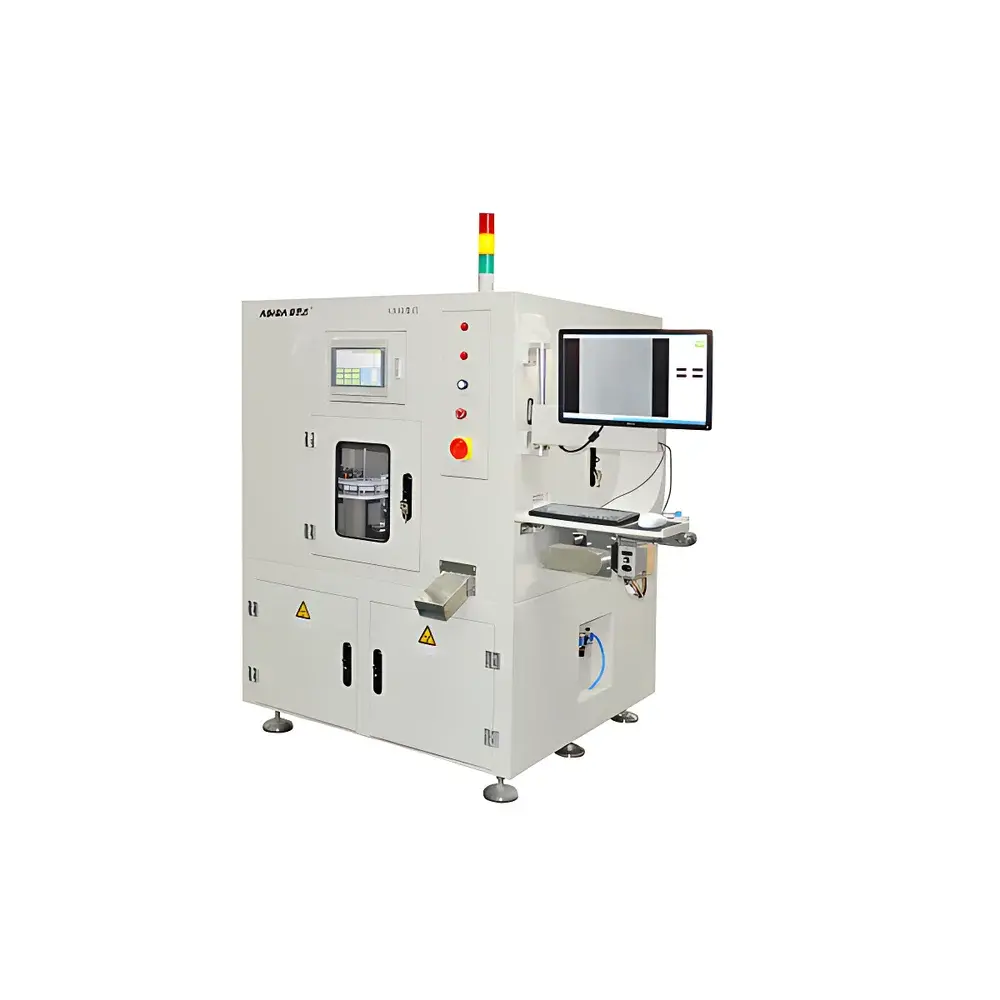
Astroda XG5600 Fully Automated In-Line X-ray Inspection System for 18650 Cylindrical Lithium-Ion Batteries
| Brand | Astroda |
|---|---|
| Model | XG5600 |
| Origin | Guangdong, China |
| Detector Type | Flat-Panel Digital Radiography System |
| Max. Tube Voltage | 110 kV |
| Max. Tube Current | 450 µA |
| Focal Spot Size | 5 µm |
| Cooling Method | Forced Air |
| Detector Active Area | 54 mm × 48 mm |
| Spatial Resolution | 20.8 lp/mm |
| Pixel Matrix | 2000 × 2249 / 1000 × 1124 |
| Repeatability Accuracy | ±60 µm |
| Throughput | ≥50 ppm |
| False Positive Rate | ≤2% |
| False Negative Rate | 0.0% |
| Pass Rate Consistency | ≥99.5% |
| Radiation Leakage | ≤1 µSv/hr (measured at 5 cm from enclosure surface) |
| Compliance | IEC 61000-6-3, IEC 61000-6-4, GBZ 126-2011, ANSI N43.3 |
Overview
The Astroda XG5600 is a fully automated in-line X-ray inspection system engineered specifically for high-throughput quality assurance of 18650 cylindrical lithium-ion batteries during manufacturing. Utilizing digital radiography based on microfocus X-ray generation and flat-panel detector imaging, the system performs non-destructive internal structural evaluation without physical contact or sample preparation. Its core measurement principle relies on differential X-ray attenuation across battery components—enabling precise visualization of electrode alignment, tab-to-can weld integrity, separator positioning, internal short-circuit indicators, and foil discontinuities. Designed for integration into continuous production lines, the XG5600 operates in real time with synchronized conveyor interfacing, supporting both inline deployment and offline batch verification workflows. The system meets industrial requirements for traceability, repeatability, and regulatory compliance in battery cell manufacturing environments governed by ISO 9001, IATF 16949, and UL 1642–based quality frameworks.
Key Features
- Fully automated inspection cycle—including automatic loading, rotational positioning, multi-angle radiographic acquisition, AI-assisted defect classification, and pneumatic sorting of pass/fail units.
- Real-time hardware status monitoring: integrated diagnostics track X-ray tube health, detector temperature, conveyor synchronization, interlock states, and radiation shielding integrity—displayed continuously via HMI dashboard.
- Multi-region imaging interface: simultaneous display of up to six orthogonal or oblique projection views per battery unit, each annotated with dimensional overlays and grayscale histogram analysis for comparative interpretation.
- Triple-layer radiation safety architecture: mechanical shutter interlock, door-mounted safety switches, and real-time dosimetry feedback loop ensure full compliance with international occupational exposure limits (≤1 µSv/hr at operator access points).
- Modular firmware architecture supporting over-the-air updates, configurable inspection recipes, and audit-ready event logging with timestamped metadata per scan.
Sample Compatibility & Compliance
The XG5600 accommodates standard 18650 cylindrical cells (diameter: 18.0 ± 0.2 mm; length: 65.0 ± 0.3 mm), including nickel-plated steel, aluminum-laminated, and stainless-steel can variants. It supports optional fixtures for 21700 and 26650 formats via mechanical adapter kits. All radiographic outputs conform to ASTM E2737-20 (Standard Practice for Digital Radiography) and ISO 17636-2:2022 (Non-destructive testing — Radiographic testing of welded joints — Part 2: X- and gamma-ray techniques with digital detectors). Radiation emission profiles are certified per GBZ 126-2011 (Chinese National Standard for Medical and Industrial X-ray Equipment Safety) and ANSI N43.3 (Radiation Protection for X-ray Systems). Full documentation supports FDA 21 CFR Part 11 readiness when deployed in GMP-regulated battery qualification labs.
Software & Data Management
The proprietary AstroVision™ inspection software provides role-based access control, configurable pass/fail thresholds, and image annotation tools compliant with DICOM 3.0 standards. All radiographs and derived metrics—including weld gap measurements, electrode misalignment vectors, and density variance maps—are stored with SHA-256 hash integrity verification. Audit trails record user actions, parameter changes, calibration events, and system errors with immutable timestamps. Data export supports CSV, XML, and HL7-compatible formats for integration into MES platforms such as Siemens Opcenter, Rockwell FactoryTalk, or custom LIMS deployments. Optional cloud gateway enables remote diagnostics and predictive maintenance alerts based on tube usage analytics.
Applications
- Electrode stack integrity verification: detection of foil tearing, delamination, and winding offset beyond ±0.15 mm tolerance.
- Tab-to-can weld assessment: identification of incomplete fusion zones, voids >50 µm diameter, and thermal distortion patterns indicative of excessive energy input.
- Separator integrity screening: visualization of wrinkles, folds, or localized thinning regions affecting thermal runaway resistance.
- Internal short detection: localization of metallic debris, burr formation, or anode/cathode contact anomalies under compressed state simulation.
- Process validation support: correlation of X-ray findings with electrochemical performance data (e.g., EIS, dQ/dV) for root cause analysis in DOE-driven process optimization.
FAQ
What types of defects can the XG5600 reliably detect in 18650 cells?
It identifies electrode misalignment, tab weld voids, foil fractures, separator folding, foreign metallic particles, and can wall deformation—with sensitivity validated down to 60 µm feature resolution under nominal operating conditions.
Does the system support integration with existing factory automation protocols?
Yes—native support for EtherNet/IP, PROFINET, and Modbus TCP enables bidirectional communication with PLCs and SCADA systems for start/stop control, reject signaling, and real-time OEE reporting.
How is radiation safety verified during installation and routine operation?
Pre-commissioning third-party dosimetry survey is required; thereafter, built-in ionization chamber monitors continuously log ambient dose rates and trigger automatic shutdown if thresholds exceed 0.5 µSv/hr at designated checkpoints.
Can inspection parameters be customized per battery chemistry or manufacturer specification?
Absolutely—the recipe editor allows independent configuration of kV/mA settings, exposure time, rotation step angle, ROI masking, and classification logic per customer-defined AQL levels.
Is remote software support and firmware update capability available?
Yes—secure TLS 1.3 encrypted remote desktop access and signed firmware package delivery are included in the annual AstroCare service subscription.



