
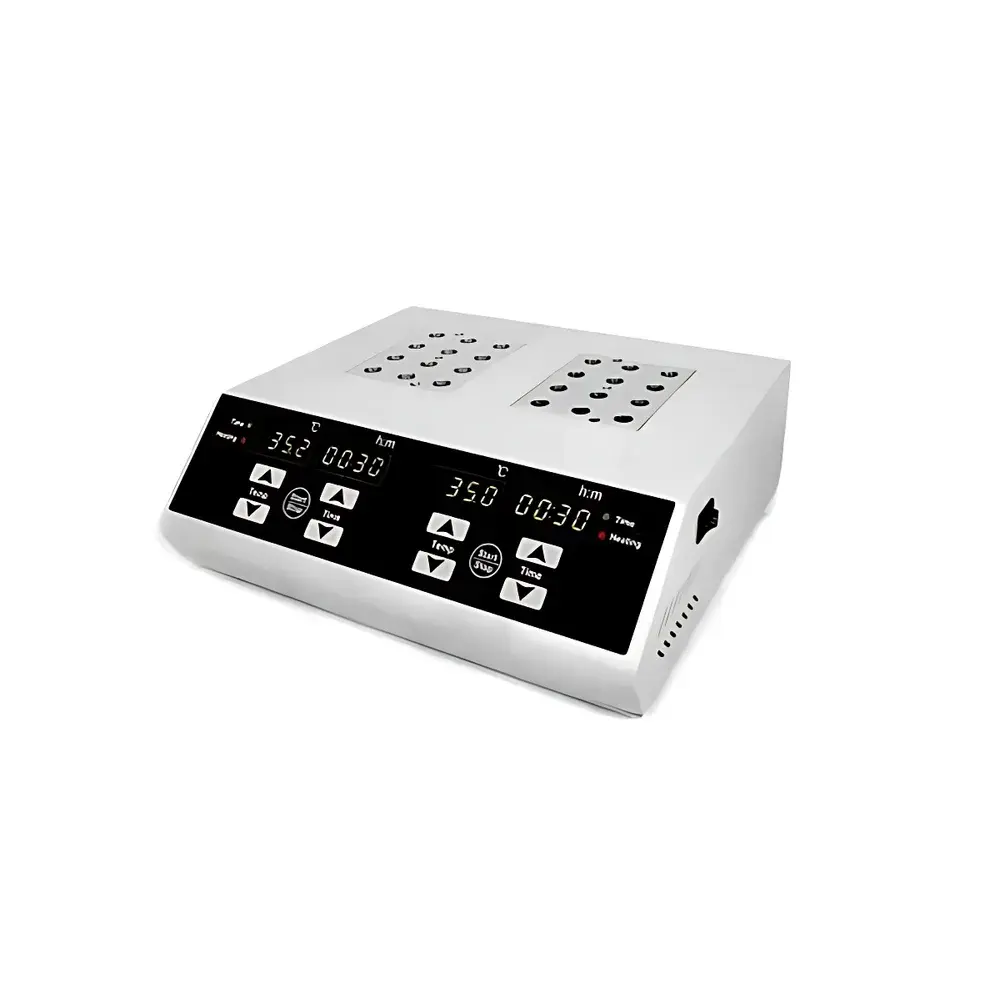
Asylum Research DKT200-2A Dual-Zone Dry Block Heater
| Brand | Asylum Research |
|---|---|
| Origin | Beijing, China |
| Model | DKT200-2A |
| Temperature Range | Ambient +5°C to 150°C |
| Temperature Stability | ≤ ±0.5°C (40–100°C), ≤ ±1.0°C (100–150°C) |
| Module Temperature Uniformity | ≤ ±0.5°C |
| Display Resolution | 0.1°C |
| Max Timer Setting | 99h 59min |
| Max Power Consumption | 600 W |
| Dimensions (W×D×H) | 260 × 290 × 95 mm |
Overview
The Asylum Research DKT200-2A Dual-Zone Dry Block Heater is a microprocessor-controlled thermal platform engineered for precise, stable, and reproducible temperature regulation across two independent aluminum heating blocks. Unlike water baths—whose thermal inertia, contamination risk, and maintenance overhead limit experimental flexibility—the DKT200-2A employs solid-state conduction via high-purity aluminum blocks to deliver rapid heat transfer, minimal temperature overshoot, and exceptional spatial uniformity. Its core architecture leverages PID feedback control with real-time deviation compensation, enabling accurate setpoint maintenance from ambient +5°C up to 150°C. Designed for routine laboratory workflows in clinical diagnostics, pharmaceutical QC, molecular biology, and environmental testing, the instrument supports critical time- and temperature-sensitive protocols including serum coagulation, enzyme activation, DNA denaturation/annealing, sample thawing, and reagent pre-warming.
Key Features
- Dual-zone independent temperature control: Each block operates at user-defined setpoints simultaneously—enabling parallel processing of dissimilar samples (e.g., 37°C incubation alongside 95°C denaturation).
- High-precision thermal regulation: Achieves ≤ ±0.5°C stability across 40–100°C and ≤ ±1.0°C at elevated ranges (100–150°C), verified per ASTM E220-22 calibration methodology.
- Rapid thermal response: Reaches 150°C from 20°C in ≤30 minutes, minimizing protocol downtime without compromising control fidelity.
- Modular aluminum block system: Supports 19 standardized interchangeable blocks (DT01–DT19), accommodating tubes from 0.2 mL PCR strips to 40 mm diameter vessels, plus 96-well microplates and custom geometries.
- Integrated safety architecture: Features dual-level overtemperature protection (hardware cutoff + software limiter), automatic fault detection with audible alarm, and auto-shutdown on sensor failure.
- Low-footprint ergonomic design: Compact chassis (260 × 290 × 95 mm) fits seamlessly into biosafety cabinets or crowded benchtops; passive cooling eliminates fan noise and vibration interference.
- Calibration-ready interface: Built-in offset adjustment function allows traceable field calibration against NIST-traceable reference thermometers—essential for GLP/GMP-compliant environments.
Sample Compatibility & Compliance
The DKT200-2A accommodates a broad spectrum of primary containment formats without requiring consumables or fluid media. All aluminum blocks are anodized for chemical resistance and autoclavable (121°C, 20 min), supporting ISO 13485-aligned cleaning validation. Tube compatibility spans common diagnostic and research standards—including 13 × 100 mm culture tubes, 16 × 100 mm centrifuge tubes, 0.2 mL PCR tubes, and flat-bottom 96-well ELISA plates. The device complies with IEC 61010-1:2010 for electrical safety and meets EMC requirements per EN 61326-1:2013. While not FDA-cleared as a medical device, its thermal performance aligns with USP environmental conditioning benchmarks and CLSI EP23-A guidelines for temperature-controlled sample handling.
Software & Data Management
The DKT200-2A operates via intuitive front-panel LED interface with tactile keypad navigation—no external PC required for basic operation. Time and temperature parameters are logged internally with timestamped records (non-volatile memory, 100-cycle retention). For audit-ready environments, optional RS-232/USB connectivity enables integration with LIMS or electronic lab notebooks (ELN) using ASCII-based command protocol. All data exports support CSV formatting and include operator ID fields, facilitating 21 CFR Part 11 compliance when paired with validated third-party software platforms. Firmware updates are performed via USB flash drive, preserving configuration integrity during version upgrades.
Applications
- Clinical coagulation assays: Standardized 37°C serum incubation for PT/INR and APTT testing per CLSI H21-A5.
- Molecular diagnostics: Thermal equilibration of master mixes prior to qPCR setup; controlled thawing of restriction enzymes to preserve activity.
- Pharmaceutical stability studies: Accelerated degradation testing at fixed temperatures (e.g., 40°C/75% RH preconditioning support).
- Food safety testing: Pre-heating of enrichment broths (e.g., BPW, TSB) per AOAC 990.12 and ISO 6579-1 protocols.
- Environmental microbiology: Activation of selective media components and temperature-dependent enzymatic assays (e.g., β-glucuronidase hydrolysis).
- Material science pre-conditioning: Controlled thermal exposure of polymer standards prior to rheological or DSC analysis.
FAQ
Does the DKT200-2A support refrigeration or cooling functionality?
No. The DKT200-2A is a heating-only dry block system. It does not incorporate Peltier or compressor-based cooling; maximum operating temperature is 150°C.
Can both zones operate at different temperatures simultaneously?
Yes. Zone A and Zone B are fully independent—each with dedicated sensors, heaters, and PID controllers—allowing concurrent operation at any combination within the specified range.
Are calibration certificates provided with the instrument?
Factory calibration is performed at three points (40°C, 75°C, 120°C) using NIST-traceable probes. Optional UKAS-accredited calibration certificates are available upon request.
Is the unit suitable for use inside a CO₂ incubator?
No. The DKT200-2A is rated for ambient laboratory conditions only (15–30°C, <80% RH non-condensing) and lacks ingress protection for humidified enclosures.
What is the recommended maintenance schedule?
No routine maintenance is required beyond periodic cleaning of block surfaces with 70% ethanol and verification of thermal accuracy every 6 months using a calibrated reference thermometer.



