
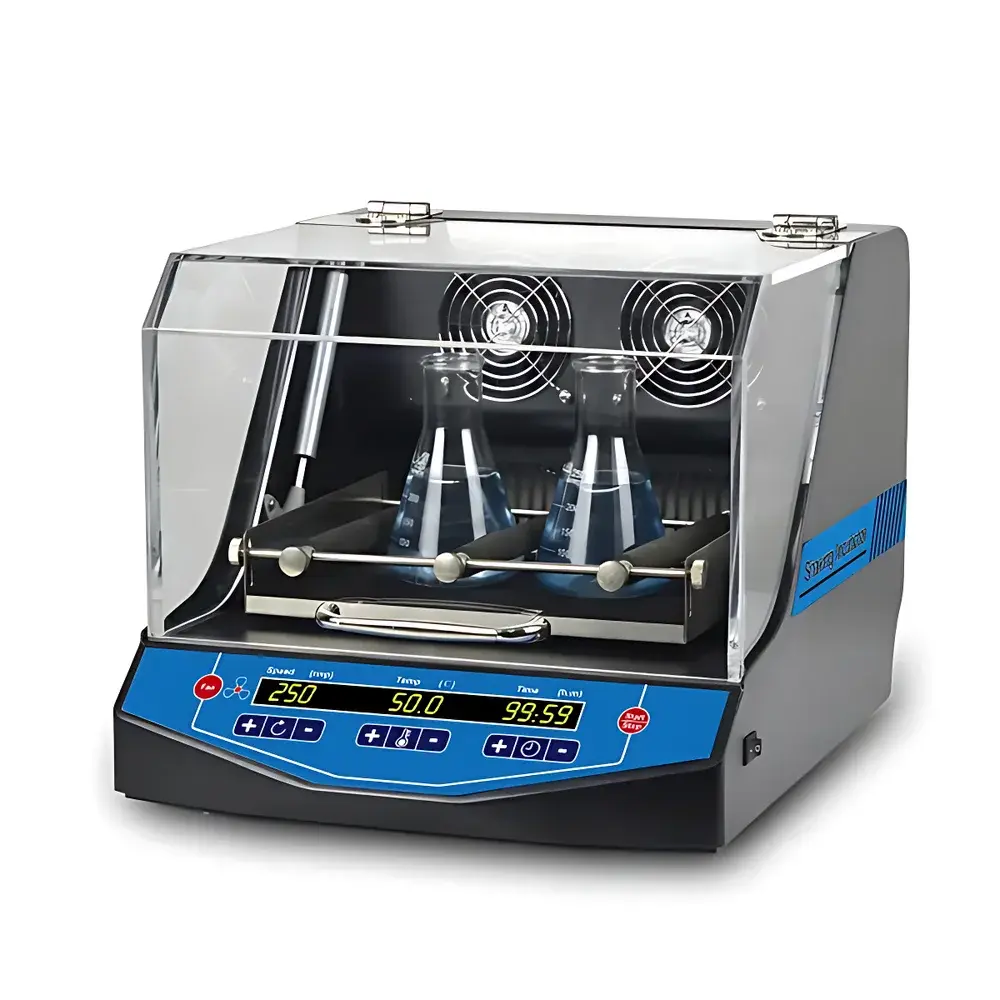
Asylum Research ES-60 Incubated Orbital Shaker
| Brand | Asylum Research |
|---|---|
| Origin | Beijing, China |
| Model | ES-60 |
| Instrument Type | Air-jacketed incubated orbital shaker |
| Timer Range | 0–99 h 59 min |
| Oscillation Speed | 50–300 rpm |
| Amplitude | 20 mm |
| Temperature Range | Ambient +5°C to 60°C |
| Number of Platforms | 1 |
| Temperature Display Accuracy | ≤ ±0.1°C |
| Temperature Stability (@37°C) | ≤ ±0.3°C |
| Power Supply | AC 110/220 V, 250 W |
| Dimensions (W×D×H) | 420 × 360 × 320 mm |
| Motor Type | Brushless DC motor |
| Fan Speed | Adjustable |
| Safety Features | Independent overtemperature cutoff, lid-interlock shutdown, audible end-of-program alarm |
Overview
The Asylum Research ES-60 Incubated Orbital Shaker integrates precise temperature control with consistent orbital agitation in a compact benchtop format. Engineered for life science laboratories requiring simultaneous thermal regulation and gentle-to-moderate mixing—such as microbial culture expansion, enzyme kinetics assays, cell suspension maintenance, and recombinant protein expression—the ES-60 employs an air-jacketed heating system coupled with forced-air circulation and PID-based temperature feedback. Its orbital motion follows a 20 mm diameter circular path at speeds adjustable from 50 to 300 rpm, ensuring uniform suspension without shear-induced cellular damage. The unit maintains temperature stability within ±0.3°C at 37°C—a critical benchmark for mammalian and bacterial incubation protocols—and achieves display resolution of ±0.1°C for real-time monitoring. Unlike water-jacketed systems, the air-jacket architecture enables rapid thermal equilibration and eliminates condensation-related contamination risks.
Key Features
- Integrated incubation and shaking functionality reduces footprint and eliminates need for separate incubators or platform shakers.
- Microprocessor-controlled PID temperature regulation with independent overtemperature protection circuitry ensures fail-safe operation; heating is automatically disabled if setpoint exceeds user-defined safety limit.
- Lid-interrupt safety logic halts heating, fan circulation, and oscillation immediately upon lid opening—preventing thermal overshoot and minimizing sample disturbance during handling.
- Brushless DC motor delivers quiet, vibration-damped operation with extended service life and zero maintenance requirements across continuous duty cycles.
- Adjustable-speed centrifugal fan allows optimization of airflow velocity to suppress evaporation in low-volume cultures (e.g., microtiter plates, Erlenmeyer flasks <50 mL) without compromising temperature homogeneity.
- Large-angle transparent polycarbonate lid facilitates unobstructed visual inspection and ergonomic access to samples; tactile touchscreen interface supports intuitive parameter entry and real-time status feedback.
- Programmable timer supports durations from 1 minute to 99 hours 59 minutes, with audible alert signaling completion—compatible with overnight and multi-shift experimental schedules.
Sample Compatibility & Compliance
The ES-60 accommodates standard laboratory vessels including 250 mL and 500 mL Erlenmeyer flasks (with optional clamping trays), 96-well microplates (using dedicated plate carriers), and test tube racks (13–16 mm diameter). Platform interchangeability supports method flexibility across workflows—from aerobic bacterial propagation (e.g., E. coli LB culture at 37°C/200 rpm) to yeast fermentation studies under controlled aeration. The device complies with IEC 61010-1:2010 for electrical safety in laboratory equipment and meets electromagnetic compatibility (EMC) requirements per EN 61326-1. While not certified for ISO 13485 or FDA 21 CFR Part 11 out-of-the-box, its audit-ready operational logs (via optional RS-232/USB data export) support GLP/GMP-aligned documentation when integrated into validated lab information management systems (LIMS).
Software & Data Management
The ES-60 operates autonomously via embedded firmware with no external software dependency. All settings—including temperature setpoint, speed, amplitude, timer duration, and fan speed—are stored in non-volatile memory and retained after power cycling. Optional serial (RS-232) or USB-C interface enables connection to host PCs for remote parameter configuration and time-stamped event logging (start/stop timestamps, temperature deviations >±0.5°C, lid-open events, alarm triggers). Exported CSV files are compatible with common analytical platforms (e.g., Python pandas, MATLAB, JMP) for trend analysis and SOP compliance reporting. Firmware updates are delivered via secure USB flash drive, supporting version traceability and regulatory change control.
Applications
- Microbial growth curve analysis under defined temperature and aeration conditions.
- Suspension culture of insect or mammalian cells requiring low-shear agitation (e.g., CHO, Sf9).
- Enzyme activity assays where thermal stability and homogeneous mixing directly impact kinetic reproducibility.
- Antibiotic susceptibility testing (AST) using broth microdilution methods in 96-well plates.
- Protein solubilization and refolding studies requiring precise thermal ramping combined with gentle agitation.
- Environmental microbiology applications including soil slurry enrichment and biodegradation rate determination.
FAQ
Is the ES-60 suitable for CO₂-sensitive cell cultures?
No—this unit lacks CO₂ supplementation or pH control capabilities. It is designed for ambient-air incubation only.
Can multiple temperature zones be programmed within a single run?
No—single-zone control only. Multi-step temperature ramps require manual intervention or external controller integration.
What is the maximum flask size supported without accessory trays?
Standard platform accepts one 2 L flask or up to four 500 mL flasks using included universal clamps.
Does the device support validation documentation (IQ/OQ/PQ)?
Yes—Asylum Research provides factory calibration certificates and can supply IQ/OQ templates aligned with ASTM E2500 and ISO/IEC 17025 guidelines upon request.
How often does the temperature sensor require recalibration?
Annual verification against NIST-traceable reference thermometer is recommended; drift exceeds ±0.2°C warrants field recalibration.





