
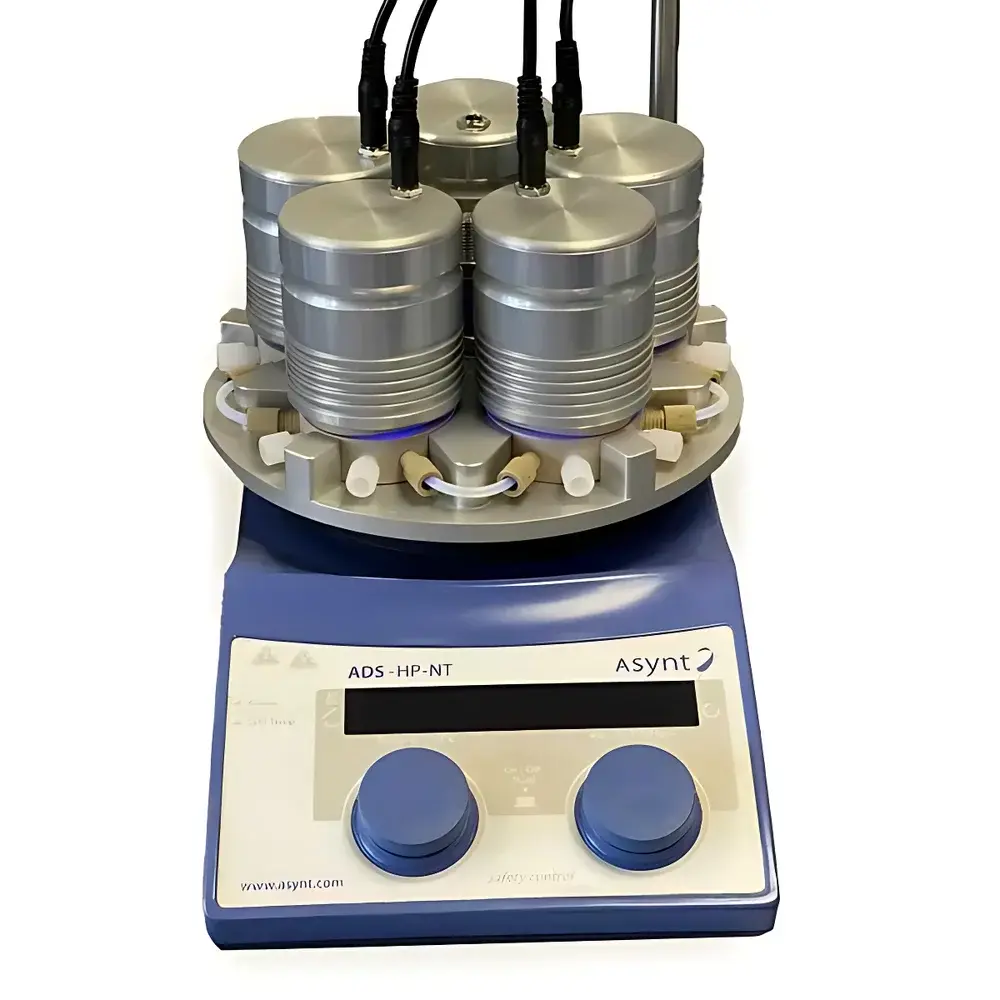
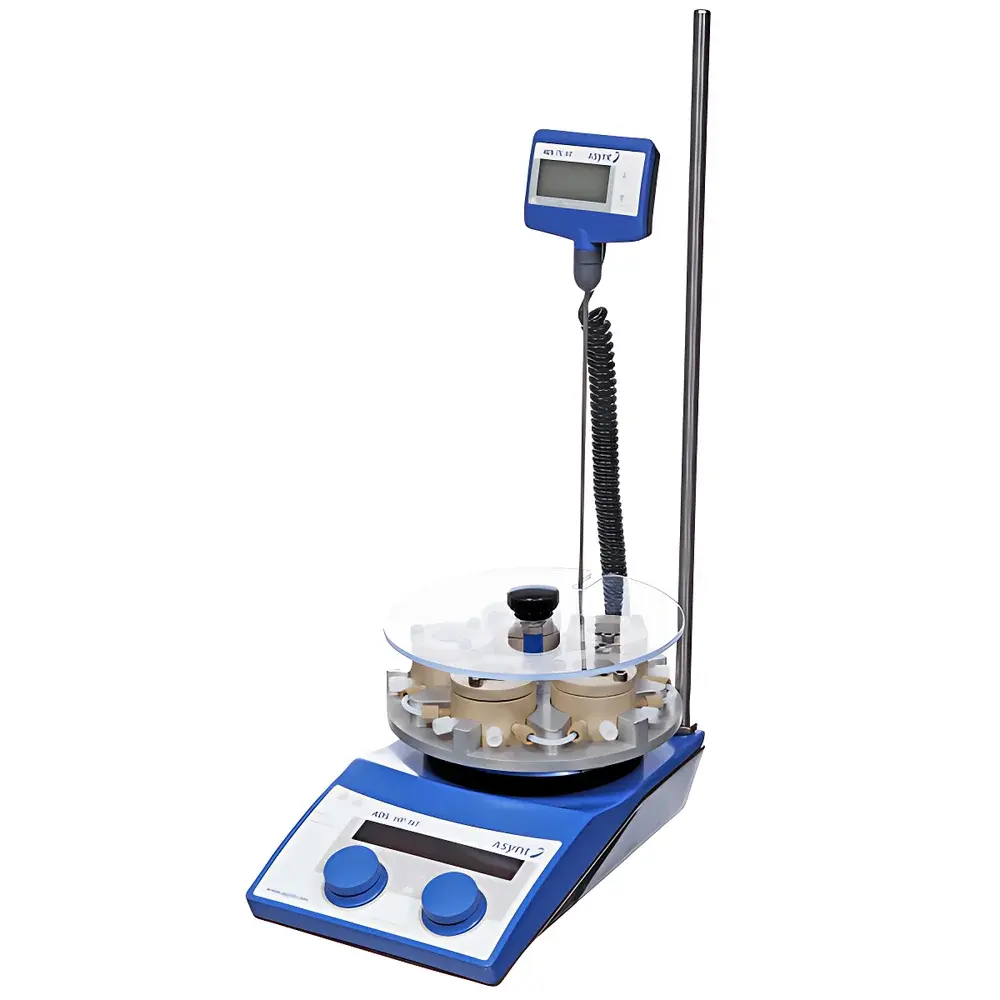
Asynt fReactor Modular Flow Chemistry System
| Brand | Asynt |
|---|---|
| Origin | United Kingdom |
| Manufacturer Type | Authorized Distributor |
| Product Origin | Imported |
| Model | fReactor |
| Price Range | USD 6,800 – 13,600 (est.) |
| Temperature Range | −40 °C to +200 °C |
| Temperature Control Accuracy | ±5% of setpoint |
| Reaction Modules | 5 |
| Total Reactor Volume (Classic) | 8.8 mL |
| Total Reactor Volume (Maxi) | 37.5 mL |
| Maximum Operating Pressure | 6.89 bar (100 psi) |
| Optical Wavelength Options | 364 nm (UV), 460 nm (Blue) |
| Construction Materials | PEEK body, tempered glass windows, standard FKM seals |
Overview
The Asynt fReactor is a modular, benchtop continuous flow chemistry platform engineered for synthetic method development, reaction screening, and process intensification in academic and industrial laboratories. Based on the cascade continuous stirred-tank reactor (CSTR) principle, the fReactor enables precise control over residence time distribution (RTD), mixing efficiency, thermal management, and mass transfer—critical parameters for reproducible and scalable chemical transformations. Developed in collaboration with the Institute for Process Research and Development at the University of Leeds, the system bridges the gap between traditional batch synthesis and high-throughput continuous processing. Its architecture supports both single-phase (homogeneous) and multiphase (liquid–liquid, solid–liquid, gas–liquid) reactions under controlled temperature and pressure conditions. With an operational pressure rating up to 6.89 bar and temperature capability from −40 °C to +200 °C, the fReactor accommodates exothermic, cryogenic, catalytic, photochemical, and heterogeneous reaction regimes without requiring custom engineering.
Key Features
- Modular 5-unit CSTR configuration with independent thermal and fluidic zones, enabling stepwise reaction control and segmented residence time profiling.
- Two core platforms: fReactor Classic (8.8 mL total volume, 1.75 mL per module) and fReactor Maxi (37.5 mL total volume, 7.5 mL per module), both sharing identical mounting geometry and baseplate compatibility.
- Robust construction using chemically resistant PEEK for wetted parts, tempered glass viewing windows for real-time visual monitoring, and FKM (fluoroelastomer) seals as standard—custom seal materials available upon request.
- Integrated photoflow modules featuring high-intensity, narrow-band LEDs (364 nm UV or 460 nm blue) with collimating optics, positioned directly above each reactor zone to ensure uniform photon flux delivery to the active mixing region.
- Four 1/4-28 flat-bottomed inlet ports per platform, supporting multi-stream reagent introduction, inline quenching, sampling loops, and integration with external sensors (e.g., pH, conductivity, FTIR flow cells).
- Compatible with standard laboratory hotplates, chillers, and circulators—no proprietary heating/cooling units required—reducing total cost of ownership and simplifying lab integration.
Sample Compatibility & Compliance
The fReactor accommodates a broad range of substrates, catalysts, and reagents common in modern synthetic organic chemistry, medicinal chemistry, and materials science—including air-sensitive organometallics (under inert atmosphere), slurries, enzymatic systems, and photoactive species. Its modular design permits rapid reconfiguration for varying stoichiometry, phase behavior, and kinetic profiles. The system complies with general laboratory safety standards for pressurized glass/PEEK apparatus (EN 61000-6-3, EN 61000-6-4). While not certified for GMP manufacturing, it supports GLP-aligned workflows through traceable parameter logging, manual calibration records, and consistent RTD validation protocols. When used with validated pumps and temperature controllers, the platform facilitates method development aligned with ICH Q5, Q8, and Q9 principles—particularly for reaction optimization and impurity profiling.
Software & Data Management
The fReactor operates as a hardware-centric platform with minimal embedded electronics; data acquisition and control are implemented externally via third-party instrumentation (e.g., syringe or HPLC pumps, PID temperature controllers, UV-Vis spectrophotometers). This architecture ensures full interoperability with existing lab infrastructure and avoids vendor lock-in. Users typically employ LabVIEW, Python (with PySerial/PyVISA), or commercial SCADA tools to log flow rates, temperature setpoints, pressure readings, and optical density changes. All mechanical components—including reactor modules, baseplates, and photoflow housings—are fully documented in STEP and PDF format for CAD-based experimental planning and audit readiness. No proprietary software license or cloud dependency is required.
Applications
- Reaction screening and kinetic profiling across temperature, residence time, and stoichiometric gradients.
- Photochemical synthesis—including [2+2] cycloadditions, C–H functionalizations, and photocatalytic reductions—enabled by integrated LED modules.
- Heterogeneous catalysis (e.g., Pd/C hydrogenations, enzyme immobilization studies) leveraging enhanced mass transfer in multiphase CSTR cascades.
- Crystallization process development, where controlled supersaturation and nucleation timing are achieved via sequential temperature and concentration modulation.
- Sustainable chemistry workflows: reduced solvent consumption, improved atom economy, and inherently safer handling of energetic intermediates (e.g., diazonium salts, acyl nitrates).
- Teaching and training in flow chemistry fundamentals—ideal for undergraduate and graduate laboratory curricula due to its intuitive layout and mechanical transparency.
FAQ
What types of reactions are most suitable for the fReactor platform?
The fReactor excels in reactions benefiting from controlled residence time, improved heat/mass transfer, or photochemical activation—including oxidations, reductions, condensations, photoinduced cyclizations, and enzymatic transformations.
Can the fReactor be used under inert or anhydrous conditions?
Yes—standard configurations include Swagelok-compatible fittings and optional glovebox-compatible feed lines. Sealing integrity has been verified under nitrogen and argon atmospheres at rated pressure.
Is the system compatible with real-time analytical monitoring?
Absolutely—four dedicated inlet/outlet ports per platform allow seamless integration with inline IR, UV-Vis, or Raman flow cells, as well as automated fraction collectors.
How is temperature calibrated and maintained across modules?
Each module is thermally isolated; temperature uniformity is ensured by placing the baseplate on a calibrated circulating bath or hotplate. Calibration follows ASTM E74 or ISO 17025-compliant procedures using NIST-traceable PT100 probes.
Are spare parts and consumables readily available?
All reactor modules, seals, glass windows, and photoflow LEDs are stocked globally by Asynt’s authorized distributors, with typical lead times under 10 business days.



