
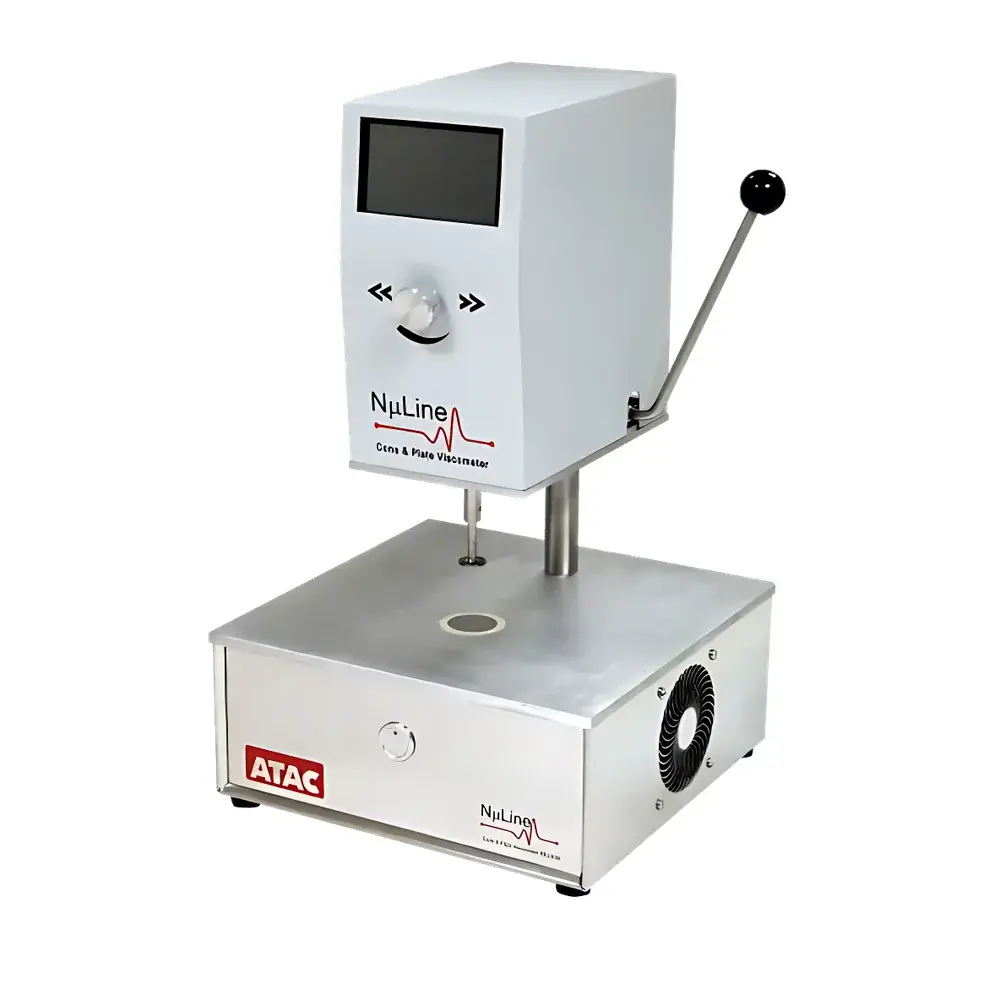
ATAC Nuline REL0230 High-Temperature Cone-and-Plate Rotational Viscometer
| Brand | ATAC |
|---|---|
| Origin | United Kingdom |
| Model | REL0230 |
| Temperature Range | Ambient to 230 °C (no cooling) |
| Sample Volume | 0.2 mL |
| Compliance | BS EN ISO 2884-1:2006 |
| Temperature Accuracy | ±0.1 °C |
| Speed Range | 5–900 rpm (integer steps) |
| Viscosity Accuracy | ±2% of full scale (calibrated with standard oils) |
| Display | 4.3″ color LCD |
| Data Interface | USB |
| Power Supply | 100–240 V AC, 50/60 Hz, 150 W |
| Dimensions (H×W×D) | 510 × 302 × 302 mm |
| Weight | 13.0 kg |
Overview
The ATAC Nuline REL0230 is a precision-engineered cone-and-plate rotational viscometer designed for high-temperature rheological characterization of structured and thermally sensitive fluids. Operating on the fundamental principle of controlled shear flow between a rotating conical rotor and a stationary flat plate, the instrument delivers highly reproducible viscosity measurements under defined shear rate conditions—critical for materials exhibiting non-Newtonian behavior. Its extended operational temperature range (ambient to 230 °C without external cooling) enables direct assessment of thermal stability, curing kinetics, and high-temperature processing behavior in industrial formulations. Developed as a modern evolution of the historic REL series—the original reference instrument specified in BS 3900—this model maintains metrological continuity while integrating digital control, multi-rotor flexibility, and traceable calibration architecture compliant with international standards including BS EN ISO 2884-1:2006.
Key Features
- High-temperature capability up to 230 °C with ±0.1 °C thermal stability and programmable ramp profiles
- 4.3-inch full-color LCD interface with intuitive menu navigation and real-time parameter visualization
- Multi-rotor support: stores calibration data for up to six distinct cone geometries (e.g., 1°, 2°, 4° cones), enabling rapid interchange without recalibration
- Dual-speed resolution modes: coarse (5–900 rpm, integer steps) and fine (5–90 rpm, 0.1 rpm increments) for low-shear sensitivity
- Minimal sample requirement of only 0.2 mL—ideal for precious or hazardous formulations
- Automatic zeroing and pressure-insensitive torque sensing ensure measurement integrity in presence of particulates or surface contaminants
- USB interface supporting PC-based data acquisition, time-series plotting, shear rate vs. viscosity curves, and export-compatible CSV logging
- Full-range accuracy of ±2% FS (verified using NIST-traceable standard oils per ISO 3219)
Sample Compatibility & Compliance
The REL0230 is routinely deployed across paint & coatings, polymer resins, pharmaceutical suspensions, asphalt binders, food emulsions, and adhesive systems—where thermal history and shear-thinning/thickening responses directly impact end-use performance. Its cone-and-plate geometry ensures uniform shear rate distribution and eliminates wall-slip artifacts common in coaxial cylinder configurations. The instrument meets the geometric and procedural requirements of BS EN ISO 2884-1:2006 for viscosity determination of paints and varnishes. While not inherently 21 CFR Part 11–compliant, its software architecture supports audit-trail-ready data capture when integrated with validated laboratory information management systems (LIMS). All calibrations are documented against certified reference materials, facilitating GLP/GMP-aligned validation protocols.
Software & Data Management
The included PC interface software provides real-time graphical display of viscosity, shear rate, temperature, and elapsed time. Users may define custom test sequences—including multi-step temperature ramps coupled with variable speed profiles—and store results with metadata (operator ID, sample ID, calibration ID, timestamp). Raw data files retain full instrumental resolution and are exportable in ASCII/CSV format for downstream statistical analysis (e.g., power-law fitting, Arrhenius modeling). Firmware updates and calibration coefficient uploads are performed via secure USB connection. No cloud dependency or subscription licensing is required—ensuring long-term operational autonomy and data sovereignty.
Applications
- Quality control of thermosetting resin viscosity during pre-polymerization stages
- Thermal degradation profiling of bituminous binders at elevated service temperatures
- Yield stress estimation of pharmaceutical gels via controlled shear startup tests
- Shear-thinning index (n-value) derivation from steady-state flow curves in inkjet inks
- Accelerated aging studies of adhesives under isothermal hold conditions
- Validation of rheological models (e.g., Cross, Carreau-Yasuda) for process simulation inputs
FAQ
What is the minimum sample volume required for reliable measurement?
0.2 mL is sufficient for all standard cone geometries; this minimizes material waste and enables testing of high-value or restricted substances.
Can the REL0230 operate under inert atmosphere or vacuum?
No—this model is configured for ambient-pressure operation only; optional glove-box integration requires external environmental enclosure.
Is temperature calibration traceable to national standards?
Yes—factory calibration uses PT100 sensors calibrated against UKAS-accredited references; users may perform in-house verification using certified thermometer standards.
Does the instrument support dynamic oscillatory testing?
No—this is a steady-shear rotational viscometer; it does not provide storage/loss modulus (G′/G″) or frequency sweep capabilities.
How is compliance with ISO 2884-1 verified during routine use?
Verification includes geometric inspection of cone angle tolerance (±0.02°), gap setting repeatability (<±1 µm), and viscosity recovery tests using certified mineral oil standards across three shear rates.



