
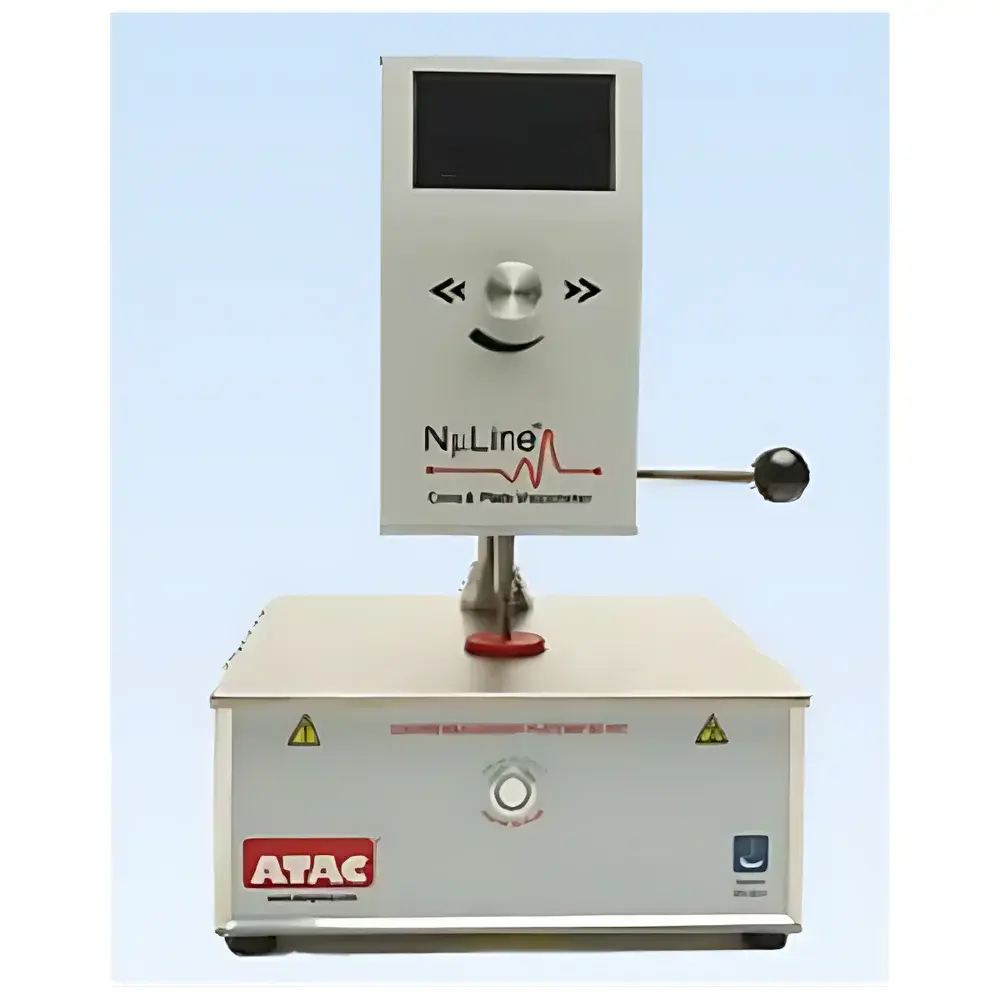
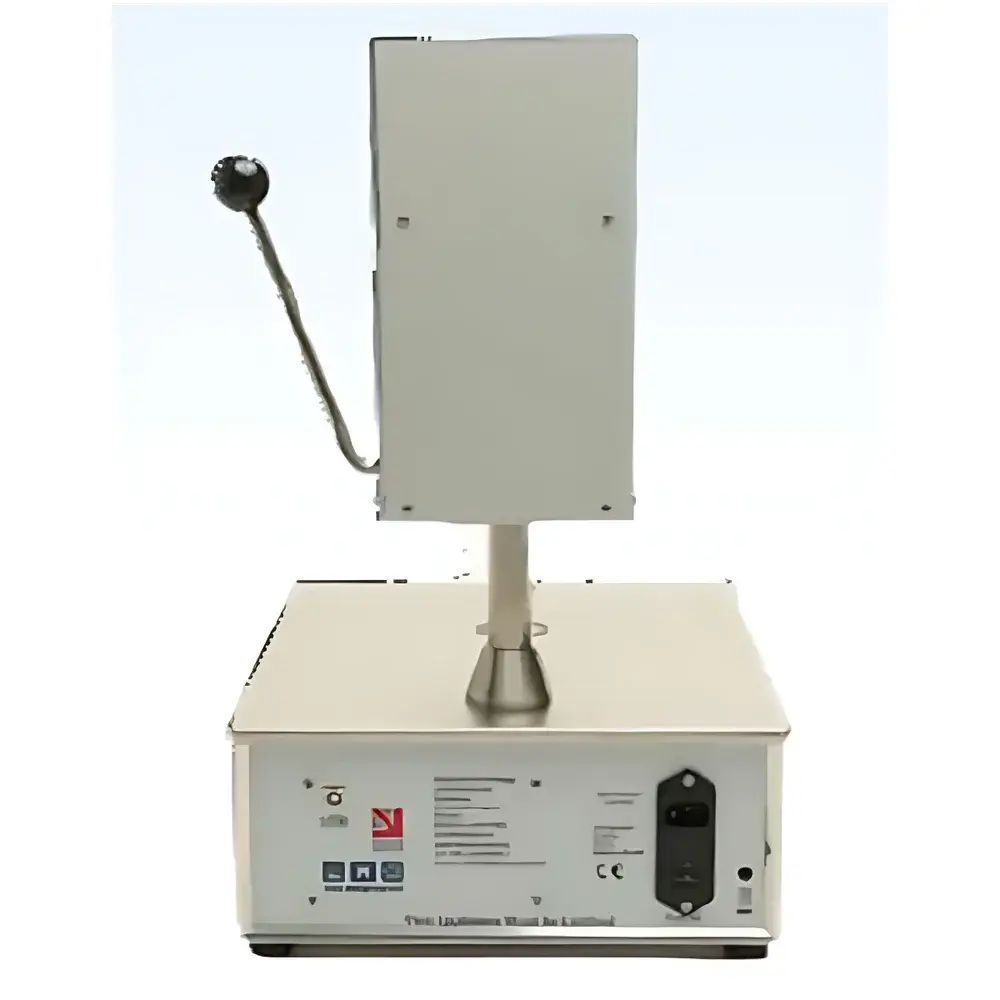
ATAC REL0150 Cone-Plate Viscometer
| Brand | ATAC |
|---|---|
| Origin | United Kingdom |
| Model | REL0150 |
| Instrument Type | Oscillatory Cone-Plate Viscometer |
| Portability | Portable |
| Operating Environment | Ambient Temperature |
| Display | 4.3-inch Color LCD |
| Speed Range | 5–900 rpm (Low-Speed Mode: 5–90 rpm, Adjustable in 0.1-rpm Increments) |
| Accuracy | ±1% (Calibrated with Standard Reference Oils) |
| Compliance | BS EN ISO 2884-1:2006 |
| Cone Options | Six Interchangeable Cones |
| Calibration | Onboard Auto-Calibration for Multiple Cone Geometries |
| Connectivity | PC Interface via USB/RS-232 for Data Acquisition and Analysis |
| Software Features | Real-Time Shear Rate vs. Time Plotting, Multi-Format Data Export (CSV, TXT, XLS), Temperature-Compensated Viscosity Readout, Unit Selection (mPa·s, cP, Pa·s) |
Overview
The ATAC REL0150 Cone-Plate Viscometer is a precision-engineered, portable rotational viscometer designed for high-fidelity viscosity characterization under controlled shear conditions. Based on the classical cone-and-plate geometry, it operates on the principle of steady-state shear rheometry—where torque exerted by a rotating cone over a fixed plate is measured to determine dynamic viscosity as a function of applied shear rate. This geometry ensures uniform shear rate distribution across the sample gap, eliminating edge effects and enabling accurate measurement of Newtonian and mildly non-Newtonian fluids. Developed by ATAC (United Kingdom), the REL0150 directly inherits the metrological legacy of the historic REL series—originally specified as the reference instrument for BS 3900 (now superseded by BS EN ISO 2884-1:2006). Its compact architecture supports benchtop deployment in QC laboratories, production floors, and field-based technical service environments without compromising traceable accuracy.
Key Features
- Interchangeable cone system: Six calibrated cones available, each optimized for distinct viscosity ranges—enabling single-instrument coverage from low-viscosity solvents (e.g., thin solvents, inks) to highly viscous resins and bituminous materials.
- Onboard auto-calibration: Eliminates manual calibration drift; automatic recognition and parameter loading for each cone geometry ensure consistent measurement traceability across configurations.
- High-resolution speed control: Full-speed range of 5–900 rpm with fine-grained low-speed mode (5–90 rpm, adjustable in 0.1-rpm increments), supporting both rapid screening and slow-shear stability assessment.
- Integrated 4.3-inch color LCD: Provides real-time display of viscosity (mPa·s, cP, Pa·s), shear rate (s⁻¹), temperature (°C), and elapsed time—without requiring external software.
- Temperature-aware operation: Designed for ambient-temperature use (15–30°C); compatible with optional external Peltier-controlled plates or circulating baths for regulated thermal testing (not included).
- Compliance-ready firmware: Built-in audit trail support for GLP/GMP-aligned workflows; all measurements timestamped and stored with cone ID, speed, and unit configuration.
Sample Compatibility & Compliance
The REL0150 is validated for use with homogeneous, non-particulate liquids—including solvent-borne and water-based paints, varnishes, printing inks, synthetic resins, edible oils, pharmaceutical suspensions, adhesives, and petroleum distillates. It is not suitable for highly filled systems (>10 vol% solids), fibrous suspensions, or thermally unstable samples requiring precise temperature ramping. Regulatory alignment includes full conformance with BS EN ISO 2884-1:2006 (“Paints and varnishes — Determination of viscosity using rotary viscometers — Part 1: Cone-and-plate viscometers”), ensuring data acceptance in UK and EU regulatory submissions. While not intrinsically 21 CFR Part 11 compliant, its PC interface software supports electronic signature-capable data export when integrated into validated laboratory information management systems (LIMS).
Software & Data Management
The REL0150 interfaces with proprietary Windows-based acquisition software via USB or RS-232. The application enables real-time plotting of viscosity versus shear rate and time, generation of flow curves (τ vs. γ̇), and calculation of apparent viscosity at user-defined shear rates. All raw data—including torque, angular velocity, temperature (if external probe connected), and cone identification—are logged with millisecond timestamps. Export formats include CSV (for Excel and statistical packages), plain-text reports, and native .rel binary files for archival integrity. Data files retain metadata required for ISO/IEC 17025 audit trails, including operator ID, instrument serial number, calibration date, and environmental conditions.
Applications
- Quality control of coating formulations per ASTM D1084 and ISO 2884-1 protocols.
- Routine monitoring of ink rheology during gravure and flexographic printing process development.
- Stability assessment of food emulsions (e.g., salad dressings, sauces) under low-shear storage conditions.
- Batch release testing of pharmaceutical ointments and topical gels where shear-thinning behavior impacts dosing consistency.
- Bitumen modification evaluation in road construction labs, particularly for polymer-modified binders requiring shear-sensitive characterization.
- Educational use in university rheology laboratories for teaching fundamental principles of shear-dependent viscosity and cone-plate geometry advantages.
FAQ
Is the REL0150 suitable for measuring yield stress?
No—the REL0150 is a steady-shear viscometer and does not perform controlled-stress ramp tests; yield stress determination requires a dedicated rheometer with stress-controlled capability.
Can I use this instrument with non-standard cone geometries?
Only ATAC-certified cones are supported; third-party cones invalidate calibration and void compliance with BS EN ISO 2884-1:2006.
Does the device store measurement history internally?
Yes—up to 500 test records are retained in non-volatile memory, each with full parameter metadata and timestamp.
What is the minimum sample volume required?
Approximately 0.5 mL for standard 40-mm-diameter cones; volume scales linearly with cone radius squared.
Is temperature control built into the instrument?
No—ambient-temperature operation only; external temperature regulation requires integration with a compatible Peltier stage or fluid-circulated plate (sold separately).



