
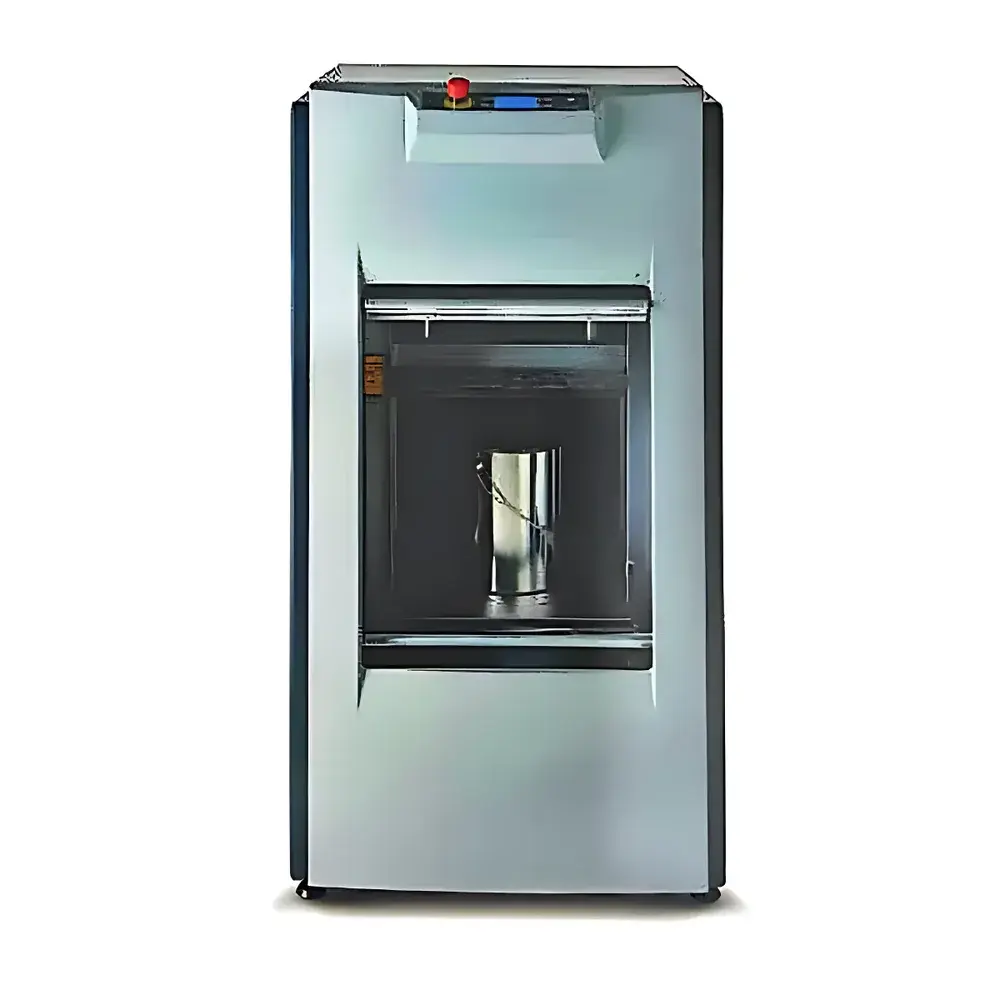
ATAC SK550 1.1 Fully Automatic Orbital Shaker
| Brand | ATAC |
|---|---|
| Origin | Netherlands |
| Model | SK550 1.1 |
| Operating Mode | Continuous Oscillation |
| Speed Range | 400–700 rpm |
| Oscillation Type | Reciprocating |
| Amplitude | 20 cm |
| Display | LED |
| Ambient Temperature Range | −10 to +60 °C |
| Max Load Capacity | 40 kg |
| Dimensions (L×W×H) | 72 × 61 × 116 cm |
| Height Adjustment Range | 6–45 cm |
| Control Interface | 4 Preset Timers, Bidirectional Oscillation Optional, Auto High/Low Container Detection, Integrated USB Port for Service Diagnostics |
| Construction Material | Metal Frame with Reinforced Structural Components |
| Drive System | Servo-Controlled Variable-Frequency Motor with Soft-Start Function |
Overview
The ATAC SK550 1.1 Fully Automatic Orbital Shaker is an industrial-grade laboratory shaker engineered for high-mass, long-duration mixing applications requiring precise mechanical reproducibility and operational robustness. Unlike conventional vortex or orbital mixers designed for microcentrifuge tubes or small flasks, the SK550 1.1 employs a servo-driven reciprocating oscillation mechanism—distinct from rotary or orbital motion—with a fixed 20 cm amplitude and speed control ranging from 400 to 700 rpm. This design delivers consistent linear inertial force distribution across large-volume containers, enabling uniform suspension, homogenization, and dissolution of viscous or particulate-laden samples up to 40 kg. Its structural architecture integrates load-bearing steel framing, dynamically balanced drive transmission, and adaptive container-height compensation (6–45 cm), making it suitable for integration into QC laboratories, formulation development workflows, and GMP-compliant material processing environments where mechanical stability and repeatable agitation profiles are critical.
Key Features
- Servo-controlled variable-frequency motor with programmable soft-start ramping to prevent sample splashing and mechanical shock during initiation
- Auto-detecting dual-clamp system that identifies container height and mass range (high/low profile) to optimize oscillation torque and stroke alignment
- Integrated LED display with intuitive navigation for real-time speed monitoring, elapsed time tracking, and selection among four user-defined timer presets
- Metal-reinforced chassis with vibration-dampened base mounting and precision-machined support rollers for secure placement and lateral stability of cylindrical or rectangular vessels
- Bidirectional oscillation mode (optional configuration) for enhanced particle dispersion in heterogeneous suspensions containing sediment-prone additives
- USB service interface compliant with standard serial communication protocols (RS-232 over USB-C), enabling firmware updates, diagnostic logging, and remote calibration verification by authorized service engineers
Sample Compatibility & Compliance
The SK550 1.1 accommodates a broad spectrum of container geometries—including stainless-steel drums (up to 200 L), polyethylene IBC totes, glass carboys, and custom-engineered process vessels—provided they fall within the specified height (6–45 cm) and weight (≤40 kg) limits. Its reciprocating motion profile ensures effective mixing without inducing excessive shear, preserving shear-sensitive biopolymers, emulsions, or cell suspensions. The unit meets CE marking requirements for electromagnetic compatibility (EN 61326-1) and low-voltage safety (EN 61010-1). While not intrinsically rated for hazardous locations, its metal enclosure and thermal management system (operable from −10 to +60 °C ambient) support deployment in controlled cold rooms, cleanrooms (ISO Class 8), and regulated manufacturing suites aligned with ISO 9001 and ISO/IEC 17025 quality frameworks.
Software & Data Management
The SK550 1.1 does not include embedded data acquisition software but provides full USB-based service diagnostics via ATAC’s proprietary maintenance toolkit (v3.2+), distributed under NDA to certified service partners. This toolkit supports audit-trail generation for calibration events, motor performance trending, and error-code decoding—enabling compliance with GLP documentation standards and internal equipment qualification (IQ/OQ/PQ) procedures. For laboratories requiring electronic record retention, the shaker can be interfaced with third-party LIMS or MES platforms through discrete digital I/O signals (optional relay module) or via external PLC integration using Modbus RTU over RS-485 (hardware add-on).
Applications
- Homogenization of high-viscosity pharmaceutical suspensions prior to fill-finish operations
- Reconstitution and dispersion of dry-powder adjuvants in vaccine formulation processes
- Stabilization of polymer blends and nanocomposite slurries in R&D-scale material synthesis
- Uniform wetting and deagglomeration of catalyst powders in fine chemical batch reactors
- Pre-analytical sample conditioning for environmental soil extracts and wastewater sludge homogenates
- Long-term stability testing of topical gels and ointments under controlled temperature-humidity cabinets
FAQ
What types of containers can be used with the SK550 1.1?
Standard cylindrical drums (20–200 L), square/rectangular IBCs, glass carboys (with reinforced bases), and custom fixtures with flat-bottomed contact surfaces are compatible—provided height remains between 6 cm and 45 cm and total mass does not exceed 40 kg.
Is the SK550 1.1 suitable for use in cold rooms or incubators?
Yes—the unit is rated for continuous operation at ambient temperatures as low as −10 °C and as high as +60 °C, with condensation-resistant electronics and non-hygroscopic metal housing.
Does the shaker support regulatory-compliant data integrity practices?
While the device lacks onboard data logging, its USB diagnostic port enables traceable service records, and optional I/O modules allow integration into 21 CFR Part 11–compliant systems when paired with validated external controllers.
Can oscillation direction be reversed during operation?
Bidirectional oscillation is available as a factory-configurable option; reversal is not user-triggered mid-cycle but pre-programmed per protocol via service-mode configuration.
What maintenance intervals are recommended for sustained performance?
ATAC recommends biannual inspection of drive belt tension, roller bearing lubrication, and clamp actuator responsiveness—documented in accordance with ISO 55001 asset management guidelines.



