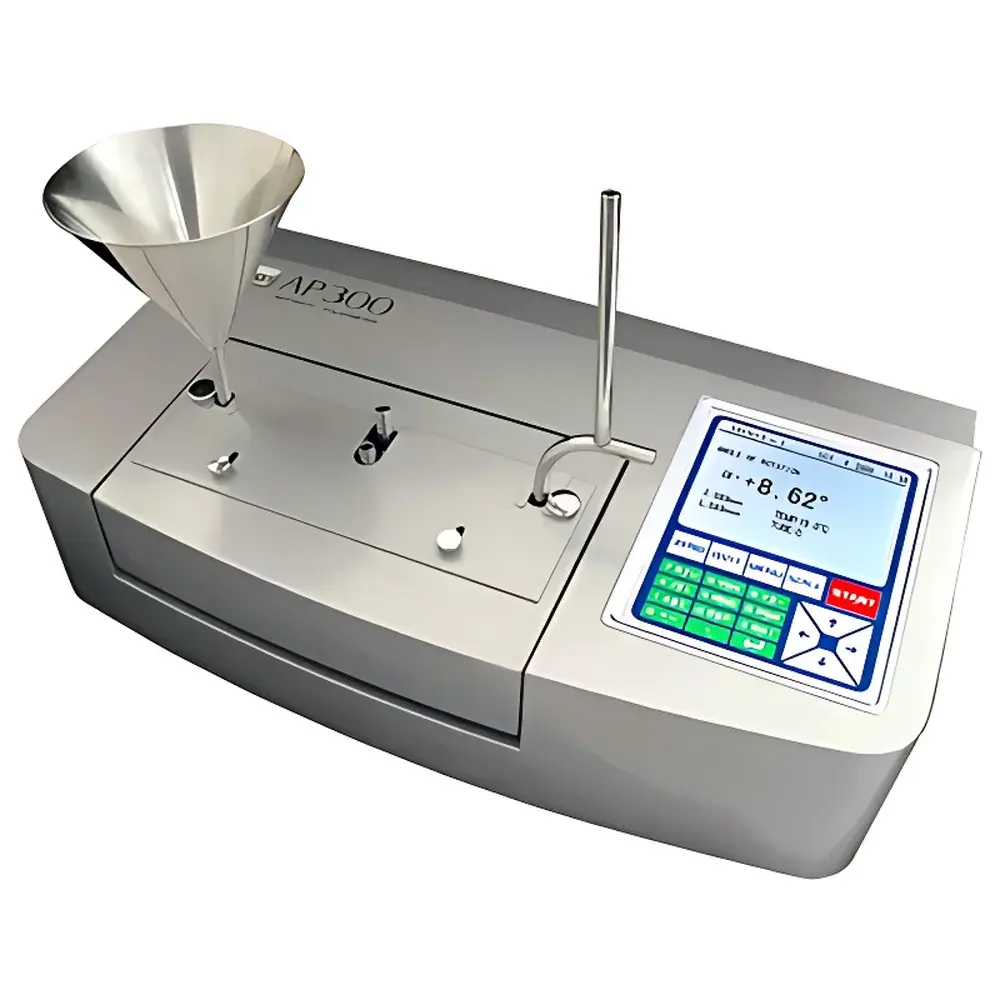
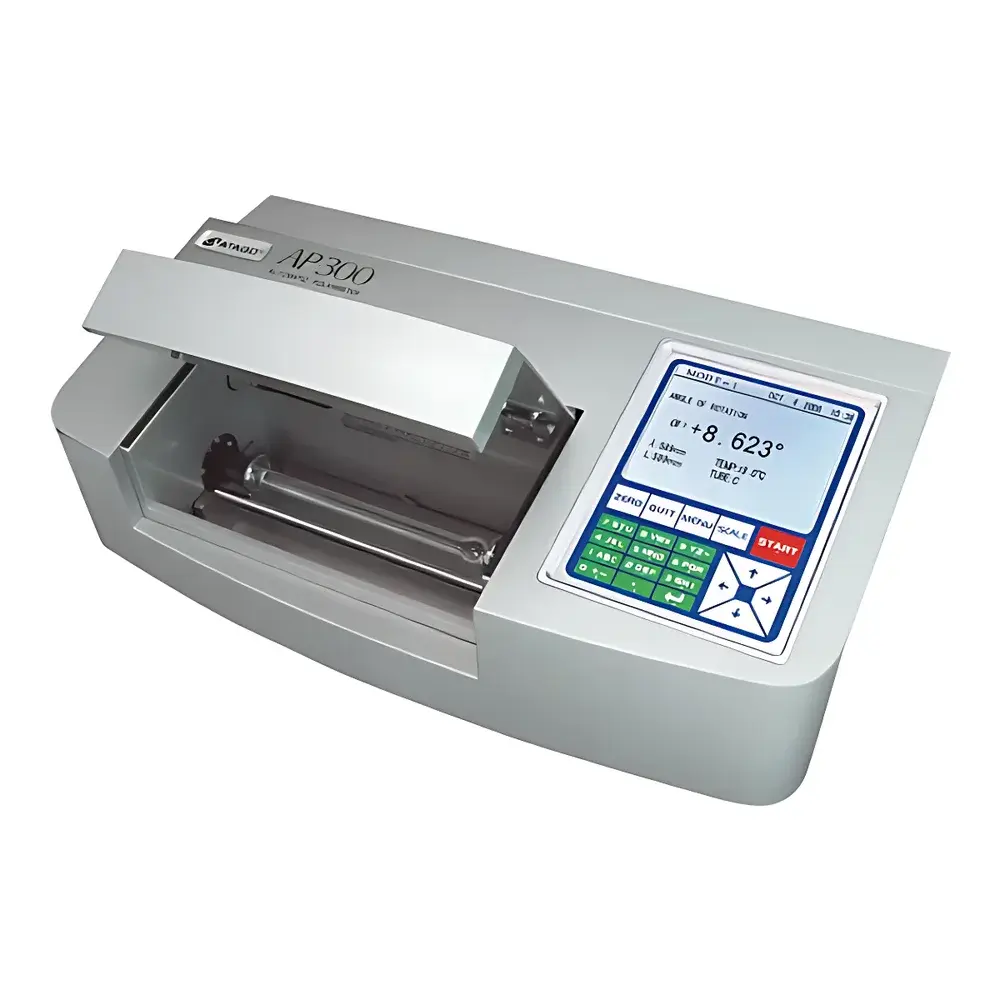
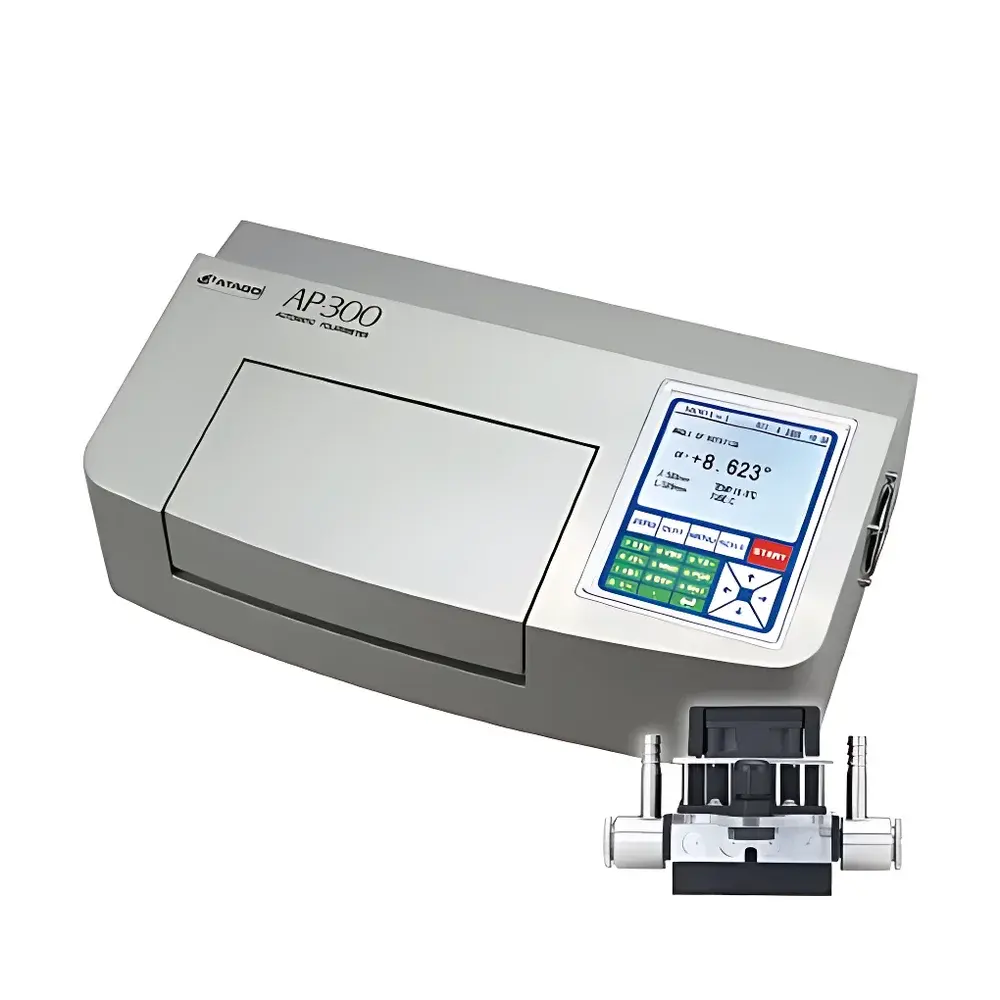
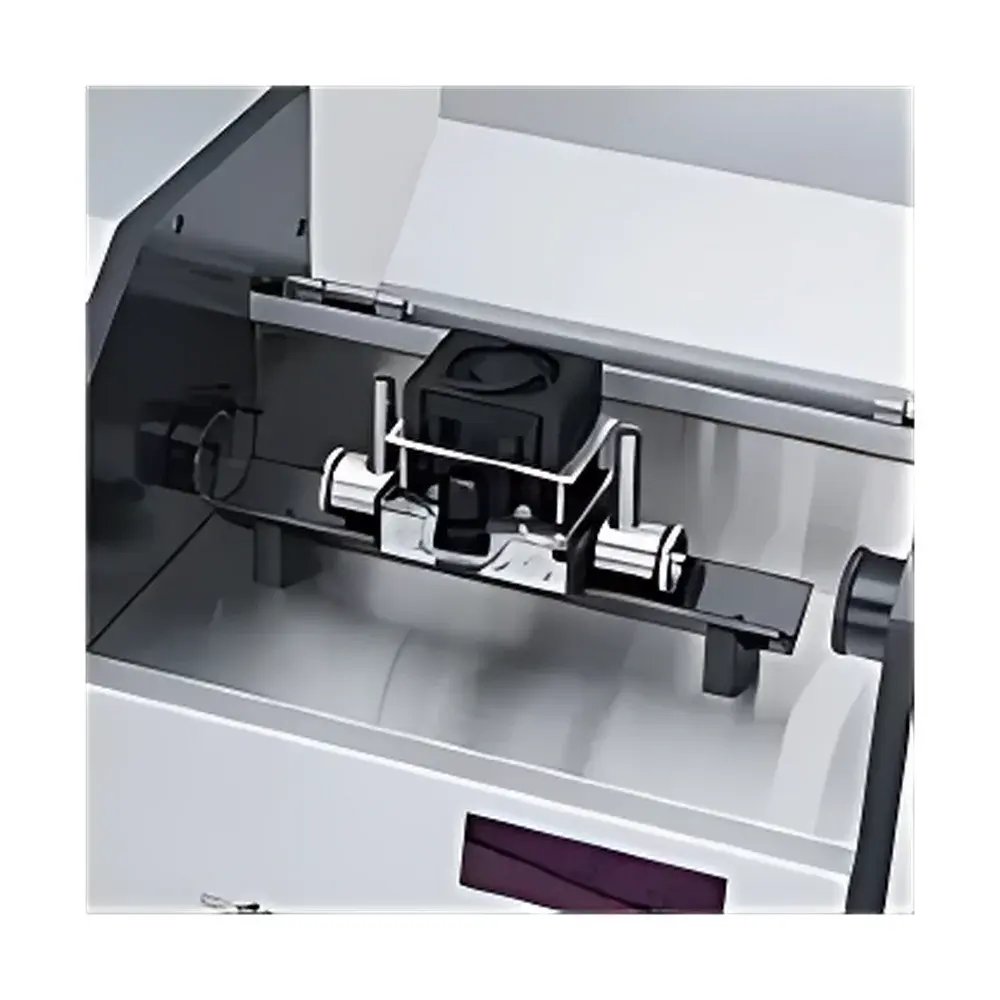
ATAGO AP-300 Automated Temperature-Controlled Polarimeter
| Key | Brand: ATAGO |
|---|---|
| Origin | Japan |
| Instrument Type | Automatic Polarimeter |
| Temperature Control | Yes (10.0–30.0 °C) |
| Display | Color Backlit LCD |
| Light Source | White LED (589 nm, approx. Na D-line) |
| Optical Rotation Range | –89.999 to +89.999° |
| International Standard Sugar Scale (ISS) Range | –130.000 to +130.000°Z |
| Optical Rotation Accuracy | ±0.01° (±0.2% outside ±35.00°) |
| ISS Accuracy | ±0.03°Z (±0.2% outside ±101.00°Z) |
| Resolution | 0.001° / 0.01° / 0.1° (selectable) |
| ISS Resolution | 0.001°Z / 0.01°Z / 0.1°Z (selectable) |
| ISS Temp. Compensation Range | 18.0–30.0 °C |
| Temp. Display Res./Acc. | 0.1 °C / ±0.5 °C |
| Data Storage | 30 measurement records |
| Interface | RS-232C (printer & PC) |
| Power | AC 100–240 V, 50/60 Hz, 140 VA |
| Dimensions (W×D×H) | 48.5 × 28.5 × 17.5 cm |
| Weight | 14.4 kg (main unit only) |
Overview
The ATAGO AP-300 Automated Temperature-Controlled Polarimeter is a precision optical instrument engineered for quantitative determination of optical rotation and International Standard Sugar Scale (ISS) values in regulated industrial and research environments. Based on the fundamental principle of polarimetry—measuring the angular rotation of plane-polarized light induced by optically active compounds—the AP-300 delivers traceable, reproducible measurements critical for quality control, identity verification, and concentration quantification. Its operation conforms to established physical optics standards, utilizing a stable white LED source centered at 589 nm (approximating the sodium D-line), ensuring spectral consistency without lamp aging or thermal drift. The instrument supports dual-mode measurement: direct optical rotation (α) in degrees and temperature-compensated ISS values in °Z—both traceable to ICUMSA (International Commission for Uniform Methods of Sugar Analysis) Method GS4/3-11 and aligned with ISO 5725 (accuracy and precision of measurement methods). Designed for routine use in GMP-compliant facilities, the AP-300 integrates hardware-level temperature stabilization (10.0–30.0 °C) and software-based temperature compensation (18.0–30.0 °C for ISS), eliminating manual correction and reducing inter-operator variability.
Key Features
- Automated temperature-controlled sample chamber with integrated Peltier-based SAC unit (optional or bundled), enabling precise thermal regulation within ±0.5 °C across the full operational range.
- Selectable resolution modes (0.001°, 0.01°, or 0.1° for optical rotation; equivalent for ISS) allow optimization between sensitivity and display clarity based on application requirements.
- Compliance-ready architecture supporting FDA 21 CFR Part 11 through password-protected user access, audit-trail-capable data logging (30 stored records), and electronic signature functionality via optional software integration.
- Intuitive color backlit LCD interface with dedicated soft keys for rapid navigation, real-time temperature readout, and simultaneous display of multiple calculated parameters (e.g., α, [α], concentration, purity).
- Multi-parameter calculation engine: automatically computes specific rotation ([α]), concentration (g/100 mL), purity (% w/w), and ISS from raw rotation data using user-defined pathlength, wavelength, and temperature inputs.
- RS-232C serial interface enables direct connection to laboratory printers or LIMS-compatible PCs for automated report generation and long-term data archival.
Sample Compatibility & Compliance
The AP-300 accommodates standard 100 mm (5 mL) and 200 mm (10 mL) sealed quartz or glass polarimeter tubes, compatible with aqueous solutions, ethanol extracts, syrups, pharmaceutical suspensions, and essential oil distillates. Its measurement methodology satisfies key international regulatory benchmarks: ICUMSA GS4/3-11 for sugar analysis in cane and beet processing; USP and Ph. Eur. 2.2.7 for optical rotation in monograph-defined APIs; and ISO 11348 for chiral compound verification in fine chemical synthesis. All accuracy specifications are validated per ISO/IEC 17025 guidelines using NIST-traceable quartz calibration plates under controlled ambient conditions (23 ± 2 °C, 50 ± 10% RH). The system’s temperature compensation algorithm adheres strictly to ICUMSA-defined polynomial coefficients for sucrose solutions between 18.0 °C and 30.0 °C.
Software & Data Management
While the AP-300 operates as a standalone instrument, its RS-232C port facilitates seamless integration with third-party laboratory informatics systems. Measurement data—including timestamp, operator ID (via password entry), temperature, raw rotation value, ISS result, and derived parameters—is transmitted in ASCII format with configurable delimiter settings. When deployed in regulated environments, users may implement external software compliant with 21 CFR Part 11 for electronic record retention, including secure user authentication, immutable audit trails, and version-controlled method files. Internal memory retains up to 30 complete measurement sets with full metadata, accessible via on-device review or export. Manual calibration is performed using certified quartz control plates (e.g., ATAGO QP-100 series), with results logged alongside date and operator ID.
Applications
- Pharmaceutical QC: Identity testing and assay of chiral active pharmaceutical ingredients (e.g., levodopa, ibuprofen, chloramphenicol) per USP/EP monographs requiring specific rotation verification.
- Flavor & Fragrance Industry: Quantitative assessment of enantiomeric excess (ee) in terpenes (e.g., limonene, pinene), citral isomers, and synthetic musks where optical purity directly correlates with olfactory profile and stability.
- Sugar Refining & Beet/Cane Processing: Real-time ISS monitoring during affination, carbonatation, and crystallization stages to optimize yield and detect adulteration or inversion.
- Food & Beverage R&D: Monitoring sucrose hydrolysis kinetics in invert syrup production, honey authenticity screening (via anomalous ISS deviations), and quality grading of maple syrup and agave nectar.
- Biotechnology: Enzymatic reaction monitoring (e.g., glucose isomerase activity) through time-resolved optical rotation changes in substrate-to-product conversion assays.
FAQ
Does the AP-300 meet FDA 21 CFR Part 11 requirements?
Yes—the instrument supports electronic signatures, role-based password protection, and secure data storage. Full Part 11 compliance requires configuration of external validated software for audit trail management and electronic record archiving.
What is the difference between optical rotation (α) and specific rotation ([α])?
Optical rotation (α) is the measured angle in degrees under defined conditions (pathlength, concentration, temperature, wavelength); specific rotation ([α]) is the normalized value calculated as [α] = 100α / (c × l), where c is concentration (g/100 mL) and l is pathlength (dm), enabling cross-laboratory comparability.
Can the AP-300 measure samples below 18 °C?
The instrument operates physically from 10.0 °C, but ISS temperature compensation is only validated and applied between 18.0 °C and 30.0 °C per ICUMSA standards; measurements outside this range require manual correction using published sucrose temperature coefficients.
Is calibration traceable to national standards?
Yes—ATAGO provides NIST-traceable quartz calibration plates (e.g., QP-100 series) with individual certificates of calibration, and all factory verification follows ISO/IEC 17025-accredited procedures.
How does the AP-300 handle viscous or turbid samples?
The instrument measures only optically transparent, non-scattering solutions. For turbid or highly viscous samples, filtration, dilution, or centrifugation is required prior to analysis to ensure beam transmission integrity and avoid photometric error.