
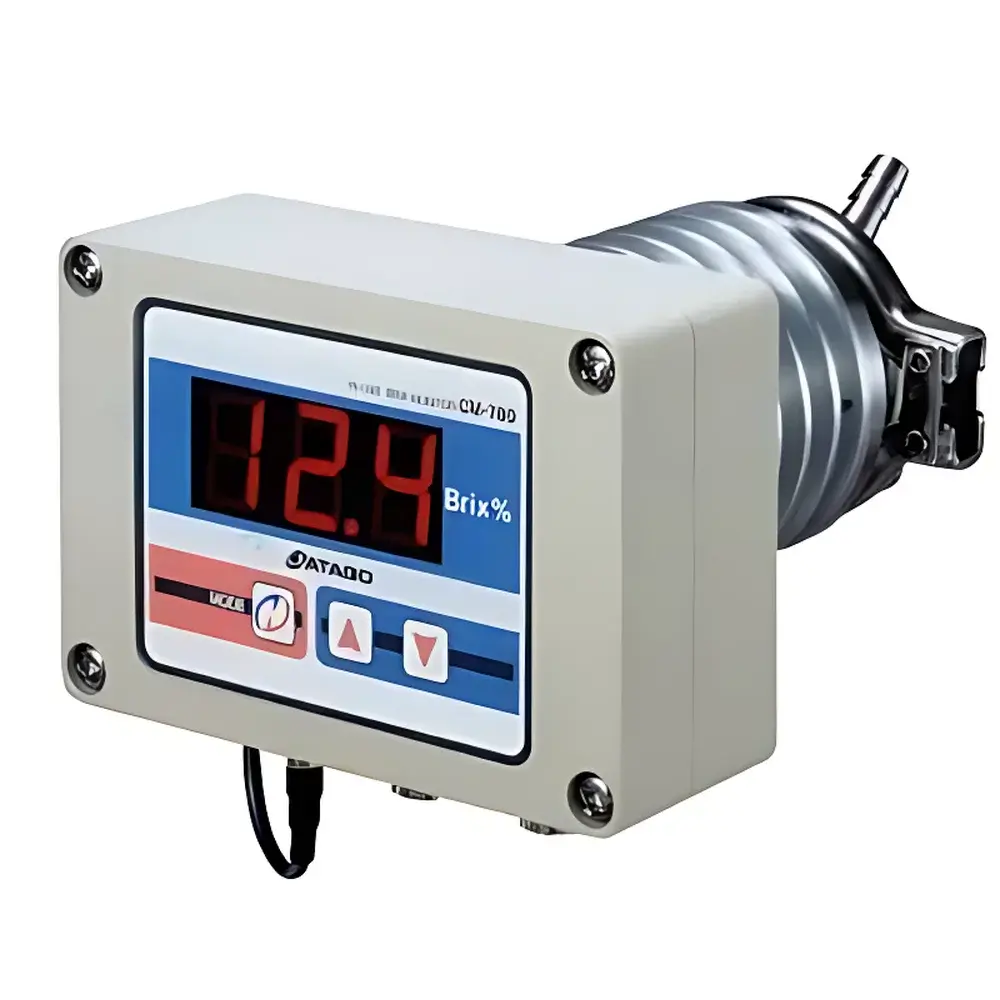
ATAGO CM-780 In-Line Brix Refractometer
| Brand | ATAGO |
|---|---|
| Origin | Japan |
| Model | CM-780 |
| Measurement Range | 0.0–78.0% Brix |
| Resolution | 0.1% Brix |
| Accuracy | ±0.2% Brix |
| Temperature Compensation | Automatic, 5–60 °C |
| Prism Material | Sapphire |
| Wetted Parts | SUS316 Stainless Steel |
| Output Interfaces | RS-232C, 4–20 mA analog (DC) |
| Power Supply | DC 24 V |
| Compliance | Designed for continuous industrial process monitoring in food, beverage, and chemical manufacturing environments |
Overview
The ATAGO CM-780 In-Line Brix Refractometer is an industrial-grade optical process analyzer engineered for real-time, non-invasive measurement of soluble solids concentration—expressed as % Brix—in flowing liquid streams. Based on the principle of critical-angle refractometry, the instrument directs a collimated light beam through a sapphire prism in direct contact with the process fluid; the resulting refraction angle is precisely correlated to the solution’s refractive index, which is linearly related to Brix under controlled temperature conditions. Unlike offline handheld or benchtop refractometers, the CM-780 integrates directly into pipe manifolds or bypass loops, enabling uninterrupted, high-reproducibility monitoring without sample extraction, dilution, or operator intervention. Its robust, sanitary design supports continuous operation in hygienic and corrosive environments, making it suitable for applications requiring adherence to Good Manufacturing Practice (GMP) and process analytical technology (PAT) frameworks.
Key Features
- True in-line measurement with no flow interruption or sampling delay
- Sapphire prism (Mohs hardness 9) ensures exceptional scratch resistance and long-term optical stability in abrasive or particulate-laden streams
- Automatic temperature compensation algorithm compliant with ISO 2173 and AOAC Official Method 932.12, correcting Brix values across 5–60 °C using integrated Pt100 sensor
- High-precision optical path design delivers ±0.2% Brix accuracy (traceable to NIST-traceable sucrose standards) and 0.1% Brix resolution
- Wetted components constructed entirely from ASTM A276 Type 316 stainless steel (SUS316), certified for FDA-compliant food contact and resistant to caustic cleaners (pH 1–14)
- Dual-output capability: isolated 4–20 mA analog signal for PLC/DCS integration and RS-232C serial interface for ASCII data logging or SCADA communication
- LED display with backlight enables local readout verification and basic diagnostics without external instrumentation
Sample Compatibility & Compliance
The CM-780 is validated for use with homogeneous, low-turbidity aqueous solutions where suspended solids do not exceed 0.5% w/w and particle size remains below 50 µm. It is routinely deployed in sugar refining, fruit juice concentration, soy sauce fermentation, ethanol production, and dairy whey processing. Optional flow cells—including single-port (Φ12 mm) and dual-port (Φ10 mm) configurations—support integration with sanitary tri-clamp or DIN 11851 fittings. The device meets IP65 ingress protection rating and conforms to IEC 61000-6-2 (EMC immunity) and IEC 61000-6-4 (EMC emissions) standards. While not intrinsically safe, it may be installed in Zone 2 classified areas when paired with appropriate barrier systems per ATEX/IECEx guidelines.
Software & Data Management
The CM-780 operates as a stand-alone sensor node but supports seamless integration into enterprise-level data infrastructure. Its RS-232C port transmits ASCII-formatted data packets (e.g., “BRIX=42.3;TEMP=38.7;STATUS=OKrn”) at user-configurable intervals (1–60 s), compatible with LabVIEW, Ignition, or custom Python-based acquisition scripts. The 4–20 mA output is calibrated to full-scale Brix range (0–78%) with HART-compatible smart transmitter functionality available via optional firmware upgrade. Audit trails, calibration history, and sensor diagnostics are retained locally for GLP/GMP traceability. When connected to a validated historian system, the CM-780 satisfies FDA 21 CFR Part 11 requirements for electronic records and signatures when deployed with appropriate access controls and change management protocols.
Applications
- Real-time control of multi-effect evaporators during juice or syrup concentration
- Endpoint detection in enzymatic hydrolysis or alcoholic fermentation (e.g., monitoring glucose depletion in sake or beer wort)
- Concentration verification of cleaning-in-place (CIP) alkaline solutions (e.g., NaOH 1–4% w/w)
- Batch-to-batch consistency assurance in condiment manufacturing (soy sauce, fish sauce, vinegar)
- Quality gate monitoring for incoming raw materials such as corn syrup or molasses
- Process validation support for regulatory submissions under USP , ISO 13485, or FSSC 22000
FAQ
Is the CM-780 suitable for measuring high-viscosity or particulate-laden fluids?
The sensor requires laminar, optically clear flow; viscosity above 500 cP or suspended solids >0.5% w/w may degrade accuracy and necessitate frequent prism cleaning.
Can the temperature compensation be disabled or recalibrated?
Temperature compensation is fixed per ISO 2173 and cannot be disabled; however, factory recalibration—including refractive index curve adjustment for non-sucrose matrices—is available through ATAGO’s certified service centers.
What maintenance is required for long-term reliability?
Daily visual inspection of the sapphire surface and weekly automated water-rinse cycles (when equipped with optional solenoid valve kit) are recommended; prism polishing is rarely needed due to sapphire’s hardness.
Does the CM-780 support Modbus RTU or Profibus DP protocols?
Native support is limited to RS-232C and 4–20 mA; protocol conversion to Modbus RTU is achievable via third-party signal isolators or gateway modules rated for industrial environments.
How is traceability ensured for calibration verification?
Each unit ships with a Certificate of Conformance referencing NIST-traceable sucrose standard measurements performed at ATAGO’s Yokohama Calibration Laboratory (JCSS Accredited, Registration No. 0266).



