
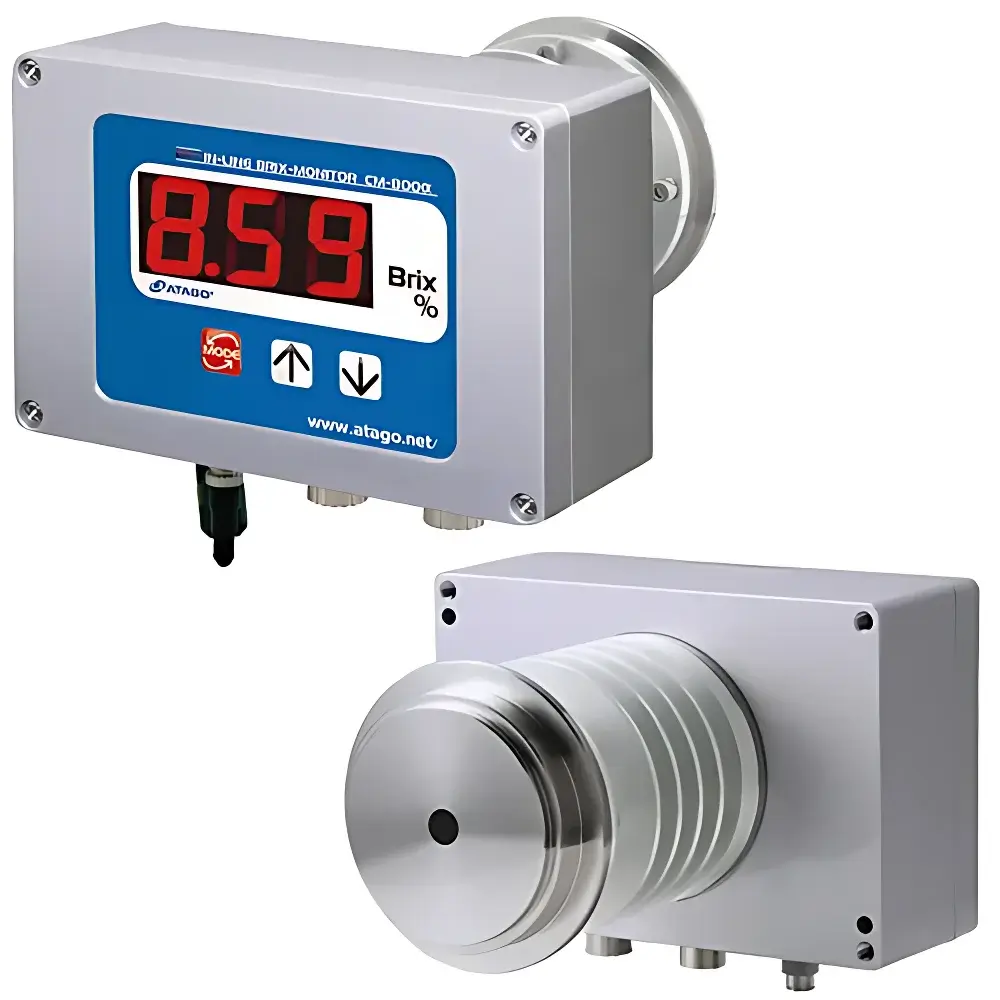
ATAGO CM-800α Inline Refractometer (Liquid Concentration Sensor)
| Brand | ATAGO |
|---|---|
| Origin | Japan |
| Model | CM-800α (Liquid Inline Concentration Sensor) |
| Product Type | Inline Refractometer |
| Brix Range | 0.00–80.00 (ATC) |
| Brix Accuracy | ±0.1% |
| Temperature Range | −15–160.0°C / 5.0–320.0°F |
| ATC Range | 5–100°C |
| Resolution | Brix 0.01% (≤9.99%), 0.1% (>9.99%) |
| Temperature Resolution | 1°C/°F |
| Output | DC 4–20 mA, RS-232C (refractive index or Brix selectable) |
| Measurement Interval | ~1 s (configurable in 5 steps) |
| IP Rating | IP67 |
| Light Source | LED (≈589 nm, sodium D-line equivalent) |
| Prism Material | Synthetic Sapphire |
| Body Material | SUS316L stainless steel |
| Dimensions | 160 × 167 × 110 mm |
| Weight | 2.4 kg |
| Power Supply | DC 24 V (AC 100 V optional with AD-32 adapter) |
Overview
The ATAGO CM-800α Inline Refractometer is an industrial-grade optical sensor engineered for continuous, real-time measurement of soluble solids concentration—expressed as Brix—in liquid process streams. Based on the fundamental principle of refractive index measurement at a fixed wavelength (~589 nm, approximating the sodium D-line), the CM-800α determines Brix by detecting the critical angle of total internal reflection at the sapphire prism–process fluid interface. Its built-in automatic temperature compensation (ATC) algorithm corrects refractive index readings across a wide operational temperature range (5–100°C), ensuring metrological consistency without external calibration loops. Designed for permanent installation in piping systems via sanitary or flanged process connections, the CM-800α delivers high reproducibility and long-term stability under demanding production conditions—including steam-in-place (SIP), clean-in-place (CIP), and high-pressure environments. Unlike benchtop or handheld refractometers, this inline instrument eliminates manual sampling, human error, and time delays—enabling closed-loop process control and compliance with Good Manufacturing Practice (GMP) and Hazard Analysis Critical Control Point (HACCP) frameworks.
Key Features
- High-precision sapphire prism (synthetic corundum) with exceptional chemical resistance and scratch hardness (Mohs 9), suitable for abrasive or corrosive media including caustic cleaning solutions and organic solvents.
- Stainless steel (SUS316L) wetted housing rated IP67 for dust-tight and immersion-resistant operation in humid or washdown-prone environments.
- Dual-output capability: analog 4–20 mA signal for PLC/DCS integration and digital RS-232C serial communication, supporting user-selectable output modes—Brix (%) or refractive index (nD).
- Configurable measurement interval (default: ~1 second; five programmable settings available) to balance data density with system bandwidth requirements.
- Robust thermal design enabling direct mounting on pipes carrying fluids up to 160°C, with no active cooling required.
- Factory-calibrated traceable to NIST-traceable standards; supports routine verification using certified sucrose reference solutions per ISO 21527-1 and AOAC Official Method 932.12.
Sample Compatibility & Compliance
The CM-800α is validated for use with homogeneous, optically transparent or mildly turbid aqueous solutions. It is routinely deployed in food & beverage (juices, syrups, malt wort, beer), pharmaceutical (buffer solutions, API crystallization slurries), and industrial fluid applications (coolants, emulsions, cutting oils, mold release agents). While not intended for highly viscous, particulate-laden, or strongly absorbing media (e.g., undiluted honey or pigment suspensions), its performance remains stable in laminar or turbulent flow regimes when installed per ATAGO’s recommended orientation and minimum velocity guidelines (≥0.3 m/s). The device complies with IEC 61000-6-2 (EMC immunity) and IEC 61000-6-4 (EMC emissions), and meets CE marking requirements for industrial instrumentation. Its analog output architecture supports integration into safety-rated control systems compliant with IEC 61511 (SIL2 capable with appropriate system design).
Software & Data Management
The CM-800α operates autonomously without embedded firmware-based data logging; however, its RS-232C interface enables seamless connection to supervisory software platforms—including ATAGO’s proprietary PC-Link utility or third-party SCADA/HMI systems (e.g., Siemens WinCC, Rockwell FactoryTalk). All output data include timestamped Brix, temperature, and diagnostic status flags (e.g., prism fouling alert, signal saturation, ATC validity). When integrated into validated environments, the instrument supports audit trail generation and electronic record retention in accordance with FDA 21 CFR Part 11 requirements—provided the host system implements appropriate access controls, electronic signatures, and change management protocols. Calibration history, configuration parameters, and firmware version are accessible via serial command set, facilitating GLP-aligned documentation workflows.
Applications
- Real-time Brix monitoring during sugar refinery evaporation, crystallization, and affination stages—ensuring consistent purity and yield per ISO 20480 and ICUMSA Methods.
- Continuous concentration control in dairy ultrafiltration, juice blending, and soft drink syrup dilution—reducing batch variability and optimizing ingredient usage.
- In-process verification of cleaning solution strength during CIP cycles, supporting quantitative validation per ASTM E2889-13 and EU Annex 15 guidelines.
- Monitoring of coolant concentration in metalworking operations to maintain lubricity and prevent microbial growth—aligned with OEM equipment specifications.
- Crystallization endpoint detection in pharmaceutical API manufacturing, where supersaturation ratio is inferred from refractive index trends.
FAQ
Is the CM-800α suitable for high-viscosity liquids such as concentrated syrups or molasses?
No. The sensor requires laminar-to-turbulent flow conditions and optical clarity. Viscosities exceeding 500 cP or suspended solids >50 ppm may cause signal attenuation or prism coating, requiring upstream filtration or dilution.
Can the device be calibrated in-situ without removing it from the pipeline?
Yes—using ATAGO’s optional calibration kit (CK-01) and certified sucrose standards, zero and span adjustments can be performed while installed, provided process flow is temporarily halted and temperature stabilized.
Does the CM-800α support Modbus RTU or Profibus DP communication?
No. It natively supports only 4–20 mA analog and RS-232C serial outputs. Protocol conversion requires an external gateway module compatible with your DCS/PLC infrastructure.
What maintenance intervals are recommended for long-term reliability?
Visual inspection every 3 months; prism cleaning with deionized water and lint-free cloth if fouling is observed; full functional verification annually using traceable reference standards.
Is explosion-proof certification available for hazardous area installation?
The standard CM-800α is not ATEX or IECEx certified. For Zone 1/2 applications, consult ATAGO’s engineering team regarding custom intrinsically safe barrier configurations or alternative models with certified housings.




