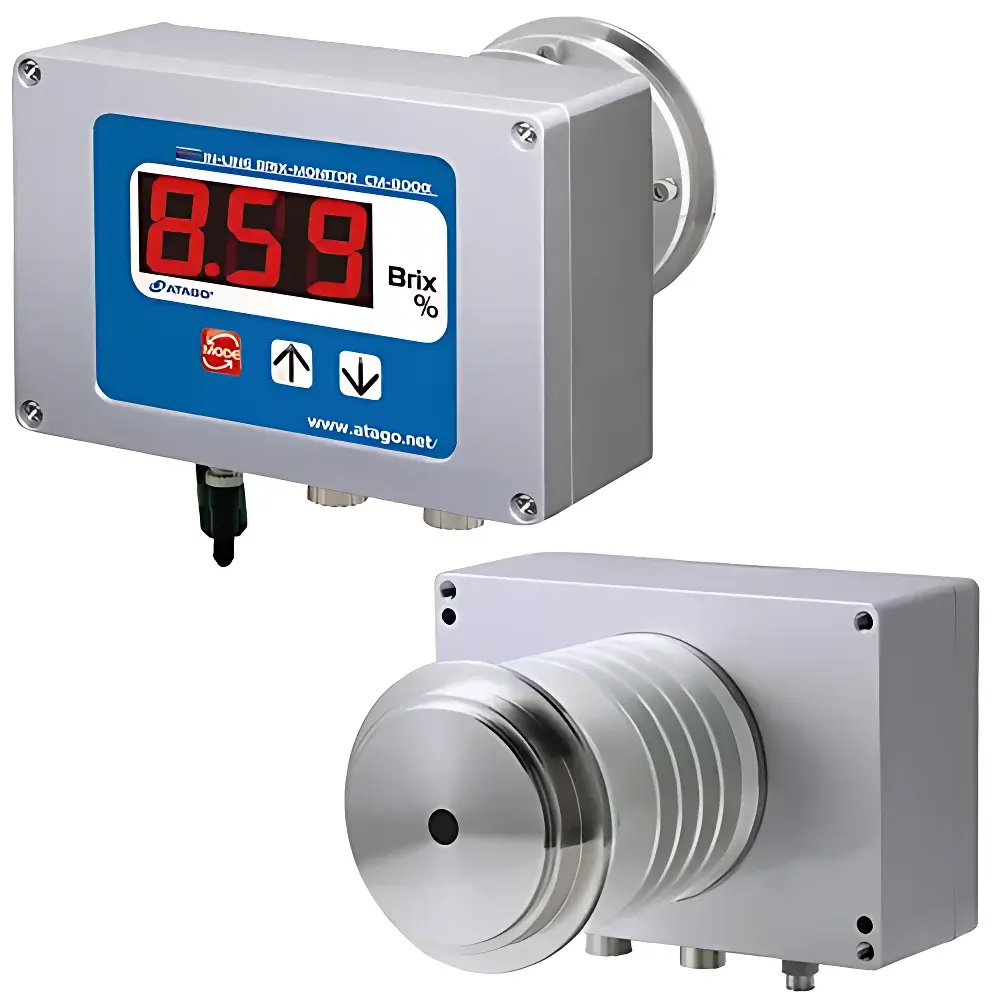
ATAGO CM-800α Online Refractometer for Chlor-Alkali Process Control
| Brand | ATAGO |
|---|---|
| Origin | Japan |
| Model | CM-800α (Chlor-Alkali Industrial Application) |
| Measurement Principle | Refractive Index (Brix, ATC) |
| Accuracy | ±0.1% Brix, ±1°C/°F |
| Range | 0.00–80.00% Brix (ATC), -15–160.0°C |
| Temperature Compensation | 5–100°C |
| Output | 4–20 mA, RS-232C |
| IP Rating | IP67 |
| Light Source | LED (≈589 nm, sodium D-line equivalent) |
| Prism Material | Synthetic Sapphire |
| Cell Body Material | SUS316L Stainless Steel |
| Dimensions | 160 × 167 × 110 mm |
| Weight | 2.4 kg |
| Response Interval | ~1 sec (configurable up to 5 intervals) |
Overview
The ATAGO CM-800α Online Refractometer is an industrial-grade process analytical instrument engineered for continuous, real-time concentration monitoring in chlor-alkali production environments. It operates on the fundamental optical principle of refractive index measurement—specifically calibrated to report Brix values (percentage of soluble solids by mass) under Automatic Temperature Compensation (ATC). In chlor-alkali processes, where precise control of sodium hydroxide (caustic soda), brine feedstock, and electrolyte circulation is critical to membrane cell efficiency, energy consumption, and product purity, the CM-800α provides non-invasive, maintenance-free inline analysis without sample extraction or reagent use. Its sapphire prism and 316L stainless steel wetted parts ensure chemical resistance against highly corrosive alkaline and saline media—including saturated brine solutions (up to 26% NaCl), caustic lye (up to 50% NaOH), and mixed electrolytes at temperatures up to 160°C. Unlike offline titration or conductivity-based methods, refractometry delivers direct correlation to total dissolved solids (TDS) independent of ionic composition—making it especially reliable for multicomponent streams where conductivity readings may drift due to ion mobility variations.
Key Features
- High-precision refractive index sensing with ±0.1% Brix accuracy and 0.01% resolution (at low concentrations) ensures repeatable quantification of caustic strength and brine saturation levels.
- Integrated ATC (5–100°C) compensates for thermal expansion effects on refractive index, eliminating manual correction and supporting stable operation across wide process temperature gradients.
- IP67-rated housing and sapphire prism withstand harsh plant environments—resistant to steam cleaning, high-pressure washdown, and aggressive chemical exposure typical in electrolysis cell rooms and evaporation units.
- Dual-output interface: isolated 4–20 mA analog signal for PLC/DCS integration and RS-232C digital output (configurable for refractive index or Brix data) enables traceable data logging and audit-ready recordkeeping.
- Compact form factor (160 × 167 × 110 mm) allows direct insertion into DN25–DN50 process lines via sanitary or flanged mounting kits—no bypass loop required for representative sampling.
- LED light source centered near 589 nm (D-line equivalent) conforms to ISO 21542 and AOAC standard wavelengths for refractometric consistency across laboratories and production sites.
Sample Compatibility & Compliance
The CM-800α is validated for continuous operation in opaque, viscous, and particulate-laden streams common in chlor-alkali ancillary systems—including evaporator condensate, caustic concentrate recirculation loops, and brine purification effluents. Its sapphire optical surface resists scaling and etching from hydroxide ions and chloride attack, maintaining long-term calibration stability without polishing or replacement. The instrument meets IEC 61000-6-2 (EMC immunity) and IEC 61000-6-4 (EMC emission) standards. While not intrinsically safe certified, it is suitable for Zone 2/Class I Division 2 areas when installed with appropriate conduit sealing. Data integrity complies with FDA 21 CFR Part 11 requirements when paired with compliant SCADA or MES systems—supporting electronic signatures, audit trails, and user access controls for GMP-aligned facilities.
Software & Data Management
The CM-800α communicates natively with industry-standard automation platforms via Modbus RTU (over RS-485 adapter) or HART-enabled 4–20 mA transmitters. Raw refractive index values (nD) and compensated Brix are timestamped and transmitted at user-defined intervals (1–30 seconds). When integrated with ATAGO’s optional PC software or third-party historian systems (e.g., OSIsoft PI, Ignition), measurements support trend analysis, deviation alerts, and batch reconciliation. All configuration changes—including calibration offsets, temperature compensation curves, and output scaling—are logged with operator ID and timestamp, satisfying GLP/GMP documentation requirements for process validation and regulatory audits.
Applications
- Real-time monitoring of caustic soda concentration in membrane cell effluent to optimize evaporation energy input and prevent crystallization in downstream piping.
- In-line verification of brine saturation prior to electrolysis, ensuring consistent current efficiency and minimizing chlorine gas impurity (O₂, CO₂).
- Control of spent electrolyte recycling loops in chlor-alkali waste treatment—tracking NaOH recovery rates and identifying breakthrough events in ion-exchange columns.
- Concentration profiling in wastewater reverse osmosis concentrate streams (1–5% TDS) to assess feasibility of zero-liquid-discharge (ZLD) pretreatment staging.
- Cross-industry deployment in pulp & paper black liquor evaporation, PVA spinning dope preparation, and textile dye bath replenishment—leveraging identical optical physics and ruggedized construction.
FAQ
Does the CM-800α require periodic recalibration in chlor-alkali service?
No—its sapphire prism and thermally stable LED source provide drift-free operation for ≥12 months under steady-state conditions. Field verification using NIST-traceable sucrose standards is recommended quarterly per ISO/IEC 17025 guidelines.
Can it measure NaOH concentration directly—not just Brix?
Yes—Brix values correlate linearly with NaOH wt% in pure aqueous systems; ATAGO provides application-specific conversion tables (certified per JIS Z 8015) for caustic concentrations from 10% to 50% w/w.
Is the sensor compatible with high-turbidity brine containing suspended calcium carbonate?
The CM-800α tolerates turbidity up to 500 NTU; however, for streams with >50 mg/L suspended solids, a self-cleaning ultrasonic mount or periodic air-pulse purge is advised to maintain optical clarity.
What is the minimum flow velocity required for accurate measurement?
A laminar-to-transitional flow regime (≥0.3 m/s) ensures representative sampling; lower velocities may necessitate installation in a recirculation loop with booster pump.
How does it interface with DCS systems requiring HART protocol?
Via optional HART communicator module (ATAGO HRT-100), enabling full device configuration, diagnostics, and multi-variable transmission (Brix + temp + status) over 4–20 mA.
Related Products