
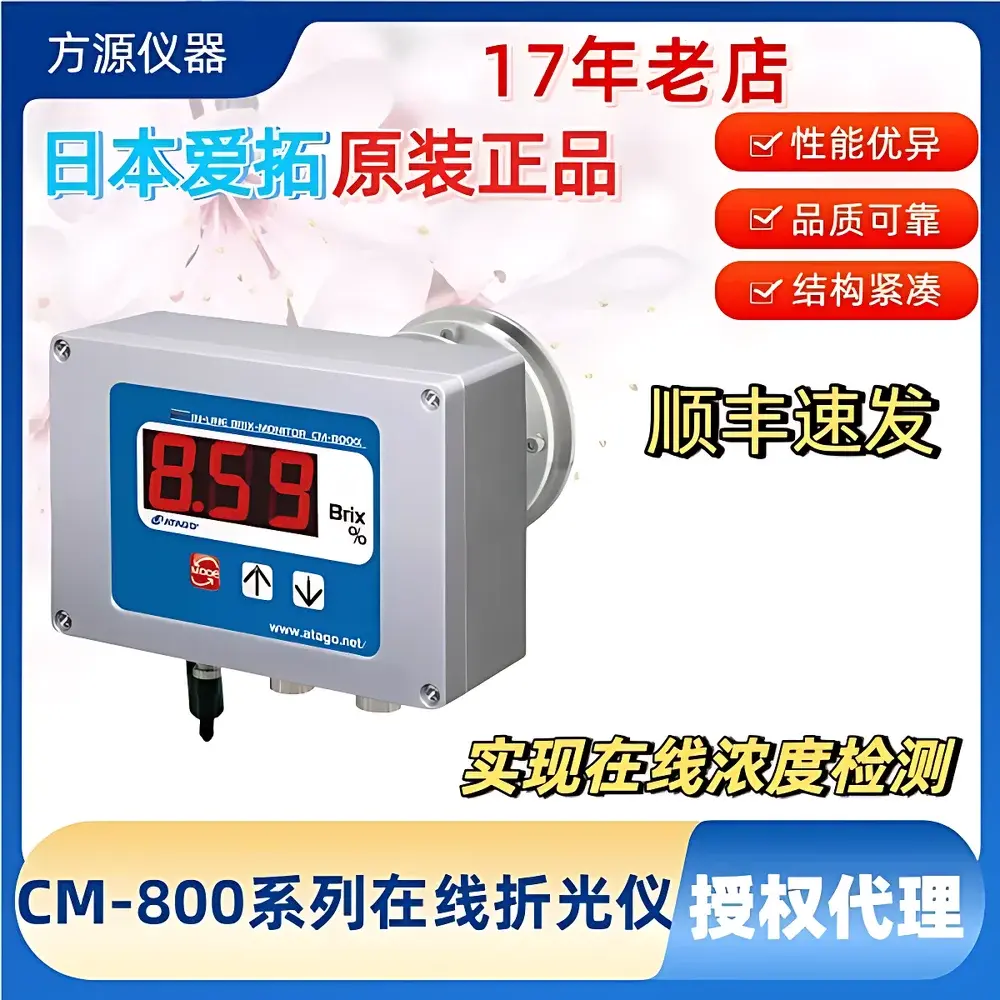
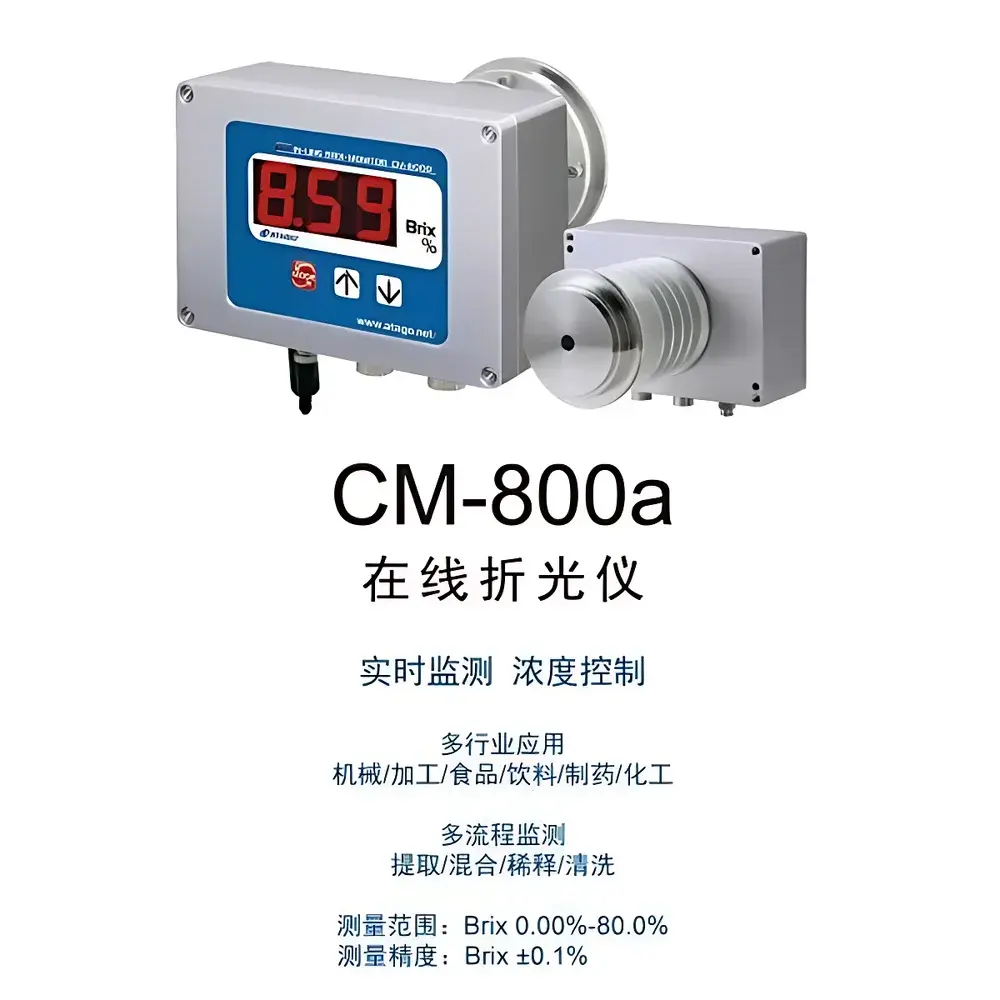
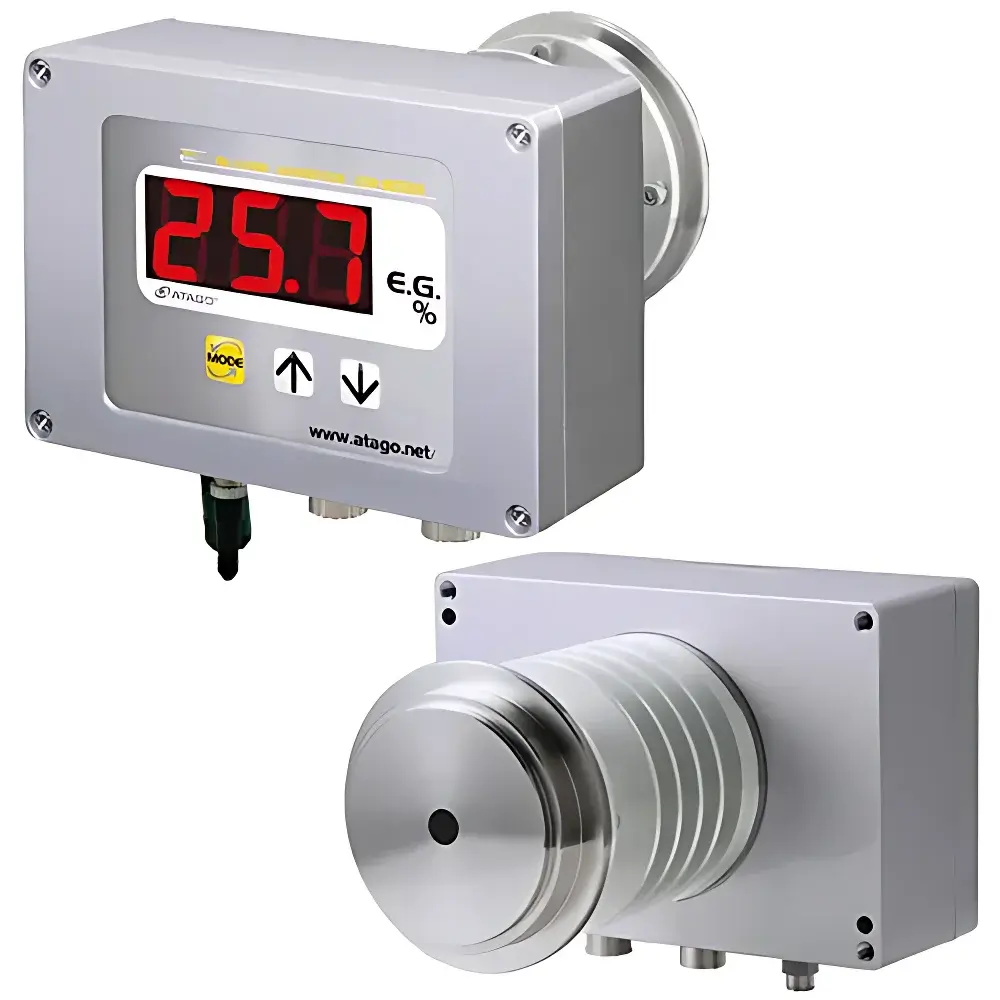
ATAGO CM-800α Series In-Line Process Refractometer for Real-Time Concentration Monitoring
| Brand | ATAGO |
|---|---|
| Origin | Japan |
| Model | CM-800α Series |
| Measurement Principle | Critical Angle Refractometry |
| Measuring Range (Brix) | 0.00–80.0% |
| Temperature Range | −15 to 160°C |
| Brix Resolution | 0.01% (0.00–9.99%), 0.1% (10.0–80.0) |
| Brix Accuracy | ±0.1% |
| Temperature Accuracy | ±1°C |
| Temperature Compensation Range | 5–100°C |
| Output Signals | DC 4–20 mA & RS-232C |
| Prism Material | Synthetic Sapphire |
| Prism Cell Material | SUS316L Stainless Steel |
| Response Time | ~1 second |
| Power Supply | DC 24 V (optional AC 100 V with AD-32 adapter) |
| Enclosure Rating | IP67 |
| Dimensions (H×W×D) | 160 × 167 × 110 mm |
| Weight | 2.4 kg (main unit only) |
| Optional Configurations | CM-800α-EG (ethylene glycol), CM-800α-PG (propylene glycol), CM-800α-SW (brine) |
Overview
The ATAGO CM-800α Series is an industrial-grade in-line process refractometer engineered for continuous, real-time concentration monitoring in dynamic fluid systems. It operates on the principle of critical angle refractometry—measuring the refractive index of a liquid sample in direct contact with a sapphire prism—and converting it into concentration units (e.g., Brix %, ethylene glycol %, or brine %) using pre-calibrated polynomial algorithms. Unlike laboratory benchtop refractometers, the CM-800α is designed for permanent installation in pressurized pipelines, reactors, and mixing tanks across food & beverage, pharmaceutical, chemical, and HVAC applications. Its robust mechanical architecture—including a fully sealed IP67-rated housing and corrosion-resistant SUS316L flow cell—ensures long-term stability under harsh process conditions. The instrument delivers high reproducibility (±0.1% Brix) and rapid measurement response (~1 second), enabling closed-loop feedback control integration via 4–20 mA analog output or digital RS-232C communication.
Key Features
- High-precision sapphire prism interface with zero drift over extended operation cycles
- Automatic temperature compensation (ATC) across 5–100°C, eliminating manual correction requirements
- Dual-output capability: simultaneous analog (4–20 mA) and digital (RS-232C) signal transmission
- Modular configuration support for application-specific calibration curves (e.g., EG, PG, SW)
- Process-compatible wetted materials: synthetic sapphire prism + electropolished SUS316L flow channel
- Compact form factor (160 × 167 × 110 mm) with low mass (2.4 kg) for flexible mounting on straight, L-shaped, or sanitary Tri-Clamp piping
- DC 24 V standard power supply; optional AC 100 V operation via AD-32 adapter for facility compatibility
Sample Compatibility & Compliance
The CM-800α series is validated for use with homogeneous aqueous solutions, glycol-based heat transfer fluids, saline media, and sugar-rich process streams. It is not intended for suspensions, emulsions, or highly viscous non-Newtonian fluids where light scattering or boundary layer instability may compromise refractive index accuracy. The instrument complies with IEC 60529 (IP67 ingress protection), meets CE marking requirements for electromagnetic compatibility (EMC Directive 2014/30/EU), and supports validation documentation for GMP environments. While not inherently 21 CFR Part 11 compliant, its RS-232C output enables integration with validated SCADA or DCS platforms that implement audit trail, electronic signature, and data integrity controls per FDA guidance.
Software & Data Management
Data acquisition and configuration are performed via RS-232C serial connection using ATAGO’s proprietary PC utility software (CM-Setup Tool), which allows users to select measurement units (Brix, % EG, % PG, % NaCl), define custom calibration coefficients, adjust display resolution, and configure output scaling for 4–20 mA loop integration. Raw refractive index (nD) values are available as default RS-232C output, supporting traceable correlation to primary standards. No embedded memory or local data logging is provided—continuous streaming to external historians or PLCs is required for long-term trend analysis. The device supports MODBUS RTU protocol via optional gateway adapters for broader industrial network interoperability.
Applications
- Real-time Brix control in juice concentration, syrup blending, and dairy evaporation lines
- Continuous monitoring of ethylene/propylene glycol concentration in HVAC chillers and antifreeze circulation systems
- In-process salinity verification during seawater desalination pretreatment and brine recovery
- Concentration feedback for inline dilution control in pharmaceutical buffer preparation suites
- Quality assurance in chemical synthesis reactors where solvent/water ratio directly impacts reaction kinetics
- Automated cleaning-in-place (CIP) endpoint detection via refractive index shift during rinse phase
FAQ
What is the maximum allowable process pressure for the CM-800α flow cell?
The standard CM-800α is rated for continuous operation at ≤1.0 MPa (10 bar) at 25°C; pressure rating decreases linearly with increasing temperature per ASME B31.3 guidelines.
Can the CM-800α be calibrated using NIST-traceable sucrose standards?
Yes—ATAGO provides certified Brix calibration solutions traceable to NIST SRM 84d; field recalibration follows ISO 21527-1 procedures for refractometric sugar analysis.
Is the RS-232C interface compatible with Modbus TCP networks?
Not natively; however, third-party serial-to-Ethernet gateways (e.g., Moxa NPort) enable transparent RS-232C bridging to Modbus TCP infrastructure.
How frequently should the sapphire prism surface be cleaned in high-fouling applications?
Cleaning frequency depends on particulate load; ATAGO recommends automated CIP-compatible wiper systems or ultrasonic cleaning intervals aligned with process shutdown schedules.
Does the CM-800α support user-defined polynomial calibration for proprietary formulations?
Yes—up to three custom calibration tables can be stored and selected via CM-Setup Tool; each requires ≥5 concentration points with certified reference standards.



