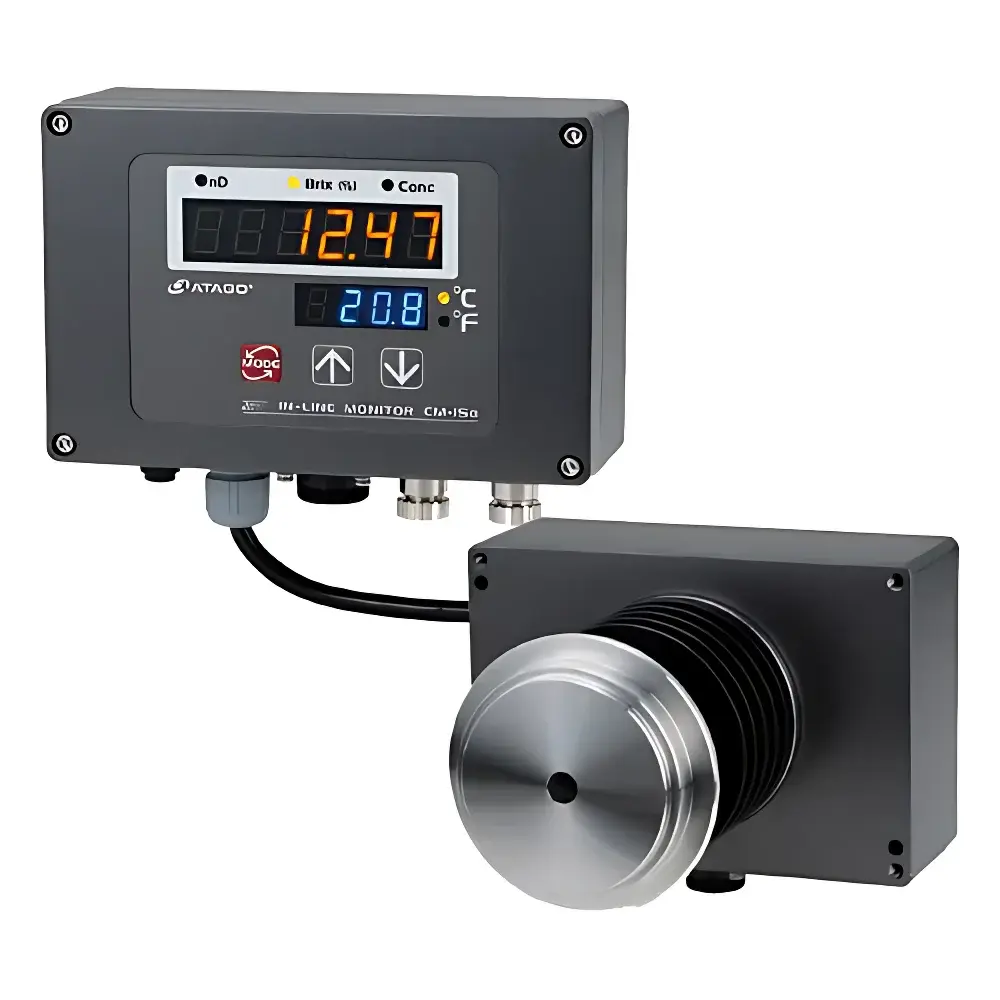
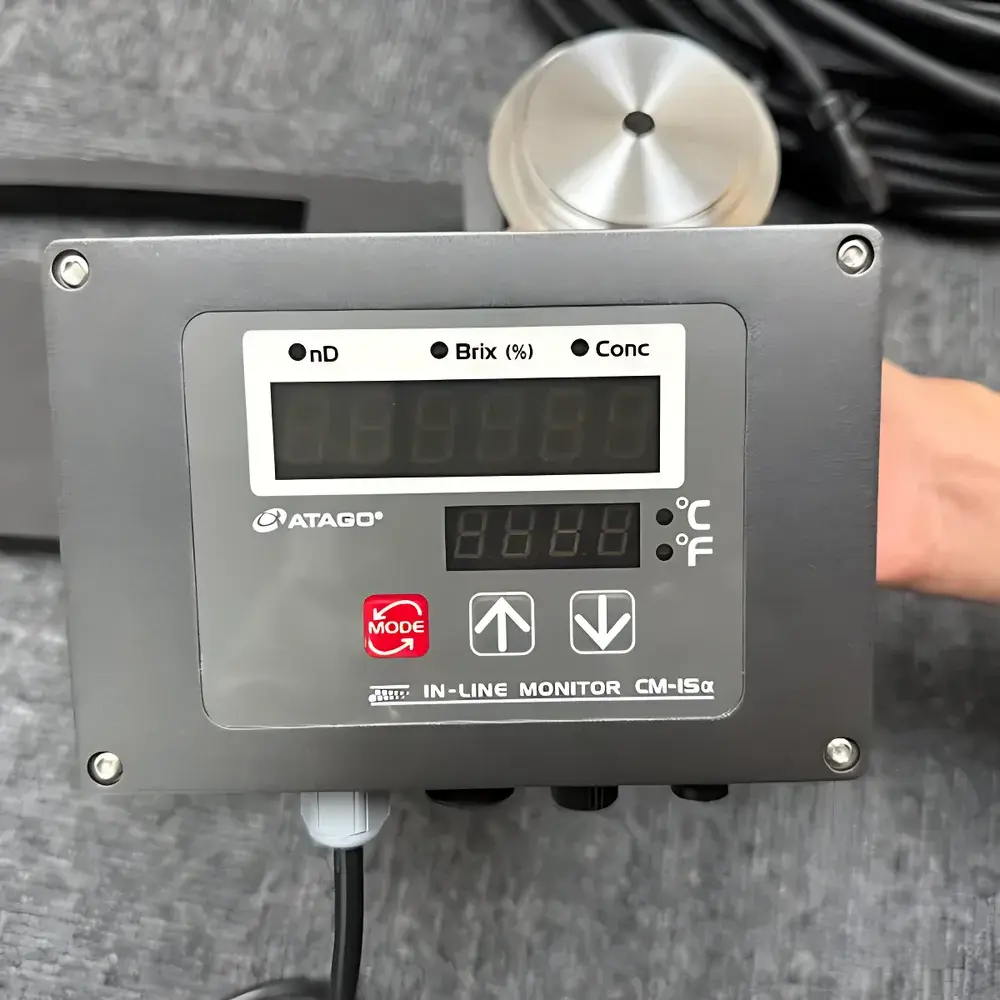
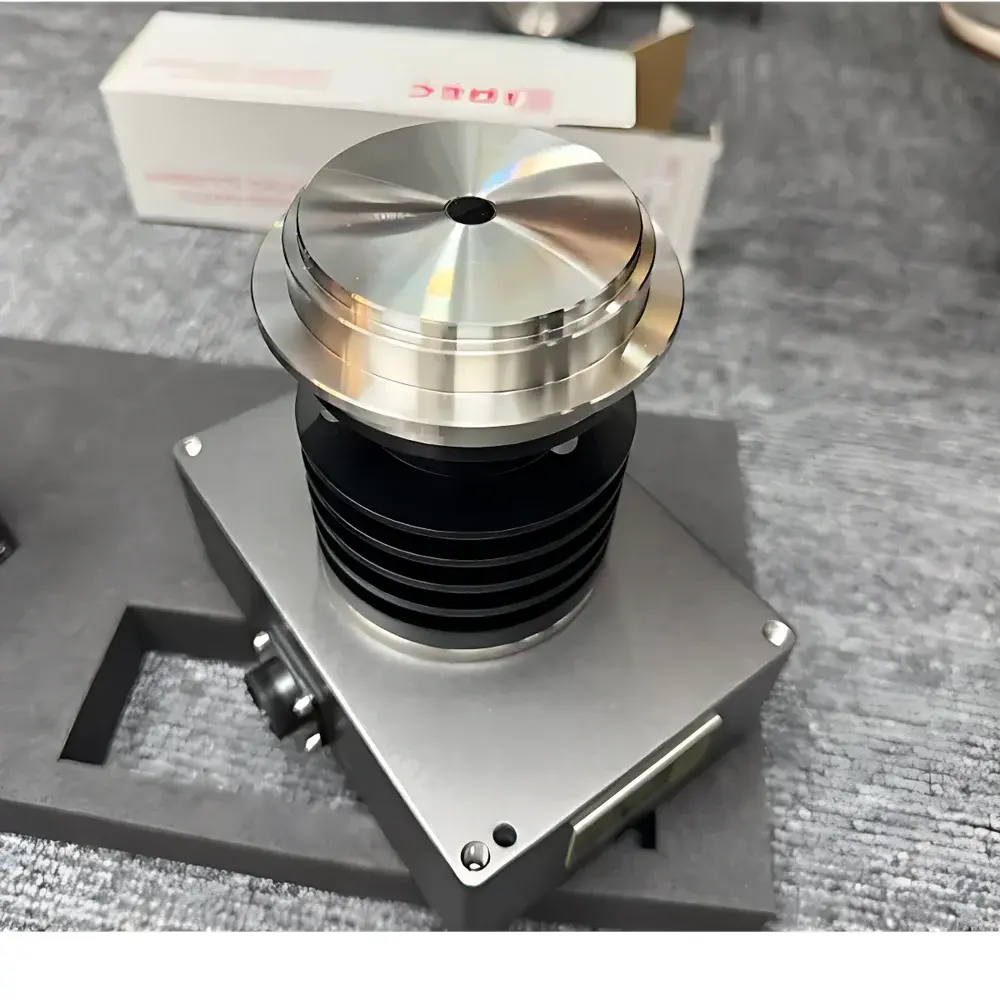
ATAGO CM-ISα Intrinsically Safe Online Refractometer for DMSO Process Monitoring
| Brand | ATAGO |
|---|---|
| Origin | Japan |
| Model | CM-ISα |
| Explosion Protection Rating | Ex ia IIB T3 Ga TA |
| Measurement Principle | Critical Angle Refraction |
| Measurable Parameters | Refractive Index (nD), Brix (% w/w), Concentration (%), Temperature |
| Refractive Index Range | 1.32000–1.49100 |
| Brix Range | 0.0–80.0% |
| Temperature Range | −15 to +160 °C |
| Refractive Index Resolution | 0.00001 |
| Brix Resolution | 0.01% or 0.1% (selectable) |
| Temperature Resolution | 0.1 °C |
| Refractive Index Accuracy | ±0.0002 |
| Brix Accuracy | ±0.1% |
| Temperature Accuracy | ±1 °C |
| ATC Range | 5–100 °C |
| Output Signals | DC 4–20 mA / RS-232C |
| Power Supply | DC 24 V |
Overview
The ATAGO CM-ISα Intrinsically Safe Online Refractometer is a purpose-engineered optical process analyzer designed for continuous, real-time concentration monitoring of dimethyl sulfoxide (DMSO) solutions in hazardous industrial environments. Utilizing the critical-angle principle of total internal reflection, the instrument measures refractive index (nD) with high optical stability and minimal drift, enabling precise derivation of DMSO mass concentration (% w/w) and Brix-equivalent values without chemical reagents or sample extraction. Its fully sealed, intrinsically safe optical sensor head is rated Ex ia IIB T3 Ga TA per IEC 60079-0 and IEC 60079-11, making it suitable for Zone 0/1 installations where flammable vapors—such as those encountered in lithium-ion battery electrolyte synthesis, pharmaceutical solvent recovery, or fine chemical manufacturing—pose ignition risks. Unlike offline titration or HPLC-based methods, the CM-ISα delivers second-level response time, eliminates operator-dependent variability, and supports unattended 24/7 operation under process pressure and thermal cycling.
Key Features
- Intrinsically safe design certified to Ex ia IIB T3 Ga TA (IEC 60079-11), approved for direct installation in explosive atmospheres including Class I, Division 1 locations.
- High-resolution optical detection system with 0.00001 refractive index resolution and ±0.0002 accuracy at 20 °C, traceable to NIST-traceable calibration standards.
- Integrated Pt100 temperature sensor with automatic temperature compensation (ATC) across 5–100 °C, ensuring stable concentration output despite process temperature fluctuations.
- Robust sapphire prism (Mohs hardness 9) and 316L stainless steel wetted parts compatible with aggressive DMSO streams, including those containing LiPF6, carbonate co-solvents, or residual moisture.
- Dual-output interface: isolated 4–20 mA analog signal (HART-compatible) for PLC/DCS integration and RS-232C serial port for configuration, diagnostics, and raw data logging.
- IP67-rated electronics housing with wide operating temperature range (−20 to +60 °C ambient) and EMC compliance per IEC 61326-1 for industrial electromagnetic environments.
Sample Compatibility & Compliance
The CM-ISα is validated for inline measurement of aqueous and non-aqueous DMSO solutions within viscosity ranges up to 20 mPa·s and suspended solids content below 0.1 wt%. It maintains measurement integrity in turbulent flow conditions (Re > 3,000) when installed in bypass loops or main pipelines with minimum flow velocity of 0.3 m/s. The instrument conforms to ISO 21501-4 for optical particle-free path validation and meets the essential requirements of the EU ATEX Directive 2014/34/EU. For regulated industries, its digital output architecture supports audit-trail-capable data recording when paired with compliant SCADA systems; while not inherently 21 CFR Part 11 compliant, it provides timestamped, uneditable analog outputs suitable for GLP/GMP-aligned process documentation when integrated with validated data acquisition platforms.
Software & Data Management
Configuration and diagnostics are performed via ATAGO’s proprietary PC-based software (CM-Config Tool), which enables user-defined concentration calibration curves—including multi-point polynomial fits for non-linear DMSO/water or DMSO/electrolyte systems. All calibration parameters, sensor diagnostics (e.g., light source intensity, detector saturation status), and real-time measurement logs are stored with UTC timestamps. The 4–20 mA output can be mapped to any primary parameter (nD, Brix, % DMSO, or temperature) with user-selectable scaling and damping filters (0.1–10 s). Raw RS-232C data output includes ASCII-formatted strings with checksum verification, facilitating integration into MES or LIMS environments through standard Modbus RTU gateways.
Applications
- Lithium-ion battery manufacturing: Real-time control of DMSO concentration in cathode slurry dispersion processes and electrode coating solvent recovery loops.
- Pharmaceutical active pharmaceutical ingredient (API) synthesis: In-process monitoring of DMSO-based reaction mixtures during cryogenic lithiation or SNAr coupling steps.
- Electronic chemicals production: Closed-loop concentration adjustment in DMSO purification trains prior to microelectronics-grade packaging.
- Specialty polymer processing: Consistency control of DMSO-dissolved polyimide or PES precursor solutions prior to phase inversion casting.
- Contract development and manufacturing organizations (CDMOs): Validated concentration assurance for GMP-compliant solvent exchange protocols.
FAQ
What is the maximum process pressure the CM-ISα sensor can withstand?
The optical probe is rated for continuous operation at up to 1.0 MPa (10 bar) at 20 °C, with derating to 0.6 MPa at 160 °C per ASME B16.5 Class 150 flange specifications.
Can the CM-ISα be calibrated for custom DMSO–salt or DMSO–LiPF6 mixtures?
Yes—users may input multi-point concentration–refractive index reference data to generate application-specific calibration curves using the CM-Config Tool.
Is cleaning-in-place (CIP) compatible with the sensor surface?
The sapphire prism tolerates standard alkaline (pH 12–14) and acidic (pH 1–2) CIP solutions at temperatures ≤80 °C; ultrasonic cleaning is not recommended.
Does the device support HART communication?
The 4–20 mA output is HART 7–compatible when used with a HART-enabled I/O module; native digital HART command set is not embedded in the device firmware.
How frequently does the instrument require recalibration under continuous operation?
Under stable process conditions and proper installation, annual verification against certified refractive index standards is recommended; drift monitoring via zero-point check with pure DMSO is advised quarterly.