
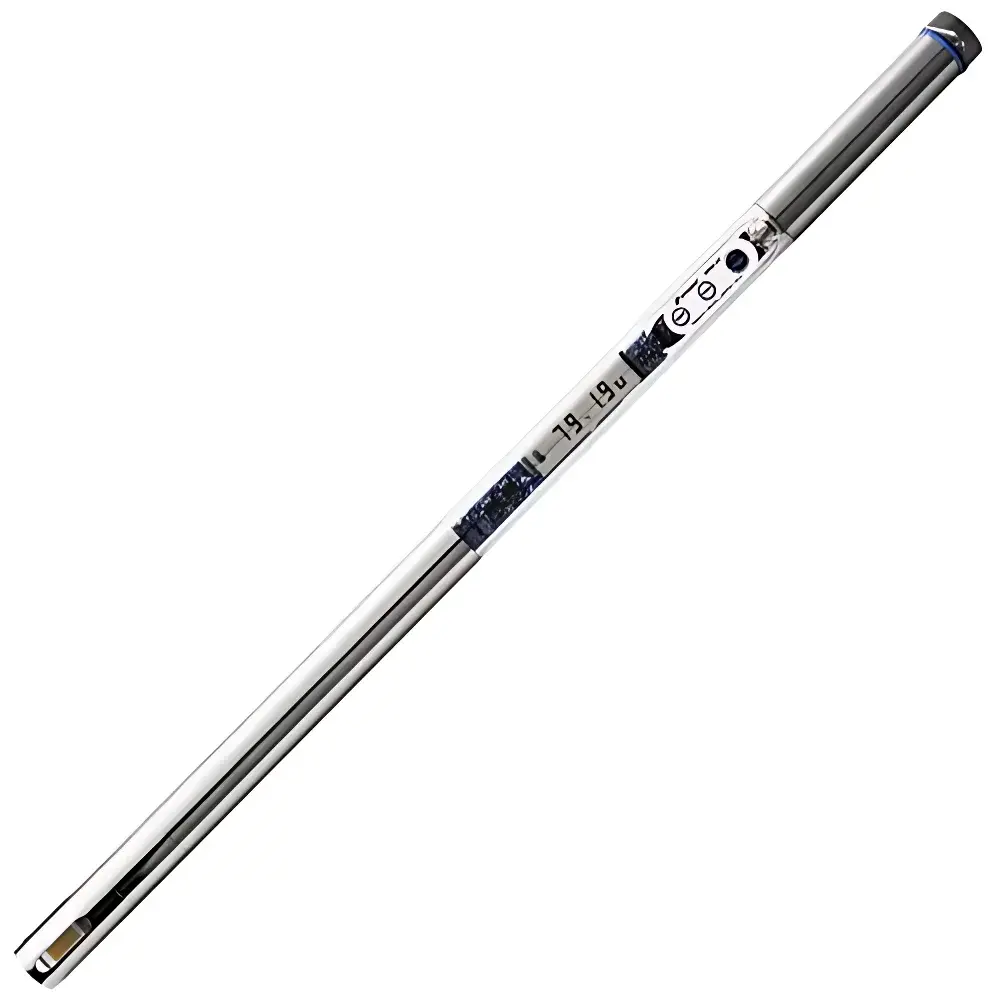
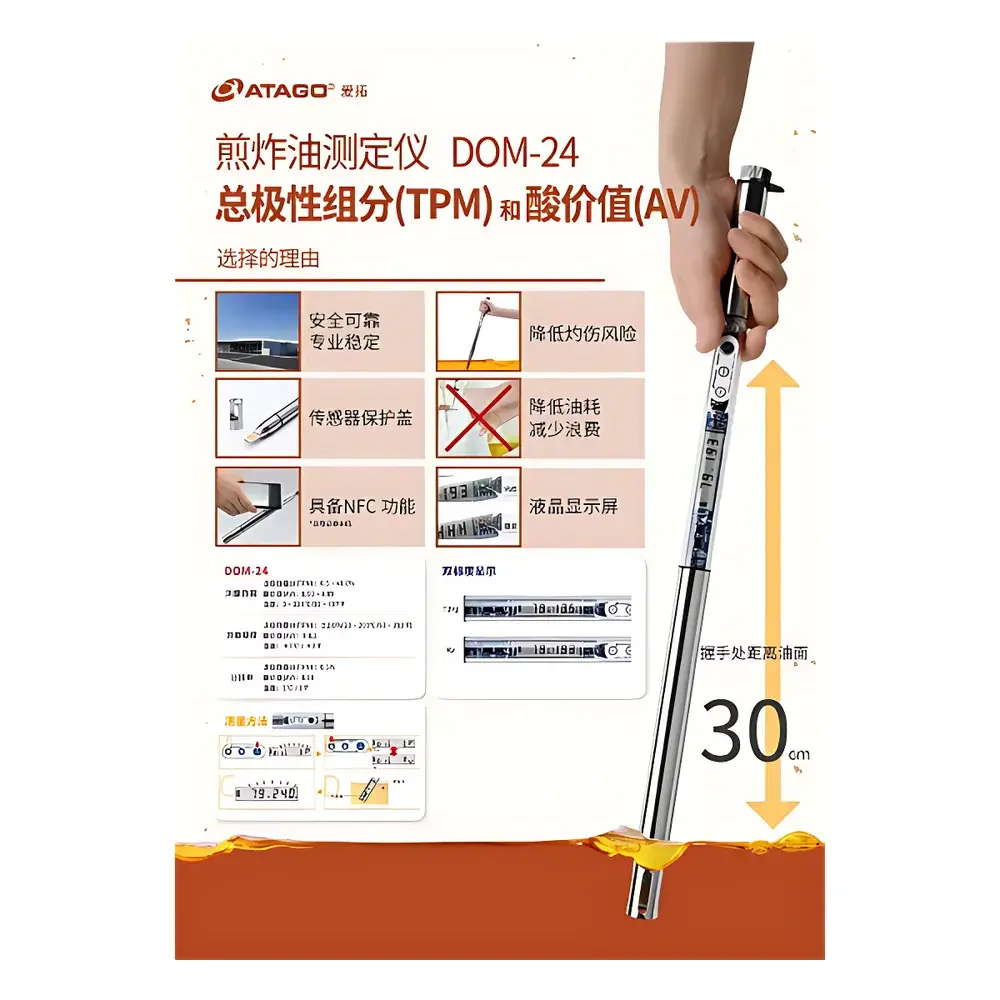
ATAGO DOM-24 Dual-Parameter Frying Oil Quality Analyzer
| Brand | ATAGO |
|---|---|
| Origin | Japan |
| Model | DOM-24 |
| Measurement Parameters | TPM (% w/w) and Acid Value (mg KOH/g oil) |
| Compliance | Designed for GB 7102.1–2003, ISO 8534, AOCS Cd 3d-63 |
| Interface | NFC (Android-compatible), USB-C data export |
| Construction | Titanium alloy housing |
| Operating Distance | ≥30 cm from hot oil surface |
| Intended Use | On-site frying oil monitoring in food service, regulatory inspection, and QC laboratories |
Overview
The ATAGO DOM-24 Dual-Parameter Frying Oil Quality Analyzer is an engineered field-deployable instrument designed for simultaneous, non-destructive quantification of Total Polar Materials (TPM) and Acid Value (AV) in used frying oils. It operates on the principle of dielectric property analysis—measuring changes in relative permittivity and conductivity induced by polar degradation compounds (e.g., mono- and di-glycerides, free fatty acids, aldehydes, ketones, and polymers) formed during thermal oxidation and hydrolysis. Unlike chromatographic or titrimetric methods requiring solvent extraction or sample cooling, the DOM-24 delivers stable readings directly in hot oil (up to 200 °C) within 3 seconds, without immersion or contact. Its optical-electronic architecture eliminates moving parts and calibration drift associated with traditional sensors, ensuring long-term repeatability under repeated thermal cycling. The device meets the functional requirements of rapid screening protocols mandated by food safety authorities for continuous frying medium surveillance.
Key Features
- Dual-parameter output: Simultaneous real-time measurement of TPM (%) and AV (mg KOH/g oil) in a single test cycle
- Non-contact operation: Safe handheld use at ≥30 cm distance from oil surface—eliminates burn risk and cross-contamination
- Titanium alloy chassis: Corrosion-resistant, lightweight (≤320 g), and thermally stable for extended field deployment
- NFC-enabled data transfer: Direct wireless pairing with Android smartphones (Android 6.0+); no drivers or apps required
- USB-C interface: Plug-and-play connectivity to Windows/macOS systems for CSV export and batch reporting
- GB 7102.1–2003 alignment: Pre-configured alert thresholds (TPM ≥27%, AV ≥5.0 mg KOH/g) with visual/audible warnings
- Low-power design: 12-hour battery life on a single charge; auto-sleep mode conserves energy between measurements
Sample Compatibility & Compliance
The DOM-24 is validated for use with common edible frying media including palm olein, soybean oil, sunflower oil, canola oil, and blended frying fats. It does not require sample homogenization, filtration, or temperature equilibration prior to testing. Instrument performance adheres to the metrological framework outlined in ISO 8534 (edible oil quality assessment) and AOCS Cd 3d-63 (acid value determination in heated oils). While not a primary reference method per ISO 660, it provides traceable screening-level results correlated to standardized laboratory procedures. For regulatory applications, the DOM-24 supports GLP-aligned documentation workflows—each measurement logs timestamp, operator ID (via NFC-linked device), ambient temperature, and instrument serial number. Data integrity complies with FDA 21 CFR Part 11 principles when exported and archived using validated software platforms.
Software & Data Management
Raw measurement data are transmitted via NFC or USB-C as structured JSON/CSV files containing TPM, AV, measurement duration, thermal stability index (derived from signal variance), and environmental metadata. No proprietary cloud service is required; users retain full ownership and control over datasets. Exported files integrate natively with LIMS environments, Excel-based QC dashboards, and statistical process control (SPC) tools. Audit trails—including firmware version, sensor health status, and last calibration verification date—are embedded in each record. Optional CSV-to-PDF report generation enables immediate hardcopy documentation for on-site inspections by municipal food safety officers or third-party auditors.
Applications
- Routine monitoring of fryer oil turnover cycles in commercial kitchens, fast-food chains, and catering facilities
- Field verification by public health inspectors enforcing national standards (e.g., China’s GB 7102.1–2003, EU Regulation (EC) No 852/2004)
- Preventive maintenance scheduling in food manufacturing plants processing battered or breaded products
- Training and compliance documentation for HACCP-based frying oil management programs
- Comparative studies of oil stabilization additives, filtration efficiency, and fryer temperature optimization
- Academic research on lipid oxidation kinetics under controlled thermal stress conditions
FAQ
Does the DOM-24 require daily calibration?
No. It uses factory-traceable dielectric reference curves and has no consumable sensors. A user-performed verification check using the included reference standard oil is recommended before first use and after prolonged storage.
Can it measure cold or filtered oil?
Yes—but optimal accuracy is achieved at operating temperatures (150–190 °C). Cold oil measurements may yield elevated TPM readings due to phase separation artifacts; always test under actual frying conditions.
Is NFC functionality compatible with iOS devices?
No. NFC data transmission is limited to Android OS versions 6.0 and higher. iOS users must rely on USB-C export for data retrieval.
How is traceability maintained during regulatory audits?
Each measurement stores immutable metadata (time, location via phone GPS if enabled, operator ID, instrument SN). When paired with a validated LIMS or audit-ready spreadsheet template, this satisfies documentation requirements under GB/T 19001 and ISO/IEC 17025 clause 7.7.
What maintenance is required?
Wipe the titanium probe tip with lint-free cloth after each use. Avoid abrasive cleaners. Store in the supplied protective case with desiccant. Firmware updates are delivered via USB-C and require no service technician.






