
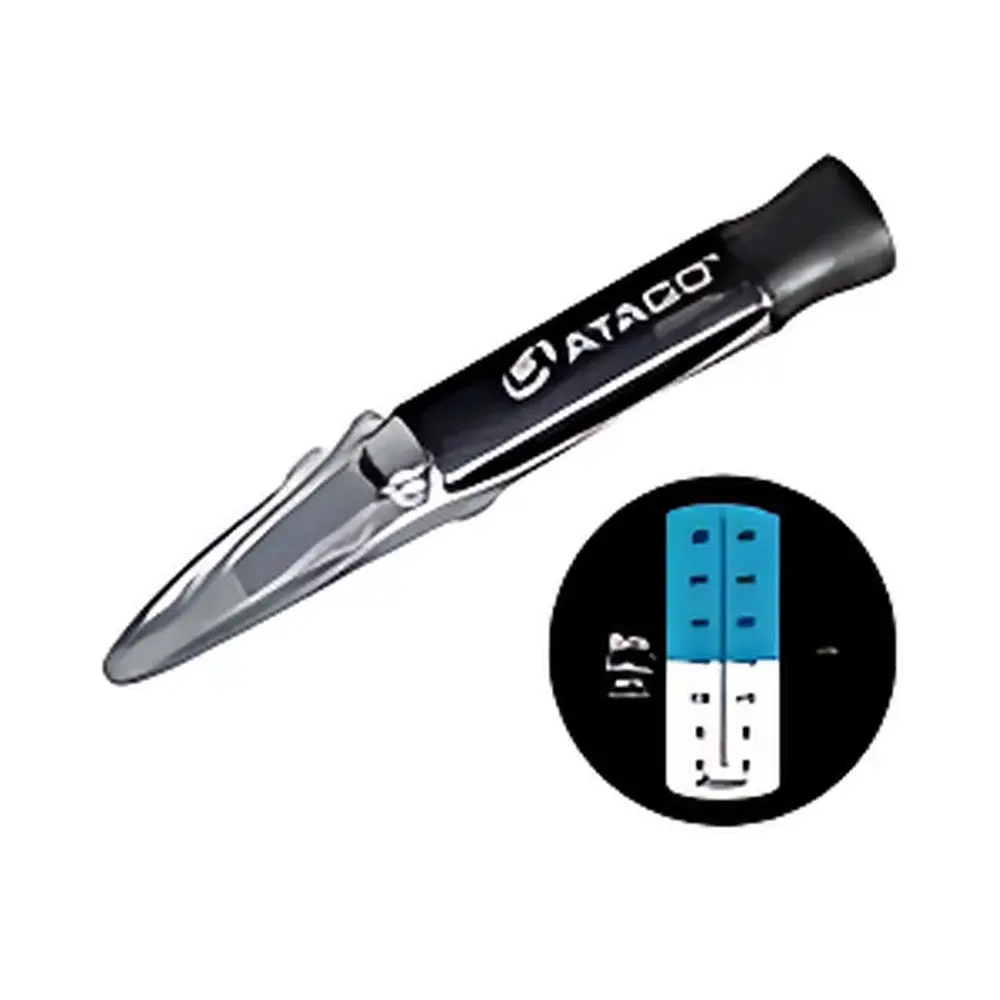
ATAGO MASTER-M Handheld Refractometer
| Brand | ATAGO |
|---|---|
| Origin | Japan |
| Model | MASTER-M |
| Measurement Range | Brix 0.0–32.0% |
| Scale Division | 0.20% |
| Maximum Operating Temperature | 40°C |
| Prism Housing | Metal (Aluminum Alloy) |
| Optical System | Single-lens, high-transmittance eyepiece |
| Ergonomic Design | Balanced weight distribution, optimized grip geometry |
| Liquid Clearance | Rapid drainage groove on prism surface |
| Compliance | Designed per JIS K 0061 and ISO 21527-1 for refractometric sugar analysis |
Overview
The ATAGO MASTER-M Handheld Refractometer is a precision optical instrument engineered for rapid, field-deployable measurement of aqueous sucrose concentration expressed as Brix (% w/w). Based on the fundamental principle of critical-angle refraction, the device determines sample refractive index via total internal reflection at the prism–sample interface. Light passes through a high-transmittance single-lens optical system into a temperature-stabilized aluminum alloy prism; the resulting shadow line position in the reticle is calibrated directly to Brix values. Unlike digital alternatives requiring power or calibration fluids, the MASTER-M operates entirely passively—no batteries, no software, no warm-up time—making it ideal for routine QC checks in food processing lines, agricultural grading, beverage formulation, and laboratory benchtop verification. Its optical path is sealed and insensitive to ambient light fluctuations, ensuring consistent readability under variable lighting conditions.
Key Features
- Metal prism housing: Machined aluminum alloy body provides superior thermal mass and rapid thermal equilibration with ambient or sample temperature—critical for minimizing measurement drift during sequential readings.
- Enhanced optical clarity: Optimized lens geometry and anti-reflective surface treatment deliver significantly higher brightness and contrast in the eyepiece compared to legacy N-1α models, reducing operator eye fatigue during extended use.
- Ergonomic form factor: Redesigned mass distribution and contoured grip improve stability during one-handed operation, particularly when measuring viscous or hot samples where steady positioning is essential.
- Prism surface drainage architecture: Strategically positioned micro-grooves around the prism aperture accelerate removal of residual liquid after sample application, minimizing cross-contamination and improving repeatability between measurements.
- Robust mechanical construction: Fully sealed optical chamber protects internal components from dust, moisture, and incidental impact—validated for daily use in production environments compliant with IP54-rated handling protocols.
Sample Compatibility & Compliance
The MASTER-M is validated for homogeneous, non-turbid aqueous solutions containing primarily sucrose, glucose, fructose, or invert sugar. It accommodates samples with viscosity up to 500 mPa·s and suspended solids < 0.5% w/v. While not intended for highly acidic (pH < 3.0), alkaline (pH > 11.0), or strongly oxidizing solutions, its aluminum prism surface exhibits resistance to mild organic solvents and food-grade cleaning agents. The instrument conforms to JIS K 0061:2018 (Refractometers for Sugar Solutions) and supports traceability under ISO/IEC 17025-accredited calibration procedures. When used within defined operating limits (ambient 10–35°C, sample temperature ≤40°C), it meets the repeatability requirement of ±0.20% Brix per ASTM D1000-22 Annex A1 for handheld analog refractometers.
Software & Data Management
As an analog optical instrument, the MASTER-M does not incorporate embedded electronics, firmware, or data logging capability. All measurements are visually interpreted and manually recorded—ensuring full compliance with environments requiring electromagnetic immunity (e.g., near industrial mixers or RF sources) and eliminating cybersecurity or validation overhead associated with digital instrumentation. For laboratories operating under GLP or GMP frameworks, manual entry into LIMS or paper-based logbooks satisfies 21 CFR Part 11 requirements when paired with controlled documentation practices, including operator identification, environmental conditions, and calibration verification timestamps.
Applications
- Real-time Brix verification during fruit juice concentration and blending operations
- In-field ripeness assessment of grapes, citrus, melons, and stone fruits prior to harvest
- QC release testing of syrups, jams, honey, and confectionery bases
- Monitoring sugar content in fermentation broths during beer, wine, and bioethanol production
- Educational demonstrations of optical density–concentration relationships in chemistry and food science curricula
FAQ
Is the MASTER-M suitable for measuring high-viscosity samples such as molasses or condensed milk?
Yes—provided the sample is applied uniformly and excess is removed before reading; however, repeated use with highly viscous materials requires frequent prism cleaning with distilled water and soft lint-free cloth to prevent residue buildup.
Does this refractometer require factory recalibration?
No scheduled recalibration is mandated; users perform daily verification using distilled water (0.0% Brix) and a certified sucrose standard (e.g., 10.00% w/w); deviation beyond ±0.20% triggers adjustment via the built-in calibration screw.
Can it be used for non-sucrose solutions like saltwater or ethylene glycol?
Not without conversion factors—Brix scale is sucrose-specific; alternative scales (e.g., NaCl % or freeze point depression) require separate instruments or empirical correlation tables.
What is the expected service life under typical industrial use?
With proper maintenance—including avoidance of abrasive cleaners and mechanical shock—the optical system and prism retain metrological integrity for ≥10 years, consistent with ATAGO’s published durability benchmarks for handheld refractometers.





