
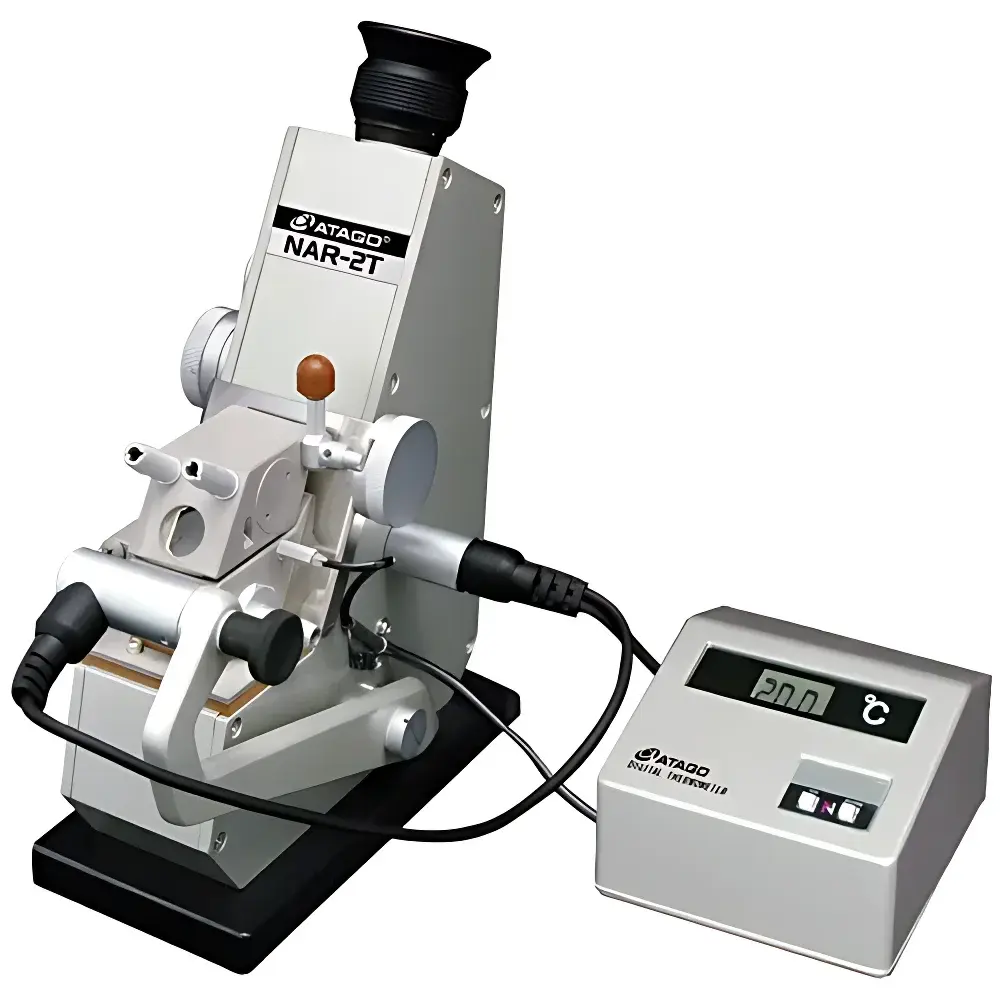
ATAGO NAR-2T High-Temperature Abbe Refractometer
| Brand | ATAGO |
|---|---|
| Origin | Japan |
| Model | NAR-2T (High-Temperature Version) |
| Product Type | Benchtop Abbe Refractometer |
| Measurement Range | Refractive Index (nD): 1.3000–1.7000 |
| Brix | 0.0–95.0% |
| Resolution | nD: 0.001 |
| Brix | 0.5% |
| Accuracy | nD: ±0.0002 |
| Brix | ±0.1% |
| Temperature Range | 5–120°C |
| Temperature Accuracy | ±0.2°C (ambient 5–40°C) |
| Power Supply | AC 100–240 V, 50/60 Hz |
| Power Consumption | 5 VA |
| Dimensions (Main Unit) | 13 × 18 × 23 cm |
| Weight (Main Unit) | 1.8 kg |
| Dimensions (Temperature Display Unit) | 10 × 11 × 7 cm |
| Weight (Temperature Display Unit) | 0.5 kg |
Overview
The ATAGO NAR-2T High-Temperature Abbe Refractometer is a precision optical instrument engineered for accurate determination of refractive index (nD) and Brix concentration in liquid and semi-viscous samples under elevated thermal conditions. Based on the classical Abbe principle—utilizing total internal reflection at the prism-sample interface—the NAR-2T enables direct, non-destructive measurement without sample dilution or chemical reagents. Its design accommodates thermally stable operation up to 120°C, making it uniquely suited for hot-process applications where conventional refractometers fail due to thermal drift or prism condensation. Unlike digital or portable units, the NAR-2T retains the mechanical robustness and optical fidelity of a traditional benchtop Abbe system, with calibrated glass prisms, adjustable collimator optics, and a high-contrast vernier scale for manual reading. This architecture ensures long-term stability, traceable calibration, and compliance with foundational metrological requirements for laboratory-grade refractometry.
Key Features
- High-temperature capability: Integrated heating block and temperature-controlled sample stage support continuous operation from 5°C to 120°C, enabling real-time analysis of hot syrups, molten sugars, sterilized pharmaceutical solutions, and thermally processed food matrices.
- Optical precision: Equipped with high-transmittance, low-birefringence crown glass prisms and a collimated sodium D-line (589.3 nm) light source, ensuring minimal chromatic aberration and consistent spectral response across the full nD range (1.3000–1.7000).
- Manual vernier readout with 0.001 resolution: Eliminates electronic sensor drift; provides direct, operator-verified readings traceable to NIST-traceable reference standards.
- Dual-scale calibrated eyepiece: Simultaneous visual indication of refractive index (nD) and Brix (% w/w), with built-in conversion tables for common substances (e.g., sucrose, glucose, glycerol, ethylene glycol).
- Thermal decoupling architecture: Separate temperature display unit (0.5 kg) interfaces via shielded analog signal transmission, minimizing electromagnetic interference and thermal crosstalk with the optical head.
- Low-power, universal AC input (100–240 V, 50/60 Hz, 5 VA): Designed for stable performance in shared lab environments with variable power infrastructure.
Sample Compatibility & Compliance
The NAR-2T accepts viscous, opaque, and thermally sensitive liquids—including fruit concentrates, caramelized syrups, polymer melts, hot lubricants, and sterile biopharmaceutical buffers—without requiring filtration or cooling. Its stainless-steel sample stage and quartz-coated prism surface resist corrosion from acidic, alkaline, or high-sugar media. The instrument conforms to ISO 2160 (petroleum products), AOAC 932.12 (food Brix), and USP (clarity and particulate matter) for refractometric validation protocols. While not intrinsically compliant with FDA 21 CFR Part 11, its analog readout and physical calibration logbook support GLP/GMP audit readiness when paired with documented SOPs and periodic verification using certified reference fluids (e.g., ATAGO Standard Liquid Set #2701).
Software & Data Management
The NAR-2T operates as a standalone optical instrument with no embedded microprocessor or digital data output. All measurements are recorded manually into laboratory notebooks or LIMS-compatible spreadsheets. For traceability, users are advised to document ambient temperature, prism temperature (via external display unit), sample identification, and observer initials per ASTM D1218–22 guidelines. Optional accessories—including temperature calibration certificates, NIST-traceable Brix standards (0–80%), and prism cleaning kits—are available to support IQ/OQ validation and routine maintenance per ISO/IEC 17025 requirements.
Applications
- Food & Beverage: Real-time Brix monitoring during jam, jelly, and syrup cooking cycles; quality control of honey, maple syrup, and concentrated fruit purees at fill temperature.
- Pharmaceutical Manufacturing: Verification of excipient concentration in hot-melt extrusion batches; assay of glycerin-based ointments and thermally sterilized injectables.
- Chemical Processing: Refractive index profiling of polymerization reactions in heated reactors; concentration tracking of ethylene glycol/water antifreeze blends post-heat treatment.
- Academic Research: Teaching fundamental optical principles in physical chemistry labs; comparative studies of temperature-dependent refractivity in binary and ternary liquid systems.
- Oil & Lubricants: Assessment of thermal degradation in synthetic ester-based lubricants after high-temperature aging tests.
FAQ
Does the NAR-2T support automated data logging or USB connectivity?
No. The NAR-2T is a fully analog, manually read instrument. Data capture requires handwritten entry or transcription into external systems.
Can the NAR-2T measure samples below 5°C?
No. The minimum operational temperature is 5°C. Sub-ambient measurements require auxiliary cooling stages not supplied with the standard configuration.
Is the temperature display unit required for operation?
Yes. The separate temperature display unit is integral to achieving ±0.2°C thermal accuracy within the 5–40°C ambient range and must be used for all calibrated measurements.
What maintenance is recommended for long-term optical stability?
Daily prism cleaning with lens tissue and anhydrous ethanol; annual recalibration against certified reference liquids; biannual inspection of collimator alignment by authorized ATAGO service centers.
How does the NAR-2T differ from the NAR-1T model?
The NAR-2T features an extended temperature range (up to 120°C vs. 80°C), reinforced heating elements, upgraded thermal insulation, and a dedicated dual-channel temperature monitoring system.





