
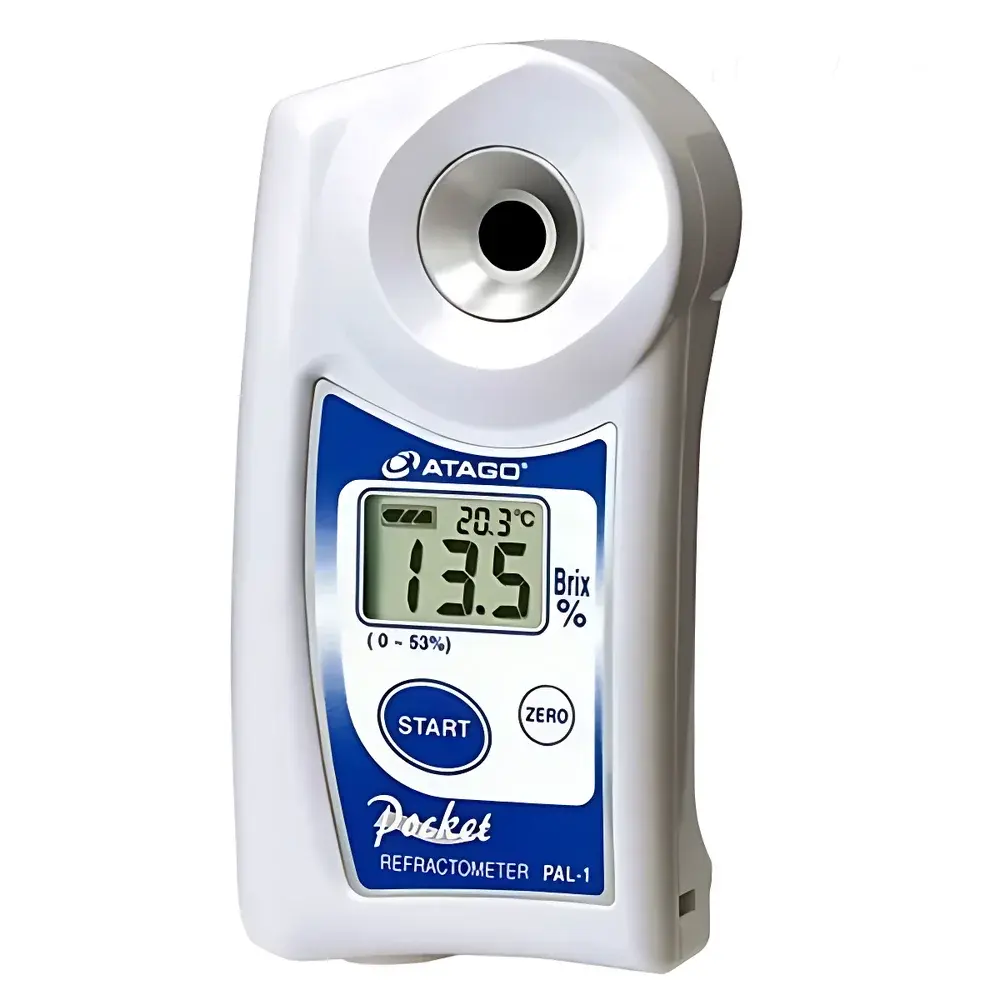
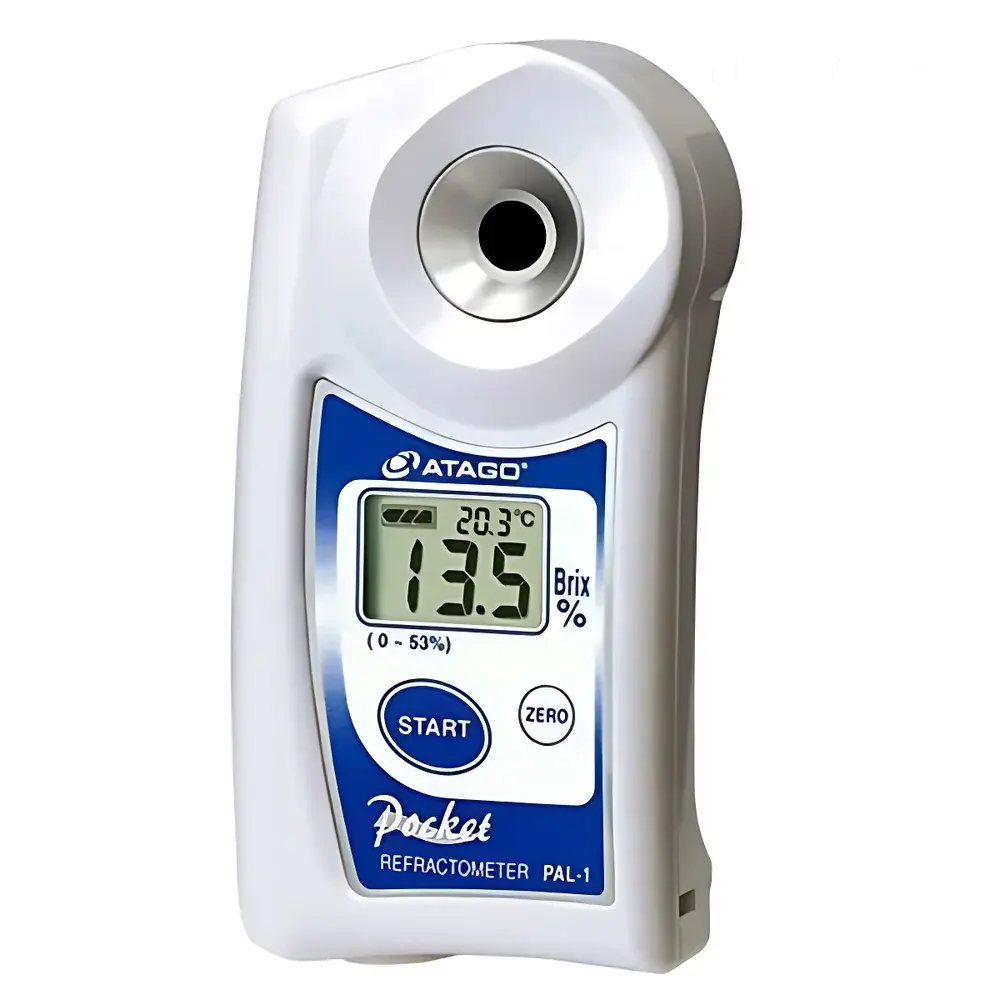
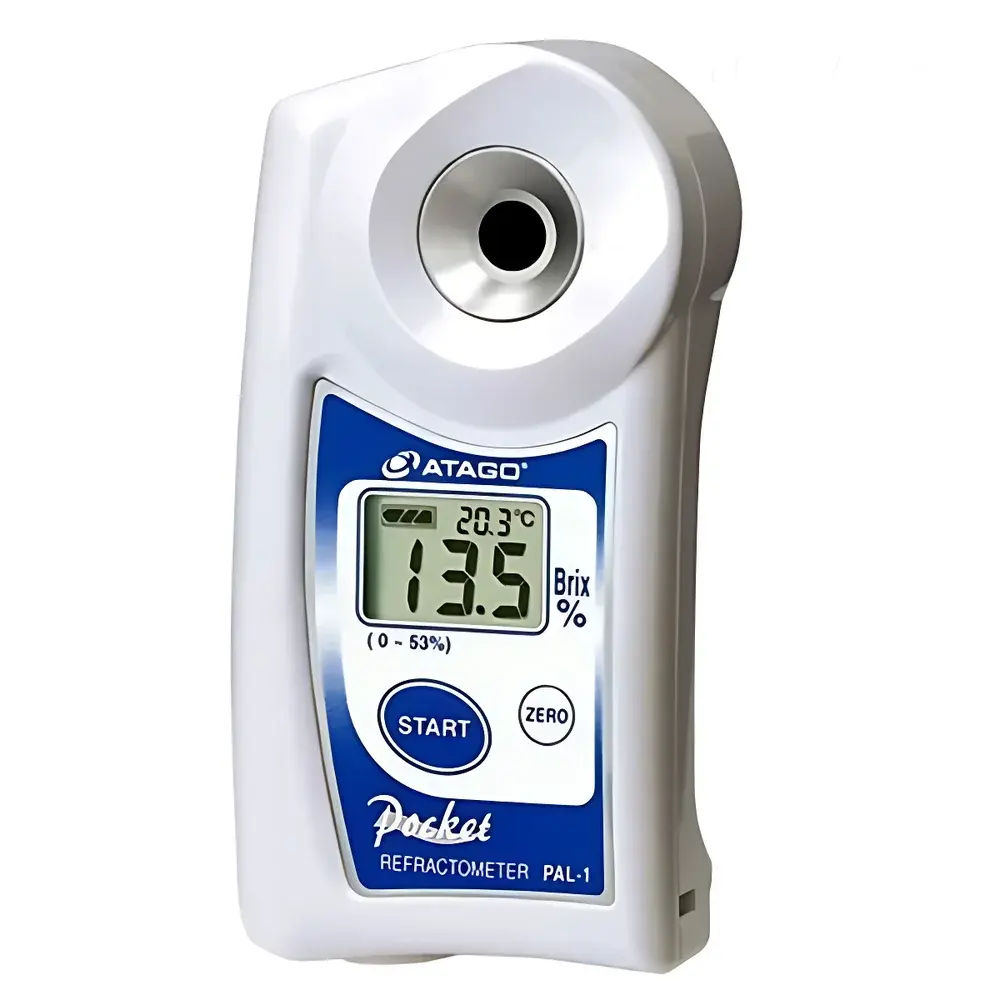
ATAGO PAL-1 Digital Portable Refractometer
| Brand | ATAGO |
|---|---|
| Origin | Japan |
| Model | PAL-1 |
| Measurement Range | 0.0–53.0% Brix |
| Automatic Temperature Compensation (ATC) | Yes |
| Digital Display | Yes |
| Data Storage Capacity | 100 measurements |
| NFC Data Transfer | Yes |
| Product Type | Portable Handheld Refractometer |
Overview
The ATAGO PAL-1 Digital Portable Refractometer is a precision handheld optical instrument engineered for rapid, field-deployable measurement of refractive index—converted directly to % Brix concentration—across diverse liquid samples. Based on the fundamental principle of critical angle refraction, the PAL-1 employs a high-stability LED light source and a sapphire prism surface to deliver repeatable optical path geometry under variable ambient conditions. Its compact, ergonomic design integrates a built-in thermistor sensor enabling real-time Automatic Temperature Compensation (ATC) across the standard operating range of 10–40 °C, ensuring measurement traceability without external calibration baths or manual correction tables. Unlike benchtop Abbe refractometers, the PAL-1 operates without requiring sample heating, solvent evaporation control, or operator-dependent visual interpolation—making it suitable for routine QC checks in production lines, orchard-side fruit assessment, and mobile laboratory applications where portability and speed are essential.
Key Features
- High-accuracy Brix measurement from 0.0 to 53.0% with ±0.2% Brix repeatability (at 20 °C, distilled water reference)
- Integrated ATC system compliant with ISO 2173:2003 and AOAC Official Method 932.12 for temperature-corrected refractometric analysis
- NFC-enabled wireless data transmission: Tap-to-transfer functionality supports direct logging into Android or Windows devices equipped with NFC readers; no proprietary software required
- Internal non-volatile memory stores up to 100 sequential measurements with timestamp metadata (date/time auto-recorded upon each reading)
- Sapphire-coated measuring prism ensures long-term scratch resistance and chemical inertness against acidic juices, alcohols, glycols, and aqueous industrial fluids
- IP65-rated enclosure provides protection against dust ingress and low-pressure water jets—suitable for use in humid processing environments or outdoor agricultural settings
- Battery-powered operation (2 × AAA alkaline cells) supports >10,000 measurements per set with auto-power-off after 3 minutes of inactivity
Sample Compatibility & Compliance
The PAL-1 is validated for use with homogeneous, non-turbid, non-viscous aqueous solutions including fruit juices (apple, orange, grape), soft drinks, syrups, honey dilutions, coolant concentrates, aqueous cutting fluids, and ethylene glycol-based antifreeze solutions. It is not intended for emulsions, suspensions, or highly viscous media (>100 mPa·s) that may impair prism contact or cause air trapping. All measurements adhere to internationally recognized refractometric standards: ISO 2173 (fruit and vegetable products), ISO 5725 (accuracy and precision of measurement methods), and ASTM D1152 (ethylene glycol and propylene glycol solutions). The device meets CE marking requirements under the EU Measuring Instruments Directive (MID) Annex MI-001 for portable refractometers used in legal metrology contexts involving trade-related concentration verification.
Software & Data Management
While the PAL-1 operates as a standalone instrument, its embedded NFC interface enables seamless integration into existing digital quality management workflows. Measurement records—including Brix value, ambient temperature, and timestamp—are transmitted in plain-text CSV format compatible with LIMS, Excel, or custom QA dashboards. No driver installation or cloud subscription is required. For regulated environments, the device supports GLP-compliant documentation: all stored readings retain immutable timestamps, and NFC transfer logs can be archived alongside batch records. Though not FDA 21 CFR Part 11 certified as a standalone system, the PAL-1 satisfies audit-ready data integrity requirements when paired with validated NFC reader hardware and controlled file-handling protocols.
Applications
- Fruit ripeness evaluation and harvest timing decisions via Brix correlation with soluble solids content (SSC), supporting compliance with USDA Grade Standards and UNECE fruit marketing guidelines
- In-process concentration monitoring of juice blends, soft drink bases, and dairy whey streams to maintain formulation consistency within ±0.3% Brix tolerance bands
- Field verification of coolant and heat transfer fluid concentrations in CNC machining centers—ensuring optimal lubricity and corrosion inhibition per OEM specifications
- Pre-shipment inspection of antifreeze/coolant premixes in automotive aftermarket distribution, verifying freeze-point alignment per SAE J1087
- Educational use in food science labs for teaching core principles of optical density, solute-solvent interaction, and empirical calibration curve development
FAQ
Does the PAL-1 require calibration before each use?
No—routine calibration is recommended once per shift using distilled water (0.0% Brix) and a certified sucrose standard (e.g., 10.0% or 30.0% Brix); the ATC system eliminates need for temperature-specific recalibration.
Can the PAL-1 measure non-aqueous solvents like ethanol or acetone?
It is not calibrated for pure organic solvents; Brix scale assumes sucrose/water matrix. Use only for aqueous solutions where refractive index correlates linearly with sugar concentration.
Is the NFC function compatible with iOS devices?
No—NFC data transfer is supported exclusively on Android 6.0+ and Windows 10/11 devices with integrated NFC controllers meeting ISO/IEC 14443-A standard.
What is the minimum sample volume required?
Approximately 0.3 mL is sufficient to fully cover the prism surface; excess fluid is automatically wicked away by capillary action.
How is measurement uncertainty quantified for regulatory reporting?
Per ATAGO’s published technical specification sheet (Rev. 2023), expanded uncertainty (k=2) is ±0.4% Brix across the full range, determined per GUM (JCGM 100:2008) using Type A and Type B evaluations.



