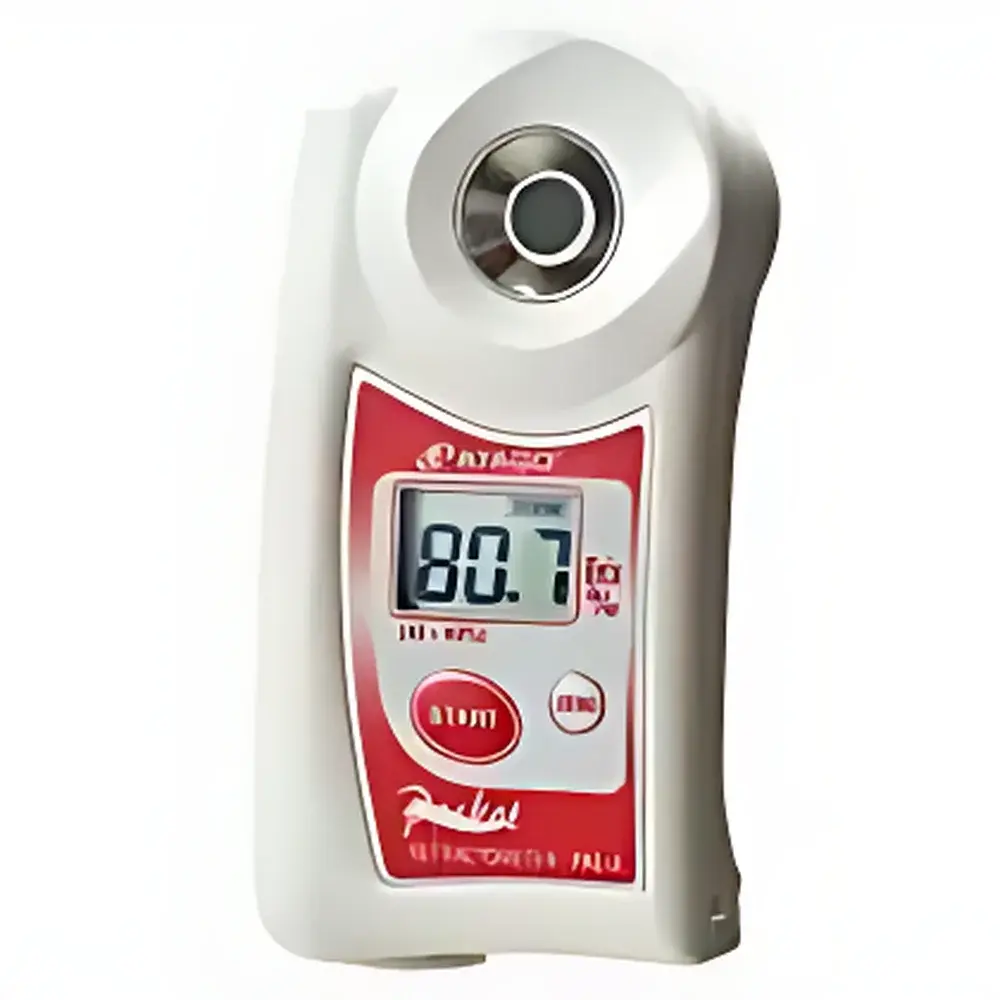
ATAGO PAL-2 Digital Pocket Refractometer
| Brand | ATAGO |
|---|---|
| Origin | Japan |
| Model | PAL-2 |
| Measurement Range | Brix 45.0–93.0% |
| Temperature Range | 9.0–99.9°C |
| Resolution | Brix ±0.1%, Temperature ±0.1°C |
| Accuracy | Brix ±0.2%, Temperature ±1.0°C |
| Sample Volume | 0.3 mL |
| Measurement Time | 3 seconds |
| Temperature Compensation | Automatic (ATC), 10–100°C |
| Environmental Rating | IP65 |
| Power Supply | 2 × AAA batteries |
| Dimensions | 55(W) × 31(D) × 109(H) mm |
| Weight | 100 g (body only) |
Overview
The ATAGO PAL-2 Digital Pocket Refractometer is a compact, handheld optical instrument engineered for rapid, field-deployable measurement of soluble solids concentration—expressed as Brix (% w/w sucrose equivalent)—in highly concentrated aqueous solutions. It operates on the principle of critical angle refractometry: light passing from a high-refractive-index prism into the sample undergoes total internal reflection at an angle inversely proportional to the sample’s refractive index, which correlates directly with solute concentration. Designed specifically for high-Brix applications, the PAL-2 delivers reliable readings in viscous, thermally unstable, or particulate-laden matrices where conventional benchtop refractometers face limitations in speed, sample handling, or thermal equilibration. Its robust mechanical architecture and integrated automatic temperature compensation (ATC) ensure consistent performance across process environments—from hot-fill jam lines to ambient storage tanks—without requiring external calibration fluids.
Key Features
- Extended high-concentration range: Brix 45.0–93.0%, optimized for honey, fruit concentrates, syrups, molasses, and processed preserves.
- True one-button operation with 3-second measurement cycle—no warm-up time required.
- IP65-rated enclosure: dust-tight and protected against low-pressure water jets, enabling direct rinsing of the sapphire-coated prism after sticky sample contact.
- Automatic temperature compensation (ATC) across 10–100°C, eliminating manual correction and supporting real-time monitoring of freshly heated samples (e.g., post-boil jam at ~95°C).
- Zero-point calibration using distilled water only—no certified sucrose standards required for routine operation.
- Low sample volume requirement (0.3 mL) minimizes waste and enables testing of small-batch or pilot-scale formulations.
- Lightweight (100 g) and ergonomic form factor supports extended use during line checks, warehouse audits, or supplier verification visits.
Sample Compatibility & Compliance
The PAL-2 is validated for use with non-volatile, non-opaque, aqueous-based solutions exhibiting moderate to high viscosity (e.g., ≥5,000 cP). It accommodates samples containing suspended particles ≤50 µm when homogenized immediately prior to measurement. While not intended for volatile solvents or emulsions, it meets standard operational requirements for food-grade quality control per ISO 2173:2003 (fruit and vegetable products) and AOAC Official Method 932.12 (refractometric determination of soluble solids). Its IP65 rating complies with IEC 60529 for ingress protection, supporting deployment in wet-processing zones under GMP-aligned hygiene protocols. Device firmware and calibration traceability support audit readiness for FDA 21 CFR Part 11–governed environments when used with documented SOPs and periodic verification using traceable sucrose reference standards (e.g., RE-110050/RE-110060).
Software & Data Management
As a standalone, battery-powered instrument, the PAL-2 does not feature onboard data logging or Bluetooth connectivity. However, its analog output-free design ensures electromagnetic compatibility in electrically noisy production areas. For traceable recordkeeping, users may pair the PAL-2 with ATAGO’s optional RE-39409 protective case (with embedded log sheet holder) and implement manual entry into LIMS or Excel-based QC databases. Calibration verification records—including date, operator ID, reference standard lot number, and deviation from nominal value—should be retained per GLP and HACCP documentation requirements. The absence of firmware updates or cloud synchronization simplifies validation and reduces cybersecurity exposure in regulated manufacturing settings.
Applications
- Real-time Brix verification during hot-fill jam, marmalade, and jelly production—immediately post-cooking, before filling.
- Concentrate blending control in juice processing (e.g., orange, apple, grape) to ensure target °Brix prior to pasteurization.
- Incoming raw material inspection of honey lots for adulteration screening (deviations >±0.5% Brix from declared specification).
- Batch release testing of sugar-based pharmaceutical excipients (e.g., sucrose solutions for lyophilization buffers).
- On-site quality assessment of syrup-based nutraceuticals and functional beverages during co-packing audits.
- Process troubleshooting in dairy evaporation lines where lactose crystallization onset correlates with Brix drift beyond 85%.
FAQ
Can the PAL-2 measure samples above 93.0% Brix?
No—the optical system is calibrated and validated exclusively within the 45.0–93.0% Brix range. Readings beyond this span fall outside linear detector response and are not traceable to NIST-traceable sucrose standards.
Is temperature compensation active below 10°C or above 100°C?
ATC is disabled outside the 10–100°C operational window. Measurements taken at 100°C will display uncorrected refractive index values and must be manually adjusted using published temperature-Brix correction tables.
Does the PAL-2 require recalibration before each use?
No—zeroing with distilled water is sufficient for daily operation. Full verification using certified sucrose standards (e.g., RE-110050) is recommended at start-of-shift, after prism cleaning, or following any physical impact to the instrument.
Can the device be used with corrosive or acidic samples?
The sapphire prism surface resists mild organic acids (e.g., citric, malic) at typical food concentrations; however, prolonged exposure to strong mineral acids (pH <2) or alkaline cleaners may degrade the anti-reflective coating. Rinse immediately with deionized water after contact.
What is the expected battery life under typical usage?
Two AAA alkaline batteries provide approximately 10,000 measurements (at 3-second intervals, 25°C ambient), equivalent to ≥12 months of routine QC lab use. Low-battery indication appears 30 seconds prior to shutdown.