
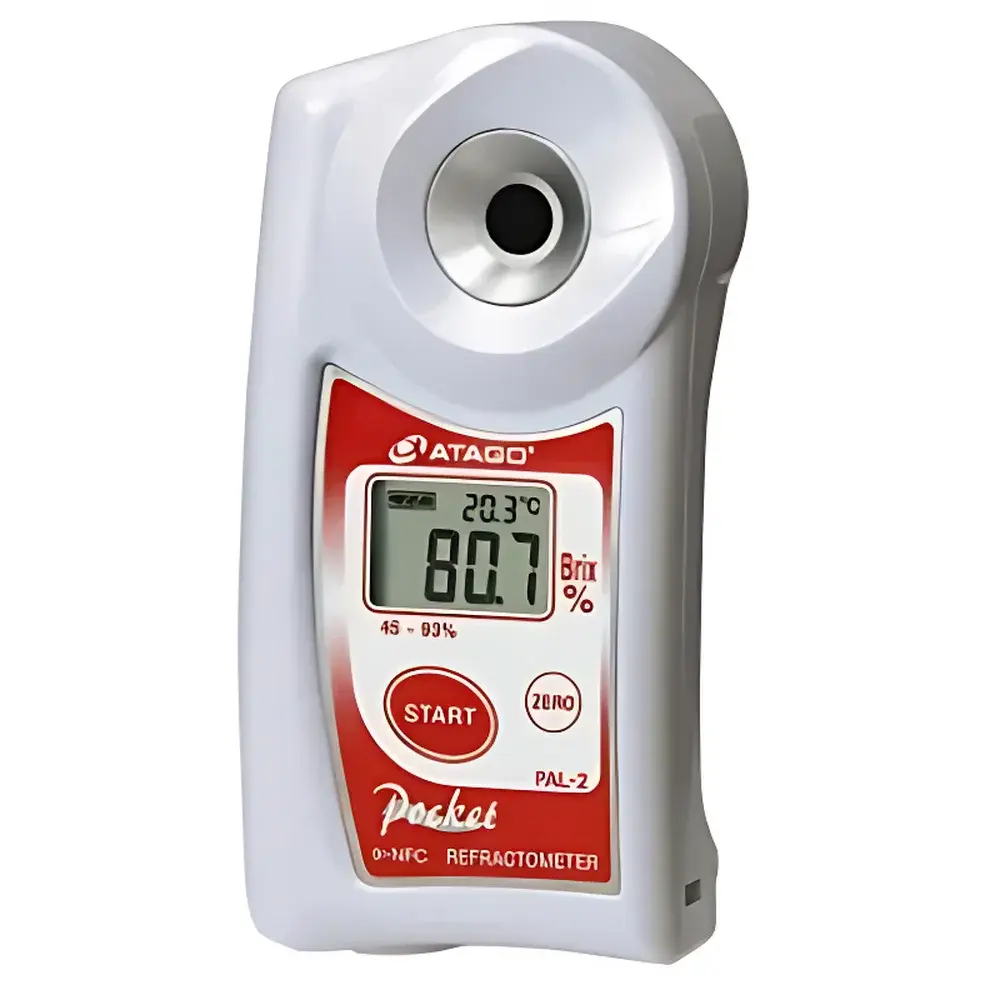
ATAGO PAL-2 Digital Refractometer for High-Brix Jam and Syrup Analysis
| Brand | ATAGO |
|---|---|
| Origin | Japan |
| Model | PAL-2 |
| Measurement Principle | Abbe-type Refractometry |
| Sample Type | Destructive (Liquid/Viscous Semi-Solid) |
| Brix Range | 45.0–93.0% |
| Temperature Range (Sample) | 10.0–100.0°C |
| Brix Resolution | 0.1% |
| Temperature Resolution | 0.1°C |
| Brix Accuracy | ±0.2% |
| Temperature Accuracy | ±1.0°C |
| Automatic Temperature Compensation (ATC) | Yes, 10–40°C ambient |
| Sample Volume | 0.3 mL |
| Measurement Time | ≤3 s |
| IP Rating | IP65 |
| Power Supply | 2 × AAA batteries |
| Dimensions (W×D×H) | 55 × 31 × 109 mm |
| Weight | 100 g (body only) |
Overview
The ATAGO PAL-2 Digital Refractometer is a compact, handheld instrument engineered for precise Brix concentration measurement in highly viscous, high-solids aqueous solutions—specifically formulated for quality control in jam, jelly, honey, concentrated fruit syrups, and evaporated juice production. Unlike standard refractometers optimized for low-to-mid Brix ranges (0–32%), the PAL-2 employs a custom-calibrated Abbe-type optical prism system with extended dispersion compensation, enabling reliable refractive index-to-Brix conversion across 45.0–93.0% w/w sucrose-equivalent concentration. Its measurement principle relies on total internal reflection at the prism-sample interface; incident light undergoes angular deviation proportional to the sample’s refractive index, which is digitally converted to Brix using a factory-validated polynomial algorithm traceable to NIST-traceable sucrose reference standards. The device operates under automatic temperature compensation (ATC), dynamically correcting readings based on real-time sample surface temperature (10.0–100.0°C), ensuring metrological consistency despite thermal variability common in hot-fill or post-cooking process streams.
Key Features
- Extended high-Brix range (45.0–93.0%) optimized for confectionery, preserves, and reduced-sugar formulations where conventional refractometers saturate or drift.
- True destructive measurement mode: accommodates semi-solid, non-homogeneous, or particulate-laden samples via direct prism contact—no dilution or filtration required.
- IP65-rated enclosure ensures resistance to dust ingress and low-pressure water jets, supporting operation in humid production environments, wet cleaning zones, and QC labs with frequent sanitation cycles.
- 0.3 mL minimum sample volume minimizes material waste and enables rapid verification of small-batch prototypes or pilot-scale trials.
- 3-second measurement cycle supports high-throughput inline checks without disrupting production flow—ideal for HACCP critical control point monitoring.
- Integrated ATC eliminates manual correction tables; compensation algorithm validated per ISO 2173:2003 (fruit and vegetable products) and AOAC Official Method 932.12 (refractometric Brix).
Sample Compatibility & Compliance
The PAL-2 is validated for direct analysis of thermally stable, aqueous-based high-solids matrices including fruit jams (pH 2.8–4.2), pectin-gelled jellies, invert sugar syrups, floral honeys (water activity <0.6), and clarified fruit concentrates. It is not intended for volatile solvents, emulsions, or suspensions containing >5% insoluble solids (e.g., pulp, seeds). Regulatory alignment includes compliance with ISO 5725 (accuracy and precision of measurement methods), adherence to GLP documentation requirements for instrument calibration logs, and compatibility with FDA 21 CFR Part 11–compliant data capture when paired with ATAGO’s optional RS-232 interface and LogMaster software (sold separately). Calibration verification follows ATAGO’s recommended quarterly schedule using certified Brix reference fluids (e.g., 50.0%, 70.0%, and 90.0% sucrose standards).
Software & Data Management
While the PAL-2 operates as a standalone field instrument, its RS-232 serial output (via optional cable kit) enables integration into centralized QC databases. When connected to ATAGO LogMaster v3.2 (Windows-compatible), users can export timestamped Brix/temperature records, generate calibration verification reports, and apply statistical process control (SPC) filters—including X-bar/R charting—to detect batch drift or equipment degradation. All exported data retain embedded instrument ID, operator code, and environmental metadata—supporting audit readiness for ISO 22000, BRCGS Food Safety Issue 9, and SQF Level 3 certification requirements.
Applications
- Final product release testing of commercial jams and jellies per USP <911> and Codex Alimentarius STAN 247-2005 specifications.
- In-process monitoring of sugar inversion during thermal concentration to prevent caramelization or Maillard reaction onset.
- Raw material acceptance of honey lots against EU Directive 2001/110/EC purity thresholds.
- R&D formulation optimization for low-sugar spreads, where Brix correlates directly with water activity (aw) and microbial stability.
- Contract manufacturing audits requiring documented proof of consistent Brix delivery across multi-site production networks.
FAQ
Does the PAL-2 require recalibration before each use?
No—factory calibration remains stable for ≥3 months under normal operating conditions. However, daily verification with a single-point Brix standard (e.g., 70.0%) is recommended prior to critical measurements.
Can the PAL-2 measure samples above 100°C?
No. Maximum sample temperature is strictly 100.0°C. Exceeding this risks prism coating degradation and permanent optical misalignment.
Is the prism surface resistant to acidic fruit matrices?
Yes—the sapphire-coated BK7 glass prism exhibits full chemical inertness toward organic acids (citric, malic, ascorbic) at concentrations typical in jam formulations (pH ≥2.5).
How is traceability maintained for regulatory submissions?
Each unit ships with a NIST-traceable calibration certificate (serial-numbered), and LogMaster software generates 21 CFR Part 11–compliant electronic records with user authentication, audit trails, and immutable timestamps.
What maintenance is required beyond cleaning?
Prism surface must be wiped with lint-free tissue and distilled water after each use; isopropyl alcohol may be used for residue removal. Annual professional inspection is advised to verify ATC sensor drift and optical alignment.






