
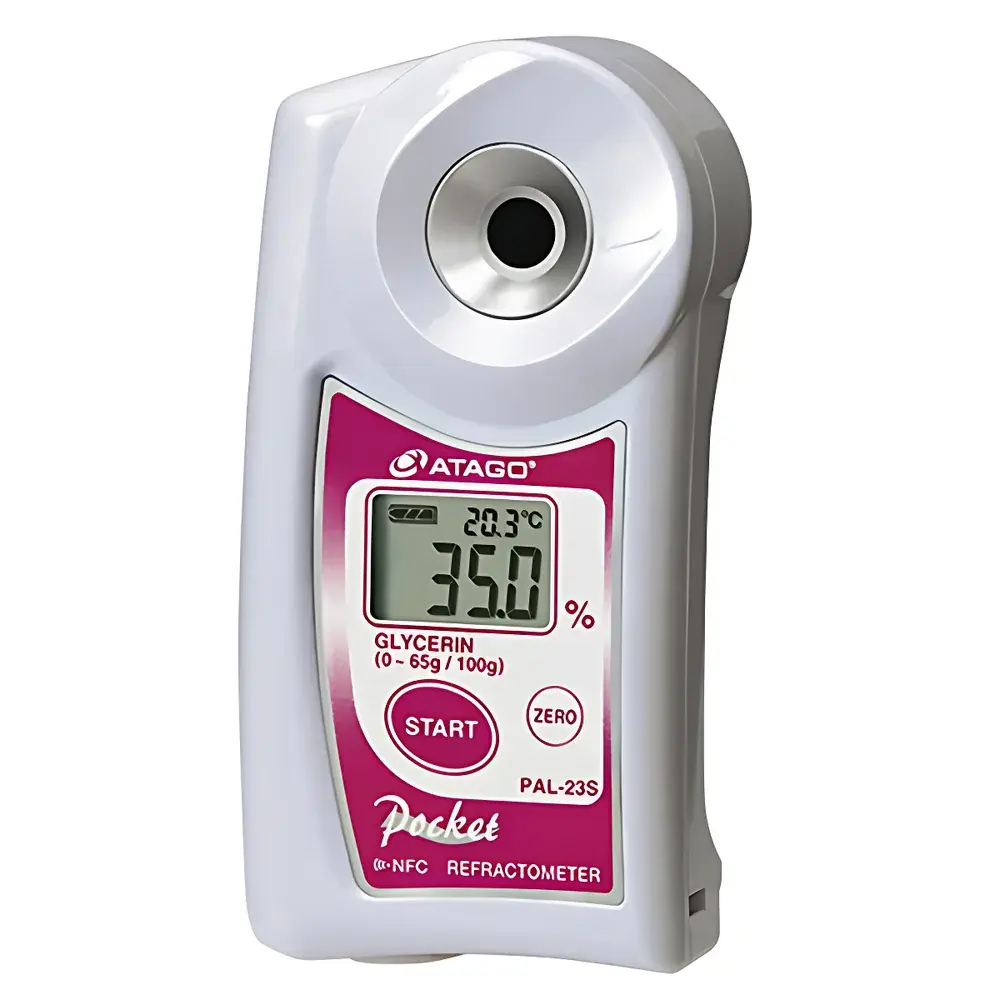
ATAGO PAL-23S Handheld Digital Glycerol Refractometer
| Brand | ATAGO |
|---|---|
| Origin | Japan |
| Model | PAL-23S |
| Product Type | Handheld Refractometer |
| Temperature Compensation | Automatic (ATC), 10–40°C |
| Display | Digital LCD |
| Measurement Range | 0.0–65.0% glycerol (w/w) |
| Accuracy | ±0.4% |
| Resolution | 0.2% |
| Sample Volume | 0.3 mL |
| Measurement Time | 3 seconds |
| IP Rating | IP65 |
| Power Supply | 2 × AAA batteries |
| Dimensions | 5.5 × 3.1 × 10.9 cm |
| Weight | 100 g (main unit only) |
Overview
The ATAGO PAL-23S Handheld Digital Glycerol Refractometer is a precision optical instrument engineered for rapid, field-deployable quantification of glycerol concentration in aqueous solutions. It operates on the fundamental principle of refractometry—measuring the refractive index (RI) of a sample and converting it to glycerol mass fraction (%) via a calibrated polynomial algorithm specific to glycerol–water binary systems. Unlike generic Brix or salinity refractometers, the PAL-23S employs a factory-installed, application-specific calibration curve traceable to NIST-traceable glycerol reference standards. Its design targets quality control environments where low-to-mid concentration glycerol verification is critical—particularly in pharmaceutical excipient preparation, sterile formulation support, biopreservation buffer validation, and diagnostic reagent manufacturing. The device integrates automatic temperature compensation (ATC) across 10–40°C, eliminating manual correction and ensuring measurement stability under variable ambient conditions typical of cleanrooms, QC labs, and production line stations.
Key Features
- Application-optimized optical path with high-stability LED light source and Abbe-type prism assembly for consistent RI detection
- Digital LCD display with backlight for clear readability in low-light environments (e.g., laminar flow hoods, glove boxes)
- IP65-rated enclosure—dust-tight and protected against low-pressure water jets—suitable for use in controlled but non-sterile manufacturing zones
- Minimal sample requirement (0.3 mL) reduces reagent waste and enables testing of precious or limited-volume batches
- 3-second measurement cycle supports high-throughput screening without thermal equilibration delay
- Low-power architecture: two standard AAA batteries provide >5,000 measurements per set, with auto-shutdown after 3 minutes of inactivity
- Ergonomic, one-handed operation with non-slip rubberized grip and intuitive single-button interface
Sample Compatibility & Compliance
The PAL-23S is validated for homogeneous, non-viscous, particle-free glycerol–water solutions at temperatures between 10°C and 40°C. It is not intended for use with suspensions, emulsions, highly viscous glycerol–polymer blends, or samples containing volatile organic solvents (e.g., ethanol, acetone), which may alter surface tension or evaporate during measurement and compromise RI accuracy. While the instrument itself does not carry CE marking for IVD use or FDA 510(k) clearance, its measurement methodology aligns with ASTM D1152–20 (“Standard Test Method for Glycerin”) and supports GLP-compliant documentation when paired with external lab notebooks or LIMS-integrated reporting workflows. Calibration verification using certified glycerol reference standards (e.g., 10.0%, 30.0%, 50.0% w/w) is recommended before each shift or after transport-induced shock.
Software & Data Management
The PAL-23S is a standalone, firmware-based instrument with no onboard data logging, USB connectivity, or Bluetooth capability. All measurements are displayed in real time and must be manually recorded or transcribed into electronic quality records. This architecture intentionally avoids regulatory complexities associated with electronic record integrity (e.g., FDA 21 CFR Part 11 audit trails), making it suitable for environments where paper-based or LIMS-managed entry remains the primary documentation method. For laboratories requiring digital capture, ATAGO recommends pairing the PAL-23S with its optional RS-232-compatible data logger (PAL-LOG series) or integrating it into automated workflows via analog output adapters compliant with 0–5 V DC signal protocols.
Applications
- Verification of glycerol concentration in cryoprotectant solutions for cell banking and stem cell storage
- In-process monitoring of glycerol dilution steps during IV drug compounding (e.g., heparin flushes, contrast media stabilizers)
- Release testing of glycerol-based topical ointments and mucosal delivery vehicles
- Raw material receipt inspection for USP/EP-grade glycerol shipments
- Stability study sampling—tracking glycerol loss due to hygroscopicity or container permeation over time
- Teaching laboratories demonstrating colligative property relationships between concentration and refractive index
FAQ
Does the PAL-23S require periodic recalibration by the user?
No—its calibration is factory-set and sealed. Users should perform daily verification using traceable glycerol standards; full recalibration is only performed by authorized ATAGO service centers.
Can the PAL-23S measure glycerol in phosphate-buffered saline (PBS) or other electrolyte solutions?
No. Dissolved salts significantly alter refractive index independently of glycerol content, leading to systematic positive bias. The instrument is validated exclusively for glycerol–water systems.
Is the prism surface resistant to corrosion from repeated glycerol exposure?
Yes—the sapphire-coated measuring prism exhibits exceptional chemical inertness and mechanical durability, with no observed degradation after >10,000 routine cleanings with deionized water and lint-free wipes.
What is the minimum detectable change in glycerol concentration?
With 0.2% resolution and ±0.4% accuracy, the PAL-23S reliably distinguishes concentration differences ≥0.6% under controlled temperature and operator technique conditions.
How does ATC function without an external temperature probe?
An integrated thermistor adjacent to the prism measures sample-contact temperature in real time and applies a pre-characterized correction coefficient derived from multi-point glycerol RI vs. temperature mapping across the 10–40°C range.




