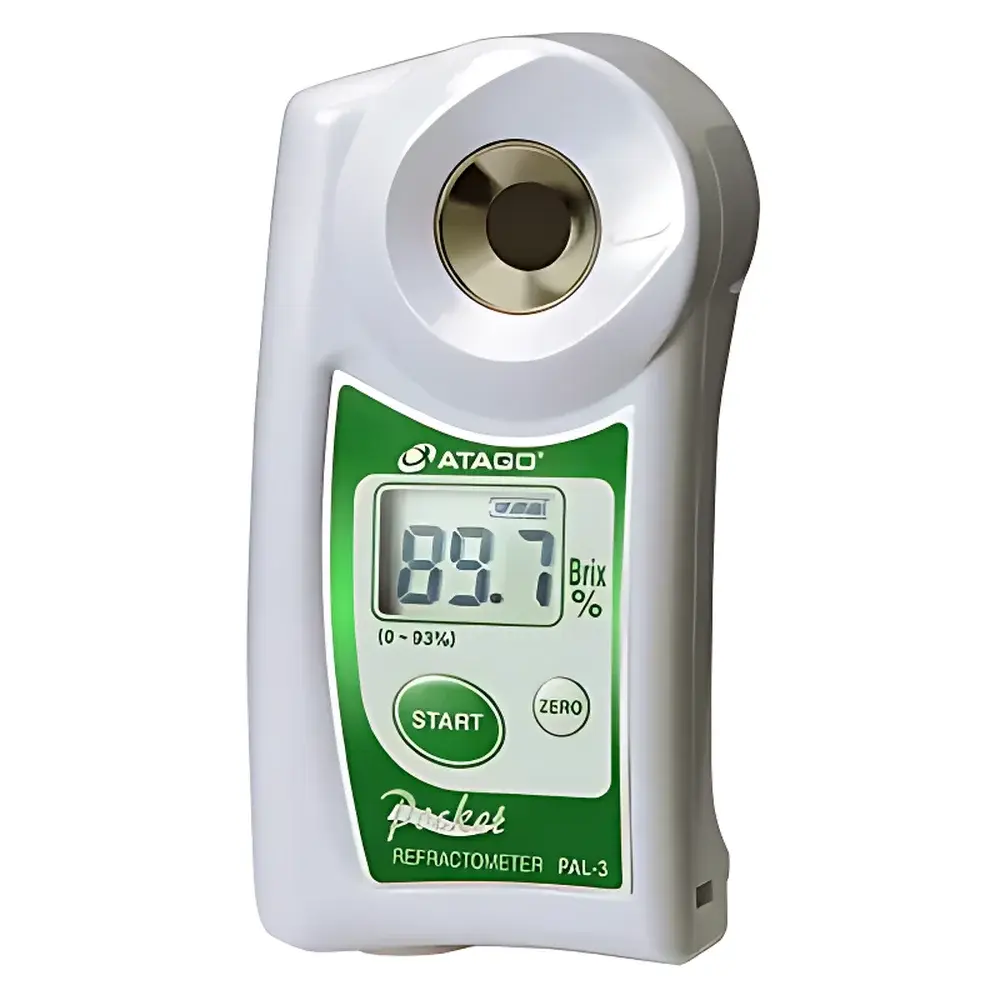
ATAGO PAL-3 Digital Pocket Refractometer
| Brand | ATAGO |
|---|---|
| Origin | Japan |
| Model | PAL-3 |
| Measurement Range | Brix 0.0–93.0% |
| Temperature Range | 9.0–99.9°C |
| Brix Resolution | 0.1% |
| Temperature Resolution | 0.1°C |
| Accuracy | ±0.1% Brix, ±1.0°C |
| Automatic Temperature Compensation (ATC) | Yes (10–100°C) |
| Sample Volume | 0.3 mL |
| Measurement Time | Approx. 3 seconds |
| Power Supply | 2 × AAA batteries |
| IP Rating | IP65 |
| Dimensions | 55(W) × 31(D) × 109(H) mm |
| Weight | 100 g (body only) |
| Operating Ambient Temperature | 10–40°C |
| Calibration Standards Available | 10–60% sucrose solutions (certified ±0.03–±0.05% Brix) |
Overview
The ATAGO PAL-3 Digital Pocket Refractometer is a compact, precision-engineered optical instrument designed for rapid, field-deployable measurement of refractive index and its derived concentration units—primarily Brix (% w/w sucrose equivalent)—in liquid and semi-liquid samples. Based on the principle of total internal reflection at the prism-sample interface, the PAL-3 employs a high-stability LED light source and a linear CCD sensor array to determine the critical angle of refraction with high repeatability. Its integrated automatic temperature compensation (ATC) algorithm applies real-time correction across the full operational sample temperature range (10–100°C), referencing the internationally accepted ICUMSA sucrose temperature coefficient curve. This ensures metrological consistency without manual recalibration, making the PAL-3 suitable for both laboratory benchtop verification and mobile process monitoring in food, beverage, pharmaceutical, and chemical manufacturing environments.
Key Features
- Ultra-compact form factor (55 × 31 × 109 mm, 100 g) enables one-handed operation and portability across production lines, storage facilities, and R&D labs.
- Wide Brix measurement range (0.0–93.0%) accommodates low-concentration brines, fruit juices, syrups, honey, concentrated acids, and industrial glycol solutions.
- High-resolution display shows Brix (0.1% resolution) and sample temperature (0.1°C resolution) simultaneously, with visual pass/fail indicators configurable via optional software tools.
- IP65-rated enclosure provides dust-tight integrity and protection against water jets—enabling reliable use in humid processing areas, washdown zones, and outdoor ambient conditions.
- Three-second measurement cycle minimizes downtime during inline quality checks; no warm-up time required.
- Low-power design powered by two standard AAA batteries supports >10,000 measurements per set under typical usage, reducing maintenance frequency and operational cost.
Sample Compatibility & Compliance
The PAL-3 is optimized for homogeneous aqueous solutions where dissolved solids dominate refractive behavior—including sucrose, glucose, fructose, sodium chloride, ethylene glycol, propylene glycol, and common organic acids. It is not intended for turbid, highly viscous, or emulsified samples without prior filtration or dilution. The instrument complies with JIS Z 8805 (Refractometers for Sugar Solutions) and aligns with ASTM D1074–21 (Standard Test Method for Refractive Index of Viscous Materials) when used with appropriate calibration protocols. While not inherently 21 CFR Part 11 compliant as a standalone device, its measurement data—when captured via ATAGO’s optional PAL-Link software—supports traceable audit trails, electronic signatures, and secure export formats required for GLP and GMP documentation workflows.
Software & Data Management
The PAL-3 operates autonomously without external connectivity; however, optional PAL-Link PC software (Windows-based) enables bidirectional communication via USB adapter (sold separately). Users can perform firmware updates, configure unit preferences (e.g., switching between Brix, NaCl %, or custom concentration curves), export timestamped measurement logs (CSV/Excel), and generate calibration reports with operator ID and environmental metadata. All calibration standards (RE-110010 through RE-110060) are NIST-traceable sucrose reference solutions certified to ±0.03–±0.05% Brix uncertainty, supporting ISO/IEC 17025-compliant internal calibration procedures.
Applications
- Food & Beverage: Real-time Brix verification during juice blending, jam cooking, syrup concentration, dairy whey processing, and fermentation endpoint detection.
- Pharmaceutical Excipients: Rapid assessment of glycerin, propylene glycol, and PEG solution concentrations in formulation development and QC release testing.
- Automotive & Industrial Fluids: Glycol concentration monitoring in engine coolants and heat-transfer fluids to ensure freeze/boil protection integrity.
- Agriculture & Horticulture: Field measurement of sap Brix as an indicator of plant nutrient status and harvest readiness.
- Chemical Manufacturing: Concentration control of caustic soda, hydrochloric acid, and ammonium sulfate solutions where refractive index correlates linearly with mass fraction.
FAQ
Does the PAL-3 require periodic recalibration?
Yes—ATAGO recommends daily verification using a certified standard solution before critical measurements; full recalibration is advised every 3–6 months depending on usage frequency and environmental exposure.
Can the PAL-3 measure non-sugar solutions accurately?
It provides accurate readings for any solute exhibiting a stable, monotonic refractive index vs. concentration relationship; however, users must validate linearity and apply custom calibration curves for non-sucrose matrices via PAL-Link software.
Is the prism surface chemically resistant?
The sapphire prism is resistant to most aqueous solutions, alcohols, and mild organic solvents; avoid contact with strong oxidizers (e.g., concentrated nitric acid), hydrofluoric acid, or abrasive particulates.
What does IP65 rating mean for operational use?
It certifies complete protection against dust ingress and resistance to low-pressure water jets from any direction—making the device suitable for Zone 22 hazardous locations and frequent wet cleaning cycles.
How is temperature compensation implemented?
The built-in thermistor continuously monitors sample temperature at the prism interface and applies a polynomial correction based on the ICUMSA sucrose reference table, eliminating manual correction tables or external thermometers.