
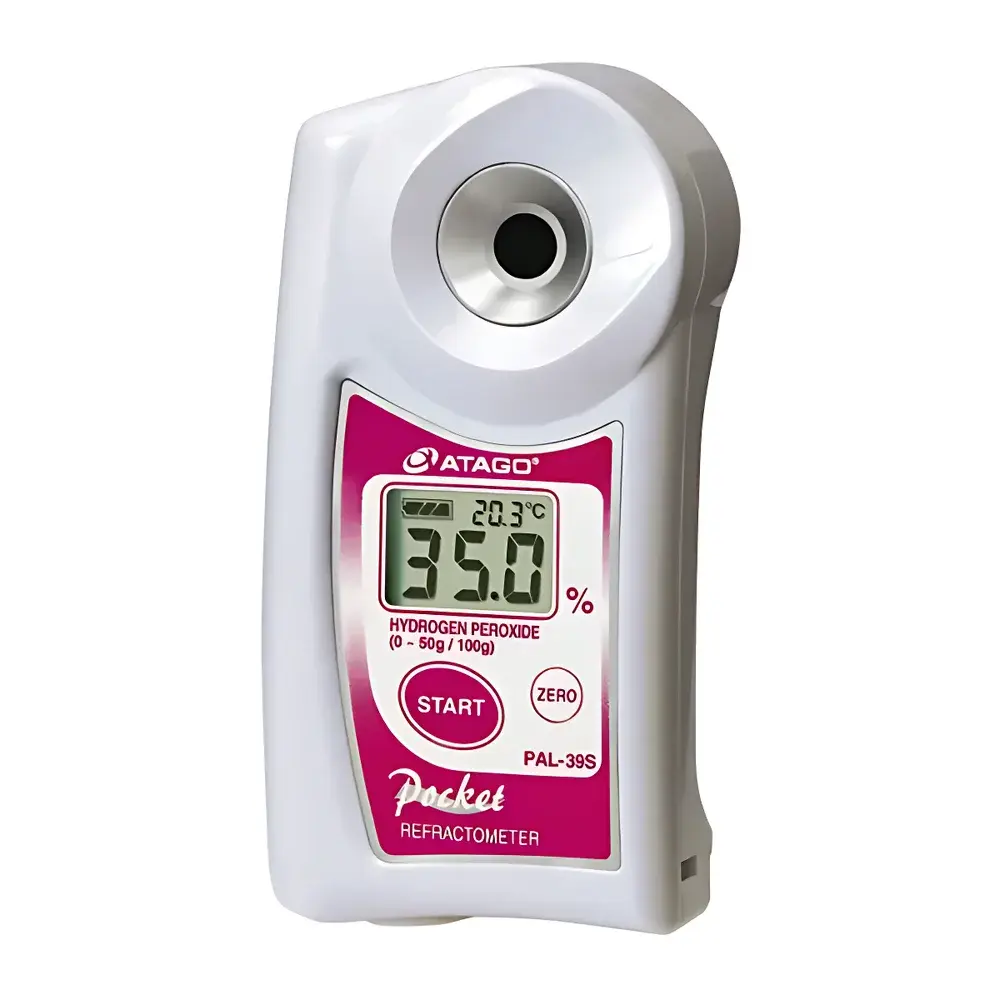
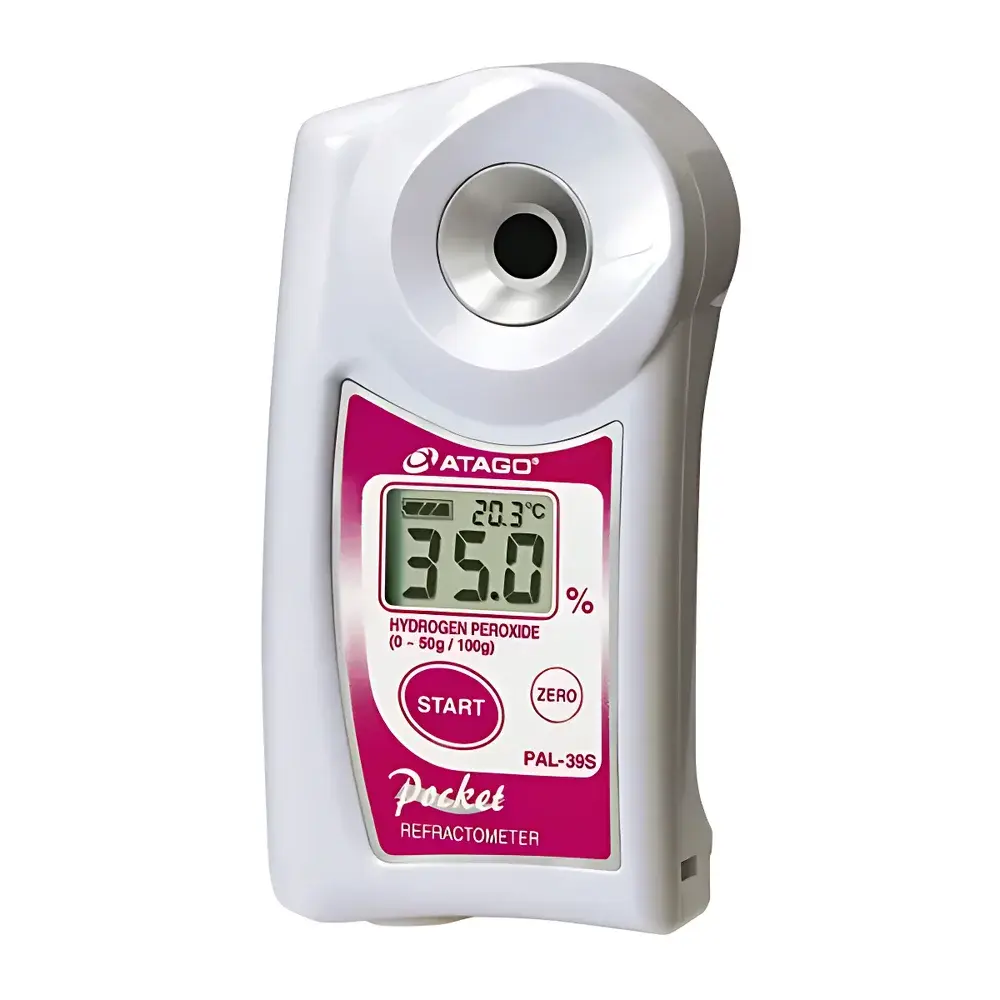
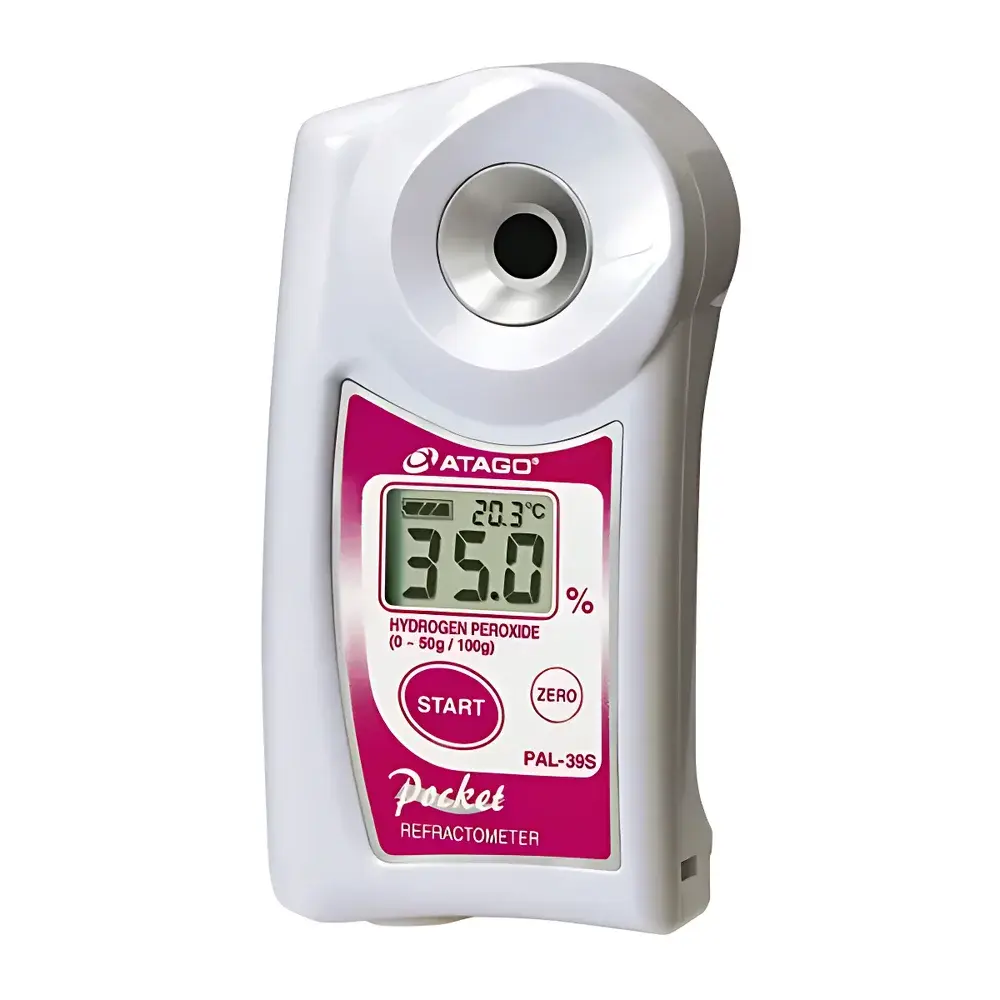
ATAGO PAL-39S Mini Digital Hydrogen Peroxide Refractometer
| Brand | ATAGO |
|---|---|
| Origin | Japan |
| Model | PAL-39S |
| Measurement Range | 0–50.0% H₂O₂ (w/w) |
| Accuracy | ±0.2% H₂O₂ |
| Resolution | 0.1% H₂O₂ |
| Temperature Compensation | Automatic (10–35°C) |
| Sample Volume | 0.3 mL |
| Response Time | ≤3 seconds |
| Power Supply | 2×AAA batteries |
| IP Rating | IP65 |
| Dimensions | 55 (W) × 31 (D) × 109 (H) mm |
| Weight | 100 g (body only) |
Overview
The ATAGO PAL-39S Mini Digital Hydrogen Peroxide Refractometer is a handheld, temperature-compensated optical instrument engineered for rapid, field-deployable quantification of hydrogen peroxide (H₂O₂) concentration in aqueous solutions. It operates on the principle of critical-angle refractometry: incident light passes through a prism-sample interface, and the resulting refraction angle—directly correlated to the solution’s refractive index—is converted into H₂O₂ mass concentration (%) via a pre-calibrated polynomial algorithm optimized specifically for H₂O₂–water systems. Unlike generic refractometers, the PAL-39S employs a dedicated optical path and calibration curve traceable to NIST-traceable reference standards, ensuring metrological integrity across the full 0–50.0% w/w range. Its design targets environments where portability, speed, and robustness are non-negotiable—pharmaceutical cleanroom monitoring, medical device sterilization validation, industrial chemical dosing control, and bioprocess intermediate checks—without requiring lab-grade infrastructure or operator training beyond basic SOP adherence.
Key Features
- Optimized optical system with high-stability sapphire prism for consistent refractive index measurement under variable ambient lighting and surface contamination conditions
- Integrated Peltier-free automatic temperature compensation (ATC) spanning 10–35°C, eliminating manual correction and minimizing thermal drift during sequential measurements
- IP65-rated enclosure certified for dust-tight operation and resistance to low-pressure water jets—validated for use in wet production floors, washdown zones, and ISO Class 7/8 cleanrooms
- Minimal sample requirement of only 0.3 mL, reducing reagent consumption and enabling analysis of precious or volume-limited samples such as sterilant rinse waters or formulation intermediates
- Three-second measurement cycle time, supporting throughput of >200 tests per shift without thermal equilibration delays
- Compact ergonomic form factor (55 × 31 × 109 mm; 100 g) compatible with single-hand operation and glove-compatible tactile feedback
- Long-life alkaline battery operation (2×AAA) with >10,000 measurements per set under typical usage—no external power supply or charging infrastructure required
Sample Compatibility & Compliance
The PAL-39S is validated for direct measurement of aqueous hydrogen peroxide solutions containing common stabilizers (e.g., sodium stannate, phosphoric acid) and low-molecular-weight additives found in commercial disinfectants, sporicidal agents, and etching formulations. It is not intended for viscous, turbid, or highly volatile organic solvents, nor for solutions containing suspended solids >1 µm or emulsified oils above 0.5% v/v. The instrument complies with IEC 61010-1:2010 for electrical safety in laboratory and industrial environments and meets JIS Z 8806:2017 for refractometric concentration determination. Calibration verification is supported by ATAGO-certified H₂O₂ reference standards (Cat. No. RE-39401, traceable to JCSS), and routine user verification aligns with ASTM D1218–22 Annex A1 for refractometer performance checks. Data integrity protocols support GLP/GMP-aligned documentation when used with optional ATAGO Data Logger software (PAL-Link v3.2).
Software & Data Management
While the PAL-39S operates as a standalone instrument, it interfaces via optional USB adapter (RE-39408) with ATAGO’s PAL-Link PC software for batch-level data export (CSV/Excel), calibration history logging, and audit trail generation. The software supports configurable pass/fail thresholds, timestamped measurement records with operator ID fields, and export formats compliant with FDA 21 CFR Part 11 requirements when deployed with Windows-based domain authentication and electronic signature modules. All internal firmware adheres to ISO/IEC 17025:2017 clause 7.7.1 for measurement equipment software validation, and calibration parameters are write-protected against unauthorized modification.
Applications
- Real-time verification of H₂O₂ concentration in VHP (vaporized hydrogen peroxide) generator feed solutions prior to chamber sterilization cycles
- In-process monitoring of peroxide-based cleaning-in-place (CIP) formulations for pharmaceutical filling lines
- Concentration control of H₂O₂ in semiconductor wafer etch baths and microelectronic component rinsing tanks
- Quality release testing of hospital-grade disinfectants per EN 13624:2013 and EPA List Q compliance protocols
- Routine dilution ratio verification for industrial coolants and metalworking fluids where H₂O₂ serves as an oxidative biocide booster
- Stability studies tracking H₂O₂ decomposition kinetics in formulated products stored under accelerated aging conditions
FAQ
Is the PAL-39S suitable for measuring H₂O₂ in ethanol-based solutions?
No. The calibration is strictly valid for aqueous H₂O₂ systems. Ethanol or other organic co-solvents alter the refractive index–concentration relationship and invalidate readings.
Does the instrument require annual recalibration by an accredited lab?
ATAGO recommends verification using certified reference standards before each shift or daily in regulated environments; full recalibration is performed only if verification fails or after physical impact/drop events.
Can the PAL-39S be used in explosive atmospheres?
It is not ATEX or IECEx certified. Use only in non-hazardous classified areas per NEC Article 500 guidelines.
What is the warranty coverage for the PAL-39S?
ATAGO provides a 2-year limited warranty covering defects in materials and workmanship under normal use; prism damage due to improper cleaning is excluded.
How is temperature compensation implemented without a built-in thermoelectric sensor?
A high-stability thermistor embedded adjacent to the prism measures sample temperature in real time; compensation uses a 5th-order polynomial derived from empirical H₂O₂ refractive index vs. temperature data across 10–35°C.



