
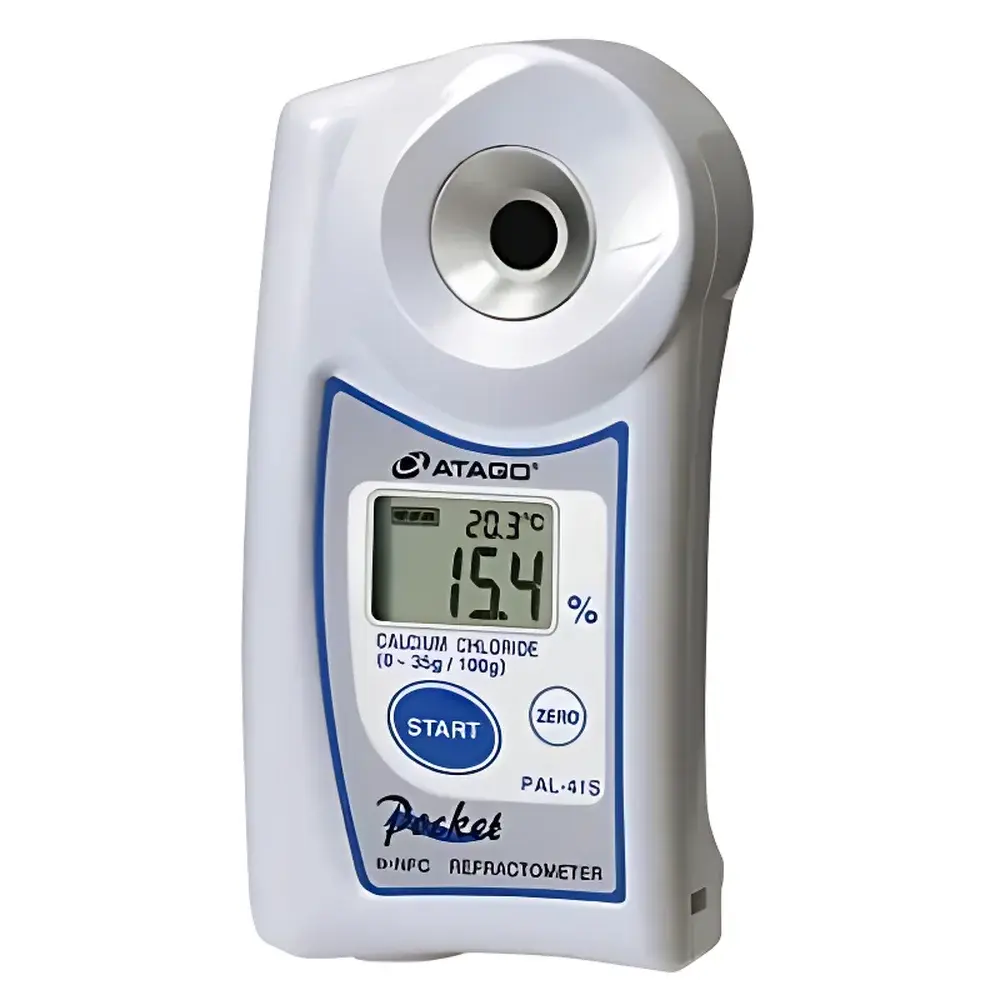
ATAGO PAL-41S Portable Digital Calcium Chloride Concentration Meter
| Brand | ATAGO |
|---|---|
| Model | PAL-41S |
| Measurement Range | 0.0–30.0% CaCl₂ (w/w) |
| Accuracy | ±0.2% |
| Temperature Compensation | Automatic (ATC), 10–40°C |
| Resolution | 0.1% |
| IP Rating | IP65 |
| Power | 2×AAA batteries |
| Dimensions | 5.5 × 3.1 × 10.9 cm |
| Weight | 100 g (instrument only) |
| Origin | Japan |
| Compliance | CE-marked, ISO/IEC 17025 traceable calibration support available |
Overview
The ATAGO PAL-41S is a handheld digital refractometer engineered for rapid, field-deployable quantification of calcium chloride (CaCl₂) concentration in aqueous deicing solutions. It operates on the principle of critical-angle refractometry: incident light passes through a prism-sample interface, and the resulting refraction angle correlates directly with solution density and solute concentration. Built-in temperature compensation (ATC) ensures measurement stability across ambient conditions from 10°C to 40°C—critical for winter operations where ambient thermal gradients significantly affect refractive index. Unlike generic salinometers or conductivity-based meters, the PAL-41S is optically calibrated specifically for CaCl₂ solutions using NIST-traceable reference standards, delivering linear response across its full 0.0–30.0% (w/w) range. Its rugged, single-piece aluminum housing and IP65-rated enclosure enable reliable use in snow removal staging areas, airport ramp zones, municipal salt barns, and highway maintenance depots—environments subject to moisture, dust, vibration, and thermal shock.
Key Features
- Optimized optical system with high-stability sapphire prism and LED illumination for consistent signal-to-noise ratio and long-term repeatability
- Automatic Temperature Compensation (ATC) algorithm compliant with ISO 21748 guidelines for refractometric correction
- Real-time digital display with 0.1% resolution and ±0.2% accuracy (at 20°C, verified against certified CaCl₂ reference solutions)
- IP65 ingress protection: fully sealed against dust and low-pressure water jets—suitable for outdoor winter deployment
- Low-power operation: two AAA alkaline batteries provide >10,000 measurements per set under typical field conditions
- Ergonomic form factor (100 g, 5.5 × 3.1 × 10.9 cm) designed for one-handed operation while wearing insulated gloves
- No reagents, no consumables, no warm-up time—measurement completed in <2 seconds after sample application
Sample Compatibility & Compliance
The PAL-41S measures only homogeneous, non-turbid CaCl₂–H₂O solutions. It is not suitable for mixtures containing glycols, surfactants, corrosion inhibitors, or suspended solids—these alter refractive behavior and invalidate factory calibration. For regulatory alignment, the instrument supports documentation workflows compatible with GLP and GMP environments: measurement records can be manually logged with operator ID, date/time stamp, and environmental temperature. While the PAL-41S itself is not FDA 21 CFR Part 11–certified (as it lacks electronic audit trail functionality), its calibration certificate—issued by ATAGO’s ISO/IEC 17025-accredited laboratory—meets ASTM D1193 Type IV water purity verification requirements for deicer preparation. Users performing routine quality checks prior to road or airfield application may reference ASTM D6347/D6347M (Standard Test Method for Determination of Calcium Chloride in Deicing Chemicals) for method validation context.
Software & Data Management
The PAL-41S is a standalone, embedded-system instrument with no Bluetooth, USB, or cloud connectivity. All data management is manual: users record readings in field logs or LIMS-compatible spreadsheets. However, ATAGO provides downloadable calibration verification protocols and blank log templates aligned with ISO 9001 Clause 7.1.5 (monitoring and measuring resources). For laboratories requiring digital traceability, the PAL-41S can be integrated into existing QA/QC workflows via optional ATAGO Data Logger Adapter (sold separately), enabling timestamped CSV export for audit-ready reporting. Firmware updates are not applicable—the optical-mechanical architecture is fixed at manufacture to preserve metrological integrity.
Applications
- Pre-deployment verification of liquid CaCl₂ brine concentration in municipal snowfighting fleets and airport ground service equipment
- On-site quality control during bulk blending of anti-icing solutions at salt storage facilities
- Field validation of pre-wetted solid CaCl₂ applications (e.g., verifying spray solution strength before granular coating)
- Winter maintenance contractor compliance checks per DOT or FAA Advisory Circular 150/5200-30E (Airport Winter Operations)
- Academic and civil engineering research on freezing-point depression kinetics of chloride-based deicers
- Verification of dilution ratios during emergency reconstitution of stock solutions following precipitation or evaporation events
FAQ
Can the PAL-41S measure sodium chloride (NaCl) or magnesium chloride (MgCl₂) solutions?
No. The optical calibration curve is specific to CaCl₂–H₂O systems. Using it for other chlorides introduces systematic bias exceeding ±1.5% due to differing partial molar refractions.
Is cleaning required between measurements?
Yes. Wipe the prism surface with lens tissue and distilled water after each reading to prevent crystallization-induced drift. Avoid alcohol or abrasive cleaners.
Does ATC compensate for sample temperature or ambient temperature?
The sensor measures prism temperature, which equilibrates rapidly with the sample; ATC applies correction based on that measured value—not ambient air temperature.
What is the minimum sample volume required?
Approximately 0.3 mL—sufficient to cover the entire prism surface without overflow.
How often should calibration verification be performed?
Before each shift in critical applications; daily in high-usage environments; always after exposure to temperatures outside 10–40°C or mechanical shock.




