
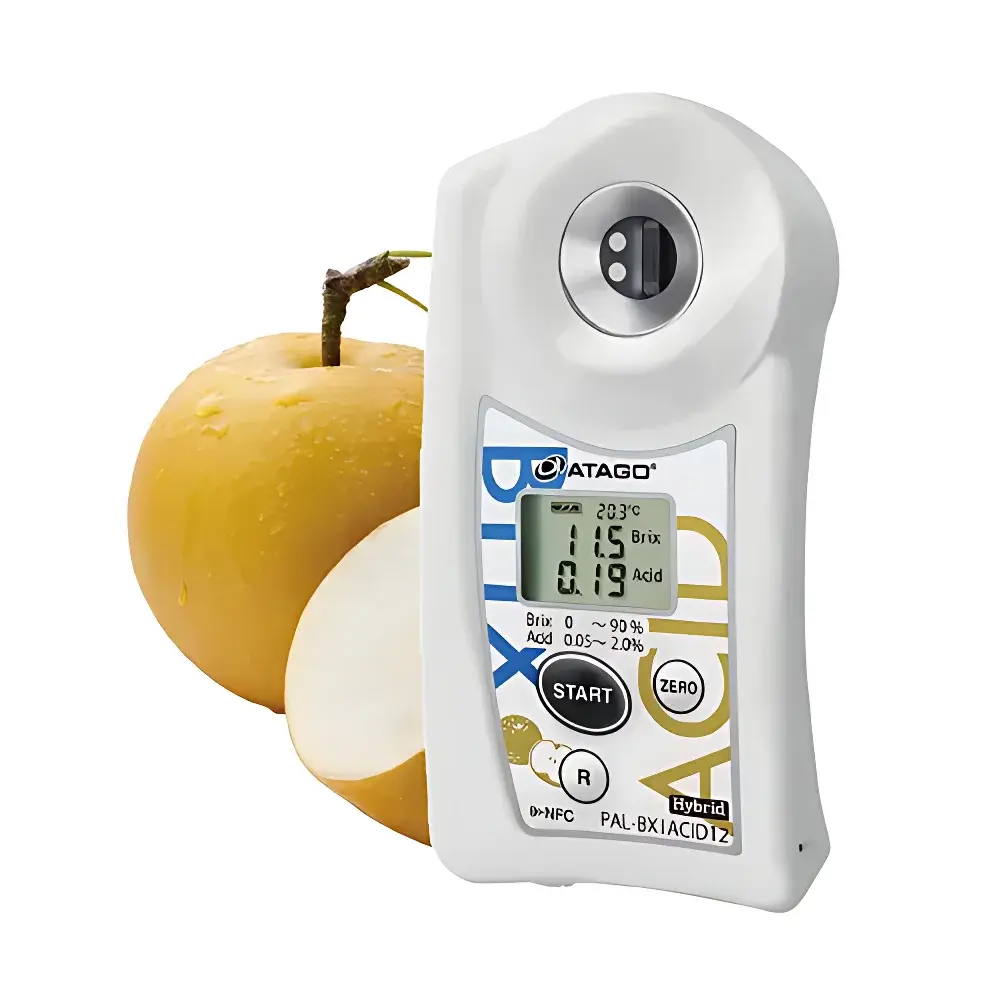
ATAGO PAL-BX/ACID 12 Asian Pear (Shousui Pear) Refractometer with Integrated Acidity Measurement
| Brand | ATAGO |
|---|---|
| Origin | Japan |
| Model | PAL-BX/ACID 12 |
| Type | Handheld Digital Refractometer |
| Temperature Compensation Range | 10–40 °C |
| Brix Range | 0.0–60.0 % |
| Acid Range (as citric acid) | 0.10–2.00 % |
| Brix Accuracy | ±0.2 % |
| Acid Accuracy | ±0.10 % (0.10–1.00 %), ±10 % relative (1.01–8.80 %) |
| Brix Resolution | 0.1 % |
| Acid Resolution | 0.01 % (0.00–9.99 %), 0.1 % (≥10.0 %) |
| Sugar-Acid Ratio Display | Yes (R key) |
| IP Rating | IP65 |
| Power | 2 × AAA alkaline batteries |
| Dimensions | 5.5 × 3.1 × 10.9 cm |
| Weight | 100 g (instrument only) |
Overview
The ATAGO PAL-BX/ACID 12 is a dedicated handheld digital refractometer engineered for rapid, on-site assessment of sugar-acid balance in Asian pears—specifically optimized for Shousui (Kosui) pear cultivars. Unlike conventional single-parameter refractometers, this instrument integrates dual optical measurement principles: Abbe-type refractometry for Brix (soluble solids content) and pH-correlated absorbance-based estimation calibrated to total titratable acidity expressed as citric acid equivalents. The device calculates and displays the sugar-acid ratio (SAR) upon user command (R key), providing an objective, quantitative metric directly linked to sensory perception—where higher SAR values correlate with perceived sweetness dominance and lower values indicate tartness prevalence. Designed for field use in orchards, packing houses, and quality control laboratories, the PAL-BX/ACID 12 operates without external power sources or reagents, eliminating dependency on wet chemistry methods such as AOAC 942.05 or ISO 750:1998 titration protocols.
Key Features
- Dual-parameter optical measurement: Simultaneous Brix and acidity determination from a single sample aliquot
- Integrated sugar-acid ratio calculation: Instant SAR readout via dedicated R key—no manual computation or external software required
- Offset curve correction function: Enables alignment of refractometric acidity values against reference titration data or alternative analytical methods, supporting method equivalence validation per ISO/IEC 17025 Clause 7.2.2
- Automatic temperature compensation (ATC): Linear compensation across 10–40 °C using built-in thermistor, compliant with ASTM D1298 and ISO 21748 guidelines for refractometer calibration stability
- Rugged, portable architecture: IP65-rated enclosure ensures resistance to dust ingress and water jets—suitable for humid post-harvest environments and outdoor orchard deployment
- High-resolution digital display: 0.1 % Brix and 0.01 % acid resolution (≤9.99 % range), supporting precise grading decisions aligned with JAS (Japanese Agricultural Standards) and Codex Alimentarius fruit quality specifications
Sample Compatibility & Compliance
The PAL-BX/ACID 12 is validated for clarified pear juice, homogenized pulp filtrates, and processed pear products—including nectars, purees, and canned syrups—provided samples are free of suspended particulates that could scatter incident light. Sample preparation follows a standardized 1:50 (w/w) dilution protocol using distilled water (per ISO 5725-2 precision requirements), ensuring reproducible acid signal response. While not intended for direct measurement of whole-fruit tissue, it complies with GLP-aligned documentation practices through traceable offset calibration records. The instrument’s acid calibration curve is traceable to NIST SRM 917 (citric acid standard), and its Brix scale is verified against sucrose reference solutions certified to ISO 6610. No regulatory submission data (e.g., FDA 510(k), CE-IVD) applies, as the device falls under general-purpose laboratory instrumentation per IEC 61010-1 safety classification.
Software & Data Management
The PAL-BX/ACID 12 operates as a standalone instrument with no embedded firmware update capability or USB/data port interface. All measurement data remain resident on-device only; no internal memory or export functionality is provided. Users intending to archive results must manually record readings or integrate the device into broader QC workflows via external logbooks compliant with 21 CFR Part 11 Annex 11 principles—where handwritten entries include operator ID, timestamp, sample ID, and environmental conditions (temperature/humidity). Offset correction parameters are retained across battery changes but require manual re-entry if reset. For enterprise-level traceability, ATAGO recommends pairing this unit with their optional PAL-PRINT portable thermal printer (sold separately) to generate auditable hard-copy reports meeting ISO 15197:2013 documentation expectations for routine QC instruments.
Applications
- Orchard maturity monitoring: Real-time SAR trending during harvest windows to identify optimal picking dates per cultivar-specific thresholds (e.g., Shousui pear SAR ≥ 25.0 indicates peak flavor balance)
- Post-harvest sorting & grading: Objective segregation of lots into commercial grades (Extra Class, Class I, Class II) per UNECE FFV-10 standards based on Brix-acid correlation models
- Processing line QC: In-line verification of pear juice concentrate consistency prior to pasteurization or blending—ensuring batch-to-batch SAR deviation remains within ±1.5 units
- Varietal screening programs: Rapid phenotyping of breeding populations for sugar-acid inheritance patterns without destructive titration labor
- Research applications: Supporting sensory panel correlation studies where instrumental SAR serves as a proxy for hedonic scoring in consumer testing (aligned with ASTM E1810 methodology)
FAQ
Does the PAL-BX/ACID 12 measure actual pH or titratable acidity?
It estimates total acidity as citric acid equivalents using a pre-calibrated optical absorption algorithm—not pH or direct potentiometric titration.
Can it be used for fruits other than Asian pears?
While optimized for Shousui/Kosui pear matrix properties, limited cross-application is possible with empirical offset adjustment—but Brix accuracy remains valid; acid values require cultivar-specific recalibration.
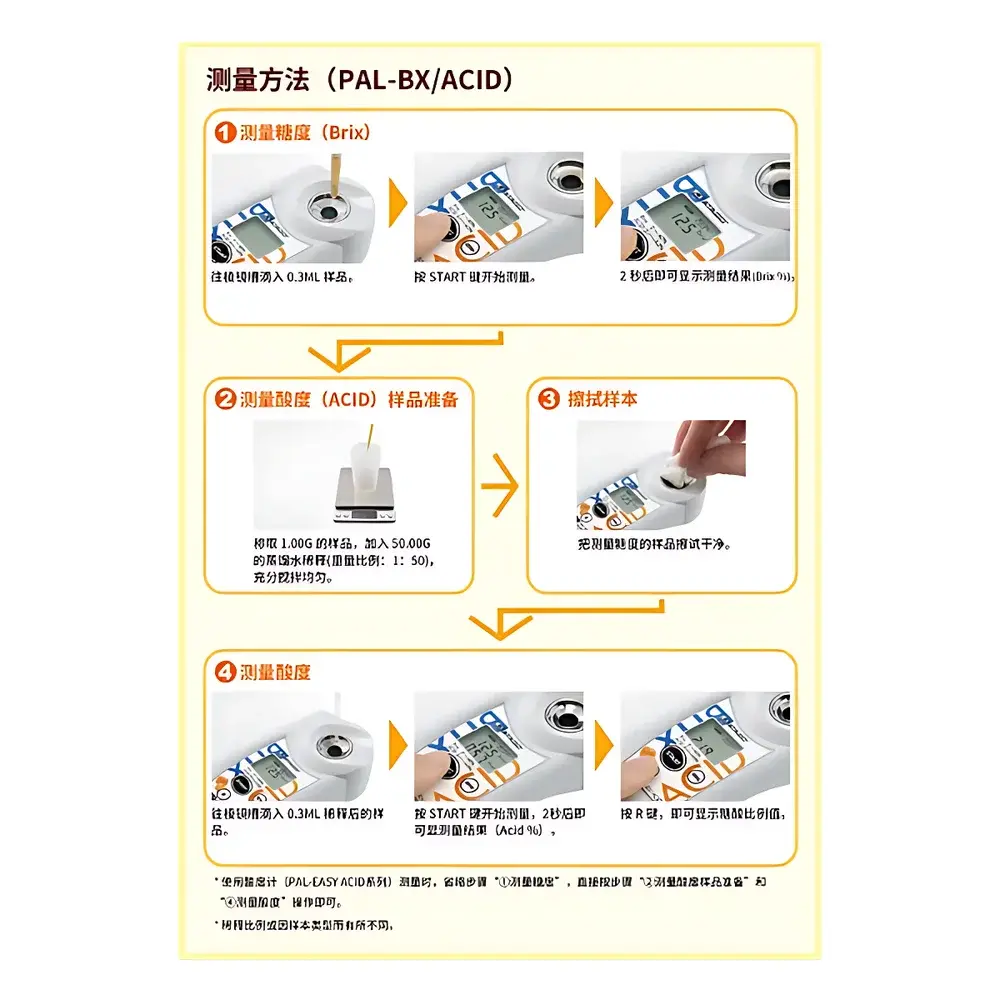
Is the 1:50 dilution ratio mandatory for acid measurement?
Yes—this ratio ensures optical path consistency and minimizes matrix interference per ATAGO’s validation protocol (Ref: PAL-BX/ACID Series Technical Bulletin TB-2021-08).
How often does the instrument require calibration verification?
Daily verification with 0.0 % and 30.0 % Brix sucrose standards is recommended before first use; acid calibration check using 0.50 % citric acid solution every 8 hours during continuous operation.
Does IP65 rating permit submersion or high-pressure cleaning?
No—IP65 confirms protection against low-pressure water jets (6.3 mm nozzle, 30 kPa, 3 min) and complete dust exclusion, but immersion or steam sterilization will damage internal optics.




