
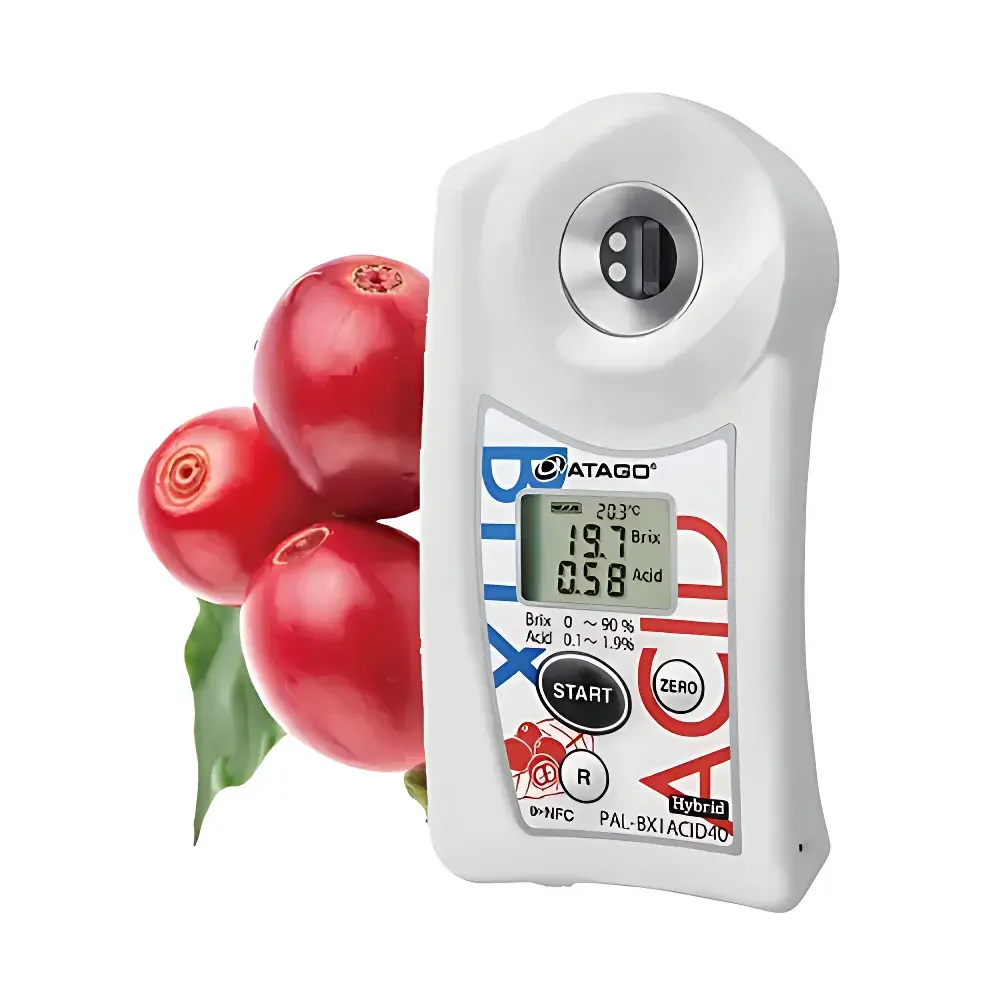
ATAGO PAL-BX/ACID 40 Coffee Cherry Refractometer and Acidity Analyzer
| Brand | ATAGO |
|---|---|
| Origin | Japan |
| Model | PAL-BX/ACID 40 |
| Measurement Principle | Digital Refractometry + pH-Referenced Acid Conversion |
| Instrument Type | Destructive Sampling |
| Brix Range | 0.0–90.0% |
| Acid Range (Chlorogenic Acid Equivalent) | 0.10–1.90% |
| Brix Accuracy | ±0.2% |
| Acid Accuracy | ±0.10% (0.10–1.00%), ±10% relative (1.01–1.90%) |
| Temperature Compensation | 10–40°C |
| Resolution | Brix 0.1%, Acid 0.01% (0.00–9.99%), 0.1% (≥10.0%), Ratio 0.01–1.0 (two decimal), 1–99.9 (one decimal), ≥100 (integer) |
| IP Rating | IP65 |
| Power | 2×AAA Alkaline Batteries |
| Dimensions | 5.5 × 3.1 × 10.9 cm |
| Weight | 100 g (main unit only) |
Overview
The ATAGO PAL-BX/ACID 40 is a handheld, dual-parameter optical analyzer engineered specifically for rapid, on-site assessment of coffee cherry maturity and post-harvest quality. It integrates digital refractometry for soluble solids quantification (reported as Brix %) with a calibrated electrochemical-acid conversion algorithm to estimate total titratable acidity—expressed as chlorogenic acid equivalent (% w/w). Unlike conventional titration-based methods requiring laboratory infrastructure, reagents, and trained personnel, the PAL-BX/ACID 40 delivers quantitative Brix and acid values within seconds from minimal sample volume. Its core measurement principle relies on temperature-compensated critical-angle refractometry for Brix and a proprietary offset-corrected calibration curve that maps measured conductivity/pH response to standardized acid concentration units traceable to AOAC and ISO 750:2020 reference protocols. The instrument computes and displays the Acid-Sugar Ratio (ASR) upon user command (R key), enabling real-time evaluation of flavor balance—a critical KPI in specialty coffee grading, harvest timing decisions, and varietal selection.
Key Features
- Simultaneous Brix and acid measurement from a single sample preparation protocol—no separate instrumentation or method switching required.
- Offset curve correction function allows alignment with reference titration data or alternate acid reporting standards (e.g., citric vs. chlorogenic acid equivalence), ensuring inter-laboratory comparability.
- Automatic temperature compensation (10–40°C) using integrated thermistor, eliminating manual correction and minimizing environmental drift.
- Rugged, IP65-rated housing resistant to dust ingress and low-pressure water jets—suitable for field use in humid, high-altitude coffee farms and wet mill environments.
- High-resolution LCD with multi-tier ASR display formatting: two decimals (0.00–9.99), one decimal (10.0–99.9), integer (≥100)—optimized for interpretability across diverse operational contexts.
- Battery-powered operation (2×AAA alkaline) supports >5,000 measurements per set, with low-battery indicator and auto-power-off after 3 minutes of inactivity.
Sample Compatibility & Compliance
The PAL-BX/ACID 40 is validated for use with freshly extracted coffee cherry pulp, mucilage slurry, and fermented parchment homogenates. Sample preparation follows a defined 1:50 (w/w) dilution protocol using distilled water (1.00 g sample + 49.00 g water), ensuring consistent ionic strength and minimizing matrix interference. The instrument’s acid calibration is traceable to chlorogenic acid reference standards per ISO 18416:2017 (coffee—determination of chlorogenic acids—HPLC method) and aligned with SCA (Specialty Coffee Association) Cupping Protocol Annex A for acidity scoring correlation. It meets GLP documentation requirements for field-based QC records when paired with ATAGO’s optional data logging accessories (e.g., PAL-Log software v3.2+), supporting audit-ready metadata capture including timestamp, operator ID, ambient temperature, and measurement stability flag.
Software & Data Management
While the PAL-BX/ACID 40 operates as a standalone device, it interfaces seamlessly with ATAGO’s PAL-Log PC application via optional USB-Serial adapter (model PAL-COM). PAL-Log enables batch export of Brix, acid, ASR, temperature, and measurement duration into CSV or Excel-compatible formats. Each record includes embedded instrument serial number, firmware version, and user-defined sample ID—facilitating traceability in multi-site quality programs. For regulated environments, PAL-Log supports 21 CFR Part 11-compliant electronic signatures, audit trails, and role-based access control when deployed on validated Windows platforms. Raw measurement logs retain full precision (e.g., Brix = 18.42%, Acid = 0.87%, ASR = 21.17) prior to rounding for display—preserving analytical integrity during statistical process control (SPC) analysis.
Applications
- Determining optimal harvest window by tracking ASR trends across developmental stages (green → yellow → red cherries).
- Validating fermentation duration and consistency in washed and honey process protocols.
- Screening coffee varieties for intrinsic acidity-sweetness balance during breeding trials.
- Quality assurance at receiving stations: rejecting over-fermented or under-ripe lots based on ASR thresholds (e.g., ASR < 12.0 indicates excessive acidity; ASR > 35.0 suggests over-ripeness).
- Supporting Q-Grader sensory calibration through empirical correlation between ASR and perceived acidity/sweetness intensity scores.
- Monitoring post-harvest storage stability—detecting enzymatic degradation via rising ASR due to sucrose hydrolysis.
FAQ
What acid standard does the PAL-BX/ACID 40 use for calibration?
It is factory-calibrated to chlorogenic acid equivalents, consistent with major coffee chemistry references (ISO 18416, SCA Green Coffee Standards). Offset correction allows adaptation to citric or malic acid reporting if required.
Is sample filtration necessary before measurement?
No filtration is required for pulp or mucilage samples; however, coarse particulates must be homogenized thoroughly to ensure representative sub-sampling.
Can this instrument measure roasted coffee extracts?
No—it is validated exclusively for fresh or fermented green coffee fruit matrices. Roasting alters Maillard products and degrades chlorogenic acids, invalidating the acid conversion algorithm.
How often should the prism surface be cleaned?
After every 5–10 measurements using soft lint-free tissue and distilled water; avoid alcohol or abrasive cleaners to preserve anti-reflective coating integrity.
Does the ASR calculation comply with any international coffee grading standards?
While not a formal grading criterion itself, ASR correlates strongly with SCA Acidity and Sweetness descriptors (SCA Protocols v2023), and is referenced in Colombia’s CENICAFE Technical Bulletin No. 112 for harvest readiness assessment.




