
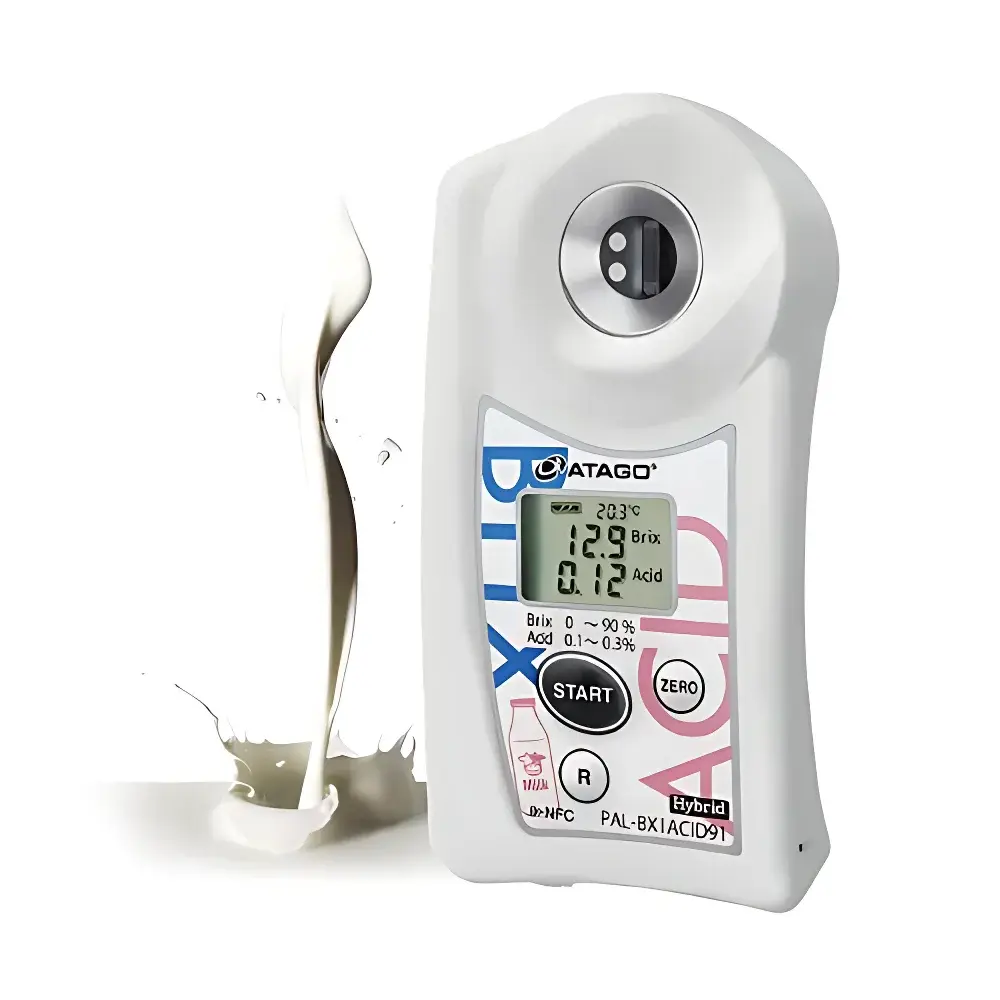
ATAGO PAL-BX/ACID 91 Portable Milk Brix & Total Acidity Analyzer
| Brand | ATAGO |
|---|---|
| Origin | Japan |
| Model | PAL-BX/ACID 91 |
| Measurement Parameters | Brix (0.0–90.0%), Total Acidity as Lactic Acid (0.10–8.80%), Brix/Acidity Ratio (R-value) |
| Accuracy | ±0.2% Brix, ±0.10% Acidity (0.10–1.00%), ±10% Acidity (1.01–8.80%), ±1°C Temperature |
| Resolution | 0.1% Brix, 0.01% Acidity (0.00–9.99%), 0.1% Acidity (≥10.0%), Ratio resolution scalable by magnitude |
| Repeatability | ±0.1% Brix, ±0.01% Acidity |
| Auto Temperature Compensation | 10–40°C |
| Power | 2× AAA alkaline batteries |
| IP Rating | IP65 |
| Dimensions | 5.5 × 3.1 × 10.9 cm |
| Weight | 100 g (instrument only) |
Overview
The ATAGO PAL-BX/ACID 91 is a handheld, dual-parameter refractometer engineered for rapid, on-site assessment of milk quality in dairy production, receiving inspection, and quality control laboratories. It simultaneously quantifies soluble solids content (expressed as Brix %) and total acidity—calculated and reported as lactic acid equivalent—based on the principle of refractive index measurement with integrated algorithmic conversion. Unlike conventional titrimetric methods requiring standardized NaOH solutions, burettes, pH indicators, and trained personnel, the PAL-BX/ACID 91 delivers results in under three seconds using only a 0.3 mL sample volume. Its optical system employs temperature-compensated Abbe-type optics calibrated against NIST-traceable sucrose and lactic acid reference standards. The instrument’s core application lies in evaluating milk freshness: natural acidity (from citrate, phosphate, CO₂, and casein buffering) increases incrementally during microbial lactose fermentation; elevated total acidity correlates strongly with reduced shelf life, impaired thermal stability during pasteurization/UHT processing, and higher risk of coagulation or sedimentation in downstream products.
Key Features
- Simultaneous Brix and total acidity measurement in a single instrument—no external software or secondary devices required.
- Three-second analysis cycle with automatic endpoint detection and audible confirmation signal.
- Integrated R-key function to compute and display real-time Brix-to-acidity ratio—a critical parameter for detecting adulteration (e.g., water dilution or reconstituted powder addition).
- Automatic temperature compensation (ATC) across 10–40°C, eliminating manual correction tables and minimizing operator-induced variability.
- Rugged, IP65-rated housing resistant to dust ingress and low-pressure water jets—suitable for wet processing environments including milking parlors, tanker unloading bays, and cold storage rooms.
- Calibration verification via two-point validation using supplied ATAGO-standard sucrose and lactic acid calibration fluids (sold separately, part nos. 2101-00 and 2102-00).
- Non-destructive, solvent-free operation—no hazardous reagents, no waste disposal protocols, and zero consumables beyond battery replacement.
Sample Compatibility & Compliance
The PAL-BX/ACID 91 is validated for raw bovine milk, pasteurized whole milk, skim milk, and standardized recombined milk formulations. It is not intended for use with high-viscosity fermented products (e.g., yogurt, kefir), cream (>40% fat), or powdered milk suspensions without full reconstitution per ISO 8587:2017 guidelines. Sample homogeneity is essential: agitation immediately prior to sampling ensures representative distribution of suspended casein micelles and fat globules. The instrument complies with JIS K 0067 (Japanese Industrial Standard for refractometers) and meets functional equivalency requirements of ISO 2173 (fruit juice Brix determination) and ISO 5725 (accuracy and precision of measurement methods). While not certified for regulatory submission under FDA 21 CFR Part 11, its audit-ready calibration log (accessible via optional PC interface cable and ATAGO Data Manager software) supports GLP-aligned recordkeeping when paired with controlled lab procedures.
Software & Data Management
Data export is supported via optional RS-232 or USB interface (cable sold separately) and ATAGO’s Windows-compatible Data Manager v3.2 software. This platform enables batch logging of timestamped measurements, operator ID assignment, statistical summary generation (mean, SD, CV%), trend charting over time, and PDF report export compliant with internal QA documentation standards. Audit trails include calibration history, firmware version, battery status, and ambient temperature at time of measurement. No cloud connectivity or remote access functionality is embedded—data remains local unless explicitly exported, satisfying data sovereignty requirements common in EU and APAC dairy supply chains.
Applications
- Receiving inspection of bulk tank milk at dairy cooperatives and processing plants—screening for spoilage, adulteration, or abnormal fermentation prior to intake.
- In-line QC during HTST pasteurization line start-up and shift handover—verifying consistency of incoming raw material acidity profiles.
- Field-based monitoring on dairy farms—assessing udder health indicators (elevated acidity may correlate with subclinical mastitis) and optimizing cooling/storage intervals.
- R&D formulation trials—evaluating acid development kinetics in cultured dairy prototypes (e.g., acidified whey beverages) when combined with timed sampling protocols.
- Educational labs—demonstrating colligative property relationships between solute concentration, refractive index, and titratable acidity in food chemistry curricula.
FAQ
How is total acidity calculated from refractive index?
The PAL-BX/ACID 91 applies an empirically derived polynomial algorithm correlating measured refractive index, sample temperature, and known Brix value to estimate total titratable acidity expressed as % lactic acid—validated against AOAC 972.16 reference titration across 0.10–8.80% range.
Can this instrument measure goat or buffalo milk?
Yes—provided samples are homogenized and free of visible clots or excessive fat separation; however, species-specific calibration offsets are not preloaded, so users should establish in-house correlation curves against reference titration for non-bovine matrices.
What is the minimum sample volume required?
0.3 mL is sufficient for reliable measurement; the prism surface requires full coverage but no overflow—excess liquid must be wiped cleanly before closing the sample cover to avoid optical interference.
Does the device require periodic recalibration?
ATAGO recommends daily verification using standard reference fluids before first use and after any temperature shock; full recalibration by authorized service centers is advised every 12 months or after 5,000 measurements, whichever occurs sooner.
Is the Brix/Acidity ratio (R-value) traceable to any industry standard?
While not codified in ISO or Codex Alimentarius, the R-value serves as an internal process control metric widely adopted in Asian and Oceania dairy processors to flag deviations indicative of dilution (low R) or advanced fermentation (high R); users should define acceptance limits based on historical baseline data from their specific supply chain.





