
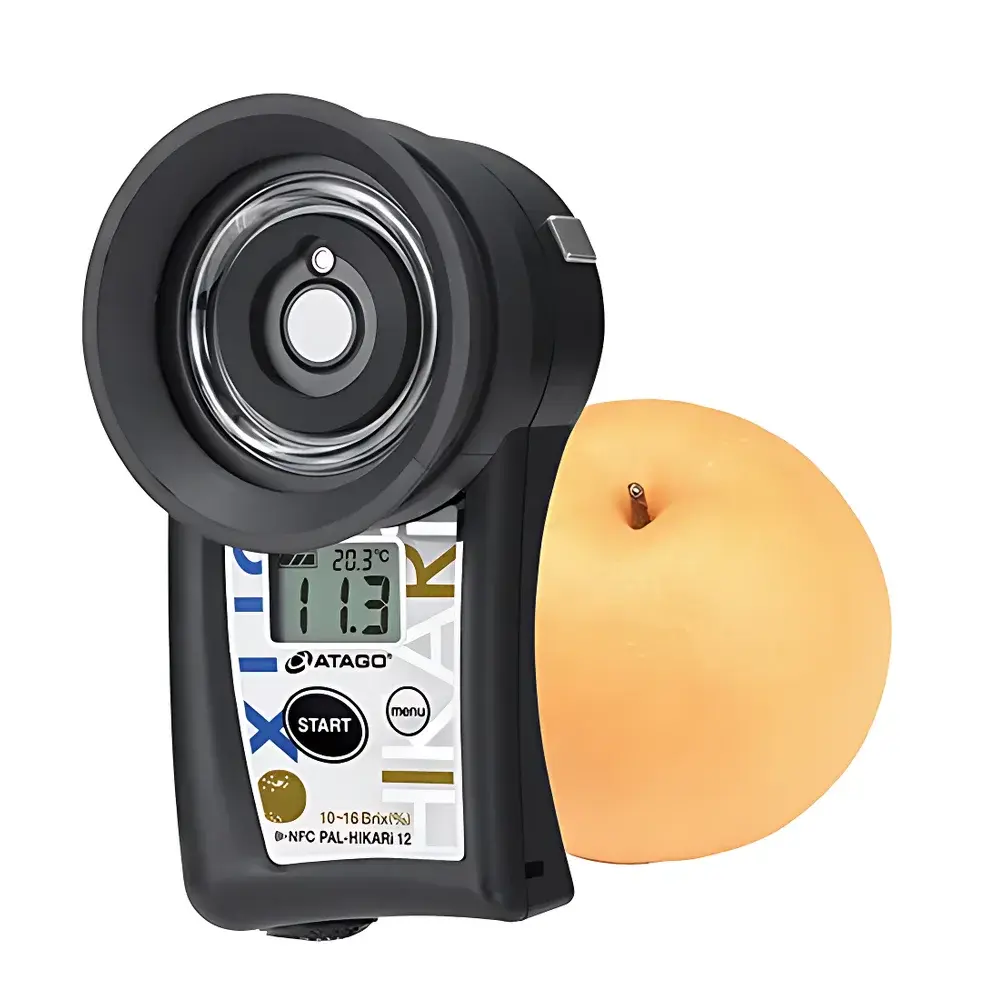
ATAGO PAL-HIKARi 12 Non-Destructive Pear Saccharimeter
| Brand | ATAGO |
|---|---|
| Origin | Japan |
| Model | PAL-HIKARi 12 |
| Fruit Type | Asian Pear |
| Measurement Principle | Near-Infrared (NIR) Absorption at 940 nm |
| Brix Range | 10.0–16.0% |
| Temperature Range | 5.0–35.0°C |
| Brix Resolution | 0.1% |
| Temperature Resolution | 0.1°C |
| Brix Accuracy | ±1.0% |
| Temperature Accuracy | ±1.0°C |
| Automatic Temperature Compensation | 5.0–35.0°C |
| IP Rating | IP64 |
| Power | 2×AAA Alkaline Batteries |
| Dimensions | 6.1×4.4×11.5 cm |
| Weight | 120 g (instrument only) |
| Instrument Type | Non-Destructive Optical Saccharimeter |
Overview
The ATAGO PAL-HIKARi 12 is a handheld, non-destructive saccharimeter engineered specifically for rapid, in-situ Brix measurement of intact Asian pears (Pyrus pyrifolia). Unlike traditional refractometers requiring juice extraction or destructive sampling, the PAL-HIKARi 12 employs near-infrared (NIR) optical absorption spectroscopy centered at 940 nm — a wavelength highly sensitive to O–H bond vibration in sucrose and fructose molecules. This principle enables quantitative estimation of soluble solids content (SSC) directly through the fruit epidermis without compromising structural integrity. Designed for field-deployable operation under variable ambient conditions, the instrument integrates real-time temperature sensing and automatic compensation across its full operational range (5.0–35.0°C), ensuring metrological consistency in orchards, packinghouses, cold storage facilities, and research greenhouses. Its compact form factor and battery-powered architecture support GLP-compliant spot-checking workflows aligned with ISO 2173:2003 (fruit and vegetable products — determination of soluble solids content — refractometric method) and ASTM D8017-16 (standard practice for determining sugar content in fresh fruit using NIR devices).
Key Features
- Non-invasive NIR measurement: No cutting, coring, or juice expression required — preserves sample viability for downstream use or ripening studies.
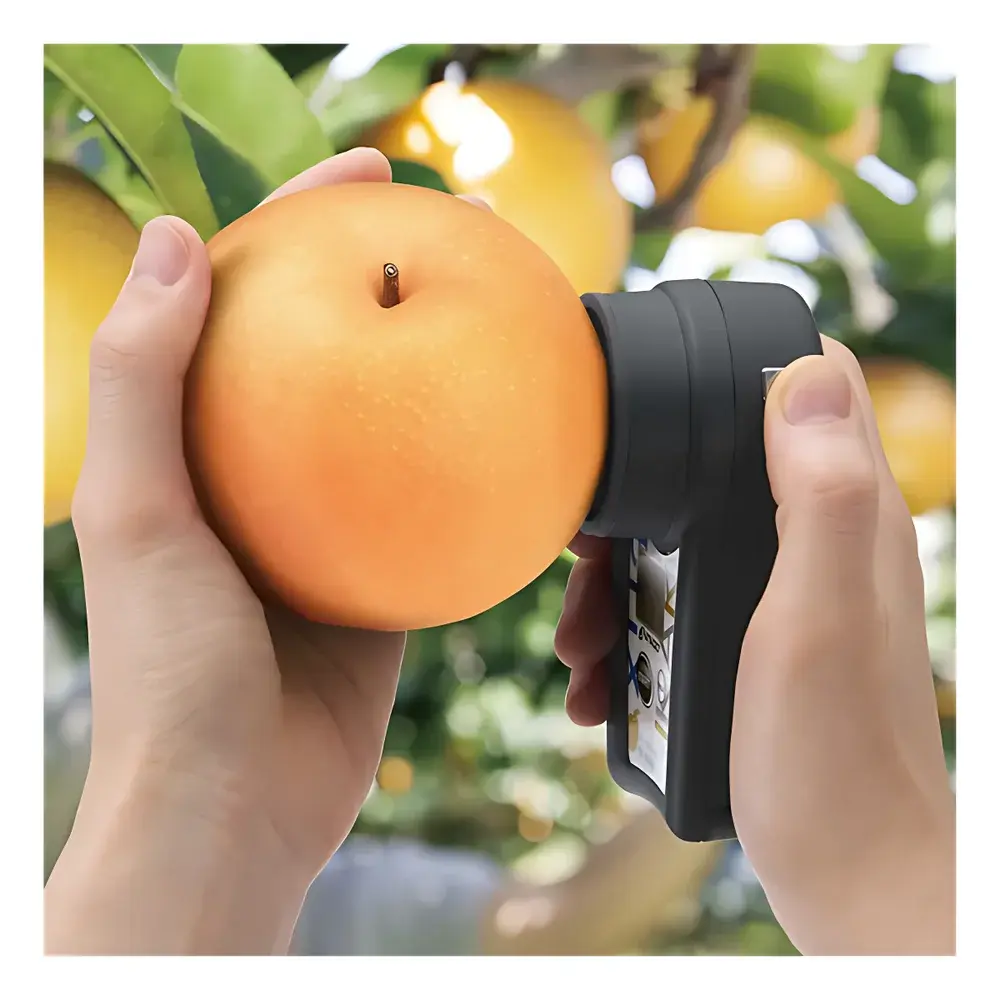
- Three-second measurement cycle: Press START, apply sensor head firmly against clean, dry pear skin, and obtain stabilized Brix and temperature readings within ≤3 s.
- Integrated dual-parameter acquisition: Simultaneous display of Brix (% w/w) and surface temperature (°C) with 0.1% and 0.1°C resolution respectively.
- Automatic temperature compensation (ATC): Embedded thermistor dynamically adjusts Brix output based on real-time skin temperature across 5.0–35.0°C, minimizing thermal drift artifacts.
- Ruggedized portable design: IP64-rated enclosure resists dust ingress and water splashing; weighs only 120 g with dimensions optimized for one-handed operation in humid or outdoor environments.
- Statistical functionality: Supports up to 30 sequential measurements per session with on-device average calculation (mean Brix, SD, min/max), facilitating batch-level quality assessment.
Sample Compatibility & Compliance
The PAL-HIKARi 12 is calibrated and validated exclusively for intact, mature Asian pears (e.g., ‘Nijisseiki’, ‘Hosui’, ‘Kosui’) with smooth, unblemished rind and typical skin thickness (0.3–0.8 mm). It is not intended for apples, citrus, stone fruits, or pears with wax coatings, bruises, or excessive surface moisture. Measurement accuracy (±1.0% Brix) reflects validation against reference digital refractometry (ATAGO PR-101α) using homogenized pear pulp extracts per AOAC Official Method 932.12. The device complies with IEC 61000-6-3 (EMC emission standards) and meets RoHS Directive 2011/65/EU material restrictions. While not FDA 21 CFR Part 11-certified as standalone software, raw measurement logs exported via optional RS-232 interface support audit-trail documentation in regulated QA/QC environments.
Software & Data Management
The PAL-HIKARi 12 operates autonomously without embedded firmware-based data logging. However, optional connectivity (via ATAGO RS-232 adapter kit, sold separately) enables serial transmission of timestamped Brix/temperature pairs to Windows-based PCs running ATAGO’s free “PAL-DataLink” utility. This application supports CSV export, batch averaging, histogram generation, and trend plotting — all traceable to operator ID and measurement location metadata. Data files retain full GLP audit capability when stored alongside calibration records (per ATAGO Calibration Certificate No. CAL-PAL-HIKARi-12-XX) and environmental logs (ambient RH, storage duration pre-measurement). Firmware updates are distributed annually via ATAGO’s secure customer portal and require USB-to-serial conversion hardware.
Applications
- Orchard management: Enables pre-harvest maturity mapping by measuring individual fruit Brix across canopy zones, supporting harvest timing decisions aligned with market-grade SSC thresholds (e.g., ≥12.5% for premium ‘Hosui’).
- Packinghouse sorting: Integrates into inline grading lines via manual station deployment; supports USDA Grade A/B/C classification where Brix correlates with sweetness perception and shelf-life stability.
- Postharvest physiology research: Facilitates longitudinal monitoring of sugar accumulation during cold storage (0–5°C) or controlled-atmosphere ripening, with minimal handling-induced stress artifacts.
- Export compliance verification: Used by third-party inspection agencies (e.g., JAS, APHIS-accredited labs) for rapid lot-level screening prior to phytosanitary certification.
- Horticultural education: Serves as pedagogical tool in university pomology programs for demonstrating genotype × environment interactions on carbohydrate partitioning in Rosaceae species.
FAQ
Is the PAL-HIKARi 12 suitable for other fruit types besides Asian pears?
No. Its optical calibration and pressure-sensitive contact algorithm are optimized exclusively for Asian pear morphology, skin optical density, and SSC distribution profiles. Use on other species yields non-representative values.
Does surface moisture affect measurement accuracy?
Yes. Condensation, dew, or wash-water residue must be gently blotted dry prior to measurement; residual water film alters NIR reflectance and induces systematic low bias (typically −0.5 to −1.2% Brix).
How often does the instrument require recalibration?
ATAGO recommends annual factory recalibration using NIST-traceable sucrose standards; field verification with certified 12.0% Brix reference solution (ATAGO SR-12) is advised before each daily shift.
Can measurements be performed on refrigerated or sun-warmed fruit?
Yes — provided the fruit has equilibrated to ambient temperature for ≥15 minutes prior to testing. The ATC function corrects for thermal gradient effects but cannot compensate for internal thermal lag in chilled samples.
What is the expected service life of the NIR LED source?
The 940 nm GaAs LED is rated for ≥50,000 measurement cycles (≈10 years at 15 measurements/day); output stability is monitored during annual recalibration and logged in the device’s internal diagnostic register.





