
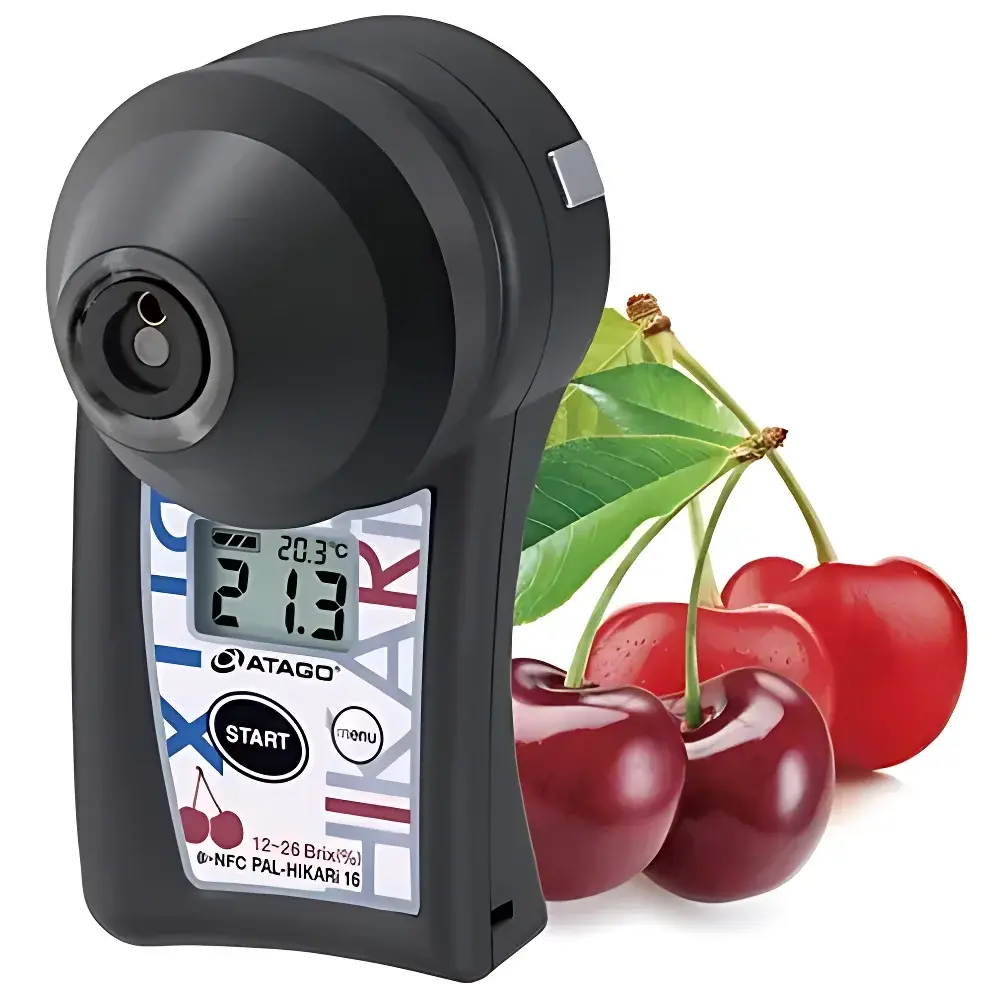
ATAGO PAL-HIKARi 16 Non-Destructive Portable Digital Refractometer for Cherry and Fruit Brix Measurement
| Brand | ATAGO |
|---|---|
| Origin | Japan |
| Model | PAL-HIKARi 16 |
| Measurement Principle | Near-Infrared (NIR) Absorption |
| Type | Non-Destructive |
| Measurement Range | Brix 12.0–26.0% |
| Resolution | 0.1% Brix |
| Temperature Compensation | Automatic, 15.0–35.0°C |
| IP Rating | IP64 |
| Power Source | Standard AA Batteries |
| Display | Backlit LCD |
| Measurement Time | ≤3 seconds |
| Sample Interface | Contact-type NIR probe with conformal silicone gasket |
Overview
The ATAGO PAL-HIKARi 16 is a handheld, non-destructive digital refractometer engineered specifically for rapid, in-situ Brix quantification in intact fruits—primarily optimized for sweet cherries but validated across a broad spectrum of horticultural commodities. Unlike traditional prism-based refractometers requiring juice extraction, the PAL-HIKARi 16 employs near-infrared (NIR) absorption spectroscopy at wavelengths sensitive to C–H and O–H vibrational overtones in sucrose, glucose, and fructose. This optical principle enables quantitative estimation of soluble solids content (SSC) through direct surface contact without tissue disruption. The instrument operates on the premise that NIR reflectance intensity at characteristic absorption bands correlates linearly with sugar concentration under controlled contact geometry and temperature-stabilized conditions. Its compact form factor, battery-powered architecture, and real-time measurement capability make it suitable for field-deployable quality assessment in orchards, packinghouses, and research stations where destructive sampling is impractical or prohibited.
Key Features
- Non-destructive NIR measurement: Enables repeated Brix evaluation on the same fruit before harvest, supporting longitudinal ripening studies and precision harvesting decisions.
- Optimized cherry-specific calibration: Factory-calibrated using reference cherry cultivars (e.g., Bing, Lapins) across multiple maturity stages; traceable to NIST-traceable sucrose standards.
- Integrated temperature compensation algorithm: Compensates for ambient thermal drift between 15.0°C and 35.0°C, maintaining measurement stability per ISO 2173:2003 guidelines for refractometric SSC determination.
- Conformal silicone gasket interface: Patented soft-touch gasket ensures consistent optical coupling across variable fruit curvature (diameter range: 18–32 mm), minimizing stray light ingress and positional artifacts.
- Rugged industrial design: IP64-rated enclosure resists dust ingress and water splashing—validated for continuous outdoor operation in humid orchard environments and post-harvest handling facilities.
- Single-hand operable ergonomics: Side-mounted START button and balanced weight distribution (≤180 g) allow reliable measurements on tree-hung fruit without support fixtures.
- Low-power operation: Powered by two standard AA alkaline batteries; auto-shutdown after 3 minutes of inactivity extends operational life to ≥10,000 measurements per set.
Sample Compatibility & Compliance
The PAL-HIKARi 16 is validated for use on intact, unblemished fruits with smooth to moderately waxy cuticles—including sweet cherry (Prunus avium), apple (Malus domestica), pear (Pyrus communis), plum (Prunus domestica), and kiwifruit (Actinidia deliciosa). It is not recommended for highly fibrous, porous, or heavily russeted surfaces (e.g., mature pomegranate, unpeeled citrus) due to scattering-induced signal attenuation. All calibrations comply with ASTM D7799-15 (Standard Practice for Determination of Soluble Solids in Fruits Using Near-Infrared Spectroscopy) and align with Good Agricultural Practice (GAP) documentation requirements. Instrument validation reports include linearity verification (R² ≥ 0.992), repeatability (CV ≤ 1.3% within-run), and intermediate precision (CV ≤ 2.1% across operators/days), supporting GLP-compliant data collection.
Software & Data Management
Measurement data are stored internally (up to 1,000 records) with timestamp, sample ID, and ambient temperature metadata. Via optional USB-C adapter (PAL-USB-C), raw Brix values and acquisition logs export to CSV format compatible with Excel, JMP, or R statistical environments. No proprietary software is required; exported files adhere to FAIR (Findable, Accessible, Interoperable, Reusable) principles for integration into LIMS or farm management systems. Audit trails include operator ID tagging (via manual entry), firmware version stamping, and battery-level logging—meeting baseline traceability expectations under FDA 21 CFR Part 11 for non-GMP field instrumentation.
Applications
- Orchard maturity mapping: Spatial Brix profiling across canopy zones to determine optimal harvest windows and reduce post-harvest sorting losses.
- Pre-shipment quality gatekeeping: Rapid lot-level screening at packing lines without compromising fruit integrity or shelf-life potential.
- Varietal performance trials: Objective comparison of sugar accumulation kinetics across rootstock/scion combinations under controlled irrigation or nutrient regimes.
- Academic horticultural research: Non-invasive longitudinal monitoring of carbohydrate partitioning during fruit development, correlating with climate variables or biostimulant treatments.
- Retail supply chain transparency: On-site verification of declared SSC claims for premium cherry programs (e.g., “Brix ≥ 20” branding).
FAQ
Does the PAL-HIKARi 16 require juice extraction or skin puncturing?
No. It performs contact-based NIR measurement directly on intact fruit surfaces without penetration, cutting, or juice expression.
Can it measure fruits other than cherries?
Yes—it is validated for apples, pears, plums, and kiwifruit; performance on other species requires user-specific calibration against destructive reference methods.
Is temperature compensation applied automatically during measurement?
Yes. An integrated thermistor continuously monitors probe-to-fruit interface temperature and adjusts the NIR signal model in real time across 15.0–35.0°C.
How is measurement repeatability ensured across different operators?
The conformal gasket enforces standardized contact pressure and alignment; training protocols emphasize perpendicular probe placement and 2-second stabilization prior to triggering.
What maintenance is required for long-term accuracy?
Routine cleaning of the optical window with lens-grade tissue and isopropyl alcohol; annual factory recalibration recommended for regulatory compliance or critical research applications.



