
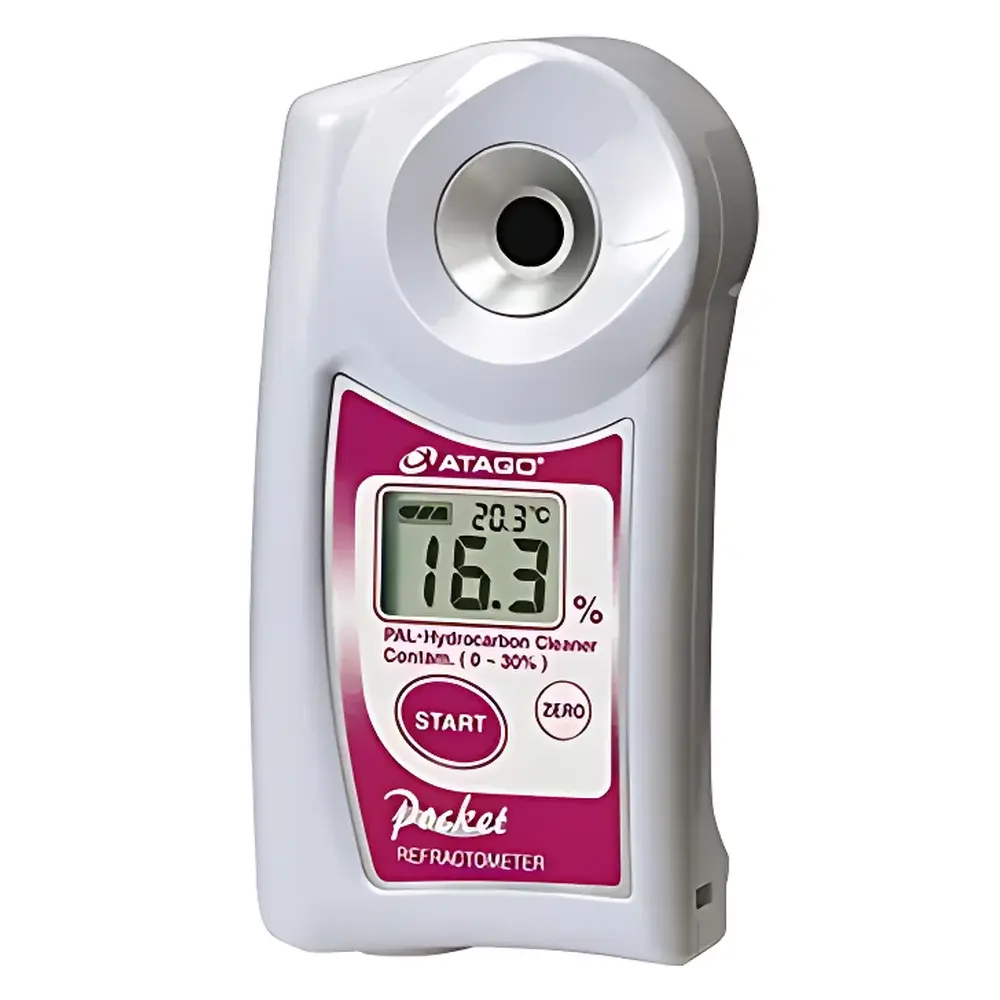
ATAGO PAL-Hydrocarbon Cleaner Handheld Digital Refractometer
| Brand | ATAGO |
|---|---|
| Origin | Japan |
| Model | PAL-Hydrocarbon Cleaner |
| Measurement Range | 0–30% (w/w) |
| Resolution | 0.1% |
| Accuracy | ±1% |
| Automatic Temperature Compensation (ATC) | 10–100°C |
| Sample Volume | ≥0.3 mL |
| Measurement Time | ~3 seconds |
| Power Supply | 2 × AAA alkaline batteries |
| IP Rating | IP65 |
| Dimensions | 5.5 × 3.0 × 10.9 cm |
| Weight | 100 g (instrument only) |
| Ambient Operating Temperature | 10–40°C |
Overview
The ATAGO PAL-Hydrocarbon Cleaner Handheld Digital Refractometer is a precision optical instrument engineered for rapid, on-site quantification of hydrocarbon-based cleaning agent concentration in industrial maintenance and metalworking environments. It operates on the principle of critical-angle refractometry: incident light passes through a sapphire prism in contact with the sample liquid, and the resulting refraction angle—directly correlated to the solution’s refractive index—is converted into concentration values (expressed as weight/weight percent, % w/w) via a pre-calibrated algorithm specific to common hydrocarbon solvents (e.g., naphtha, mineral spirits, isoparaffinic blends). Unlike generic refractometers, this model integrates a proprietary calibration curve optimized for the refractive index–concentration relationship of non-aqueous, low-polarity hydrocarbon cleaners—ensuring metrological traceability and measurement stability across typical operating temperatures encountered in shop-floor settings. Its design addresses a critical process control gap: unmonitored dilution or solvent degradation leads to insufficient cleaning efficacy, increased rework rates, and premature part rejection—particularly in high-tolerance automotive component manufacturing and precision machining operations.
Key Features
- Optimized optical path with sapphire prism for exceptional scratch resistance and long-term calibration stability under repeated industrial handling.
- Integrated Automatic Temperature Compensation (ATC) covering 10–100°C, eliminating manual correction and enabling reliable measurements directly from warm rinse tanks or heated cleaning baths.
- Digital LCD display with 0.1% resolution and ±1% accuracy (at 20°C), validated per ISO 21748 guidelines for refractometer performance verification.
- IP65-rated enclosure ensures dust-tightness and protection against low-pressure water jets—suitable for use in wet, oily, or coolant-splashed production areas.
- Compact ergonomic form factor (100 g, palm-sized) enables one-handed operation and eliminates dependency on lab benches or external power sources.
- Low-power architecture with standard AAA batteries supports >5,000 measurements per set—minimizing downtime and consumable logistics.
Sample Compatibility & Compliance
The PAL-Hydrocarbon Cleaner is calibrated for common petroleum-derived cleaning agents—including aliphatic hydrocarbons (e.g., Shellsol™ T, Isopar™ series), naphthenic solvents, and select semi-volatile hydrocarbon blends used in vapor degreasing, cold cleaning, and ultrasonic parts washing. It is not suitable for aqueous alkaline cleaners, chlorinated solvents, or glycol-based formulations. The instrument complies with IEC 60529 (IP65), meets RoHS Directive 2011/65/EU requirements, and supports GLP-aligned documentation practices through its stable, non-volatile calibration memory. While not FDA 21 CFR Part 11 compliant (as it lacks audit-trail functionality), its measurement repeatability (RSD < 0.8% over 10 replicates) satisfies internal QC thresholds defined in ISO 9001:2015 Clause 8.5.1 for monitoring process-critical parameters.
Software & Data Management
This handheld refractometer operates as a standalone, firmware-embedded measurement system with no onboard data logging or Bluetooth/Wi-Fi connectivity. All calibration and operational parameters are stored in non-volatile memory. For integration into digital quality management systems (QMS), users may manually record results in electronic batch records or export via optional ATAGO Data Logging Software (sold separately) when paired with the PAL-Communication Cable (Model: PAL-COM). Calibration verification is supported by traceable NIST-traceable refractive index standards (e.g., ATAGO Standard Solution Set #RS-100), enabling periodic verification per ASTM D1218 or internal SOPs governing analytical instrument qualification.
Applications
- Real-time monitoring of hydrocarbon cleaner concentration in automated parts washers and conveyorized cleaning lines.
- Pre-shift verification of bath integrity prior to high-value component processing (e.g., engine blocks, transmission housings, brake calipers).
- Troubleshooting inconsistent surface cleanliness leading to coating adhesion failures or electroplating defects.
- Supporting preventive maintenance scheduling by correlating concentration drift with filtration cycle life and carbon bed saturation.
- Training frontline technicians in quantitative process control—replacing subjective “drop test” or visual clarity assessments with objective, repeatable metrics.
FAQ
Can this refractometer measure aqueous cleaning solutions?
No. The PAL-Hydrocarbon Cleaner is calibrated exclusively for non-aqueous hydrocarbon solvents. Aqueous alkaline or acidic cleaners require dedicated refractometers with different calibration curves (e.g., ATAGO PAL-ACID or PAL-ALKALI models).
Does it require recalibration before each use?
No. The unit retains factory calibration indefinitely under normal operating conditions. Verification with a certified standard solution is recommended daily or per shift in regulated environments.
Is the sapphire prism replaceable if damaged?
Yes. ATAGO offers field-replaceable prism assemblies (Part No. PRISM-PAL-HC) with full recalibration service available through authorized service centers.
What is the minimum sample temperature for accurate ATC compensation?
The ATC function remains effective down to 10°C; however, samples below 15°C should be equilibrated to ambient temperature (per ISO 21748 Annex B) to minimize thermal gradient errors at the prism–sample interface.
Can it be used in explosive atmospheres?
No. This device is not intrinsically safe or ATEX-certified. It must not be operated in Class I, Division 1 hazardous locations where flammable vapors may be present at ignitable concentrations.





