
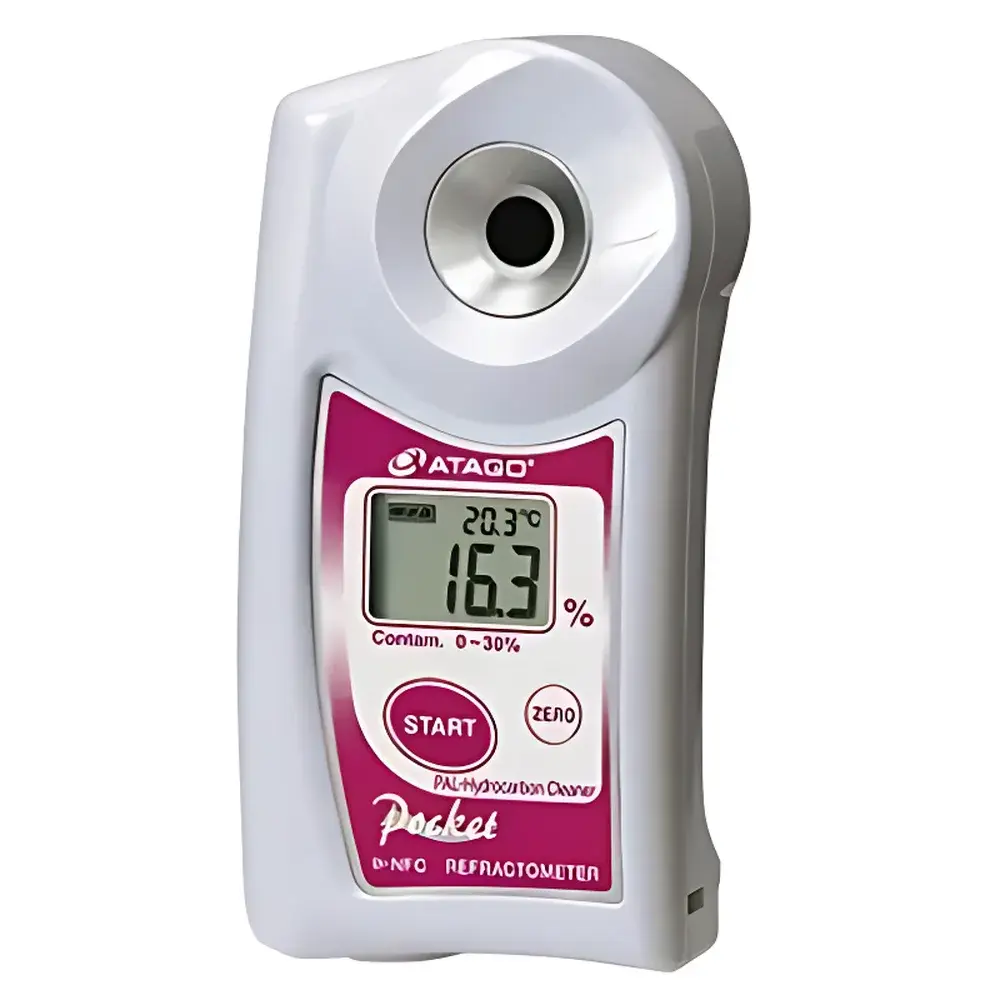
ATAGO PAL-Hydrocarbon Cleaner Handheld Refractometer
| Brand | ATAGO |
|---|---|
| Origin | Japan |
| Model | PAL-Hydrocarbon Cleaner |
| Measurement Range | 0–30% w/w |
| Resolution | 0.1% |
| Accuracy | ±0.2% |
| Automatic Temperature Compensation (ATC) Range | 10–100°C |
| Sample Volume | ≥0.3 mL |
| Measurement Time | ~3 seconds |
| Power Supply | 2 × AAA alkaline batteries |
| IP Rating | IP65 |
| Dimensions | 55 (W) × 31 (D) × 109 (H) mm |
| Weight | 100 g (main unit only) |
| Display | Digital LCD |
Overview
The ATAGO PAL-Hydrocarbon Cleaner is a precision handheld refractometer engineered specifically for real-time, on-site concentration monitoring of hydrocarbon-based cleaning solvents used in metalworking, automotive component manufacturing, and precision parts cleaning processes. It operates on the principle of critical-angle refractometry: light passing through a solvent sample undergoes refraction at the prism-sample interface, with the resulting critical angle directly correlating to the solution’s refractive index—and thus its solute concentration. This optical measurement method provides rapid, non-destructive, and operator-independent quantification without reagents or calibration curves. Designed for industrial environments where solvent degradation, water ingress, or additive depletion compromises cleaning efficacy, the PAL-Hydrocarbon Cleaner enables proactive maintenance scheduling by tracking concentration drift over time—ensuring consistent surface cleanliness, minimizing rework, and extending bath life.
Key Features
- Optimized optical system calibrated for hydrocarbon solvent refractive index profiles (e.g., n-hexane, isoparaffins, d-limonene derivatives), delivering traceable linearity across 0–30% w/w concentration range
- Integrated Automatic Temperature Compensation (ATC) using high-stability thermistor array, correcting measurements dynamically from 10°C to 100°C to eliminate thermal drift errors common in warm cleaning tanks
- Rugged, IP65-rated enclosure resistant to solvent splashes, particulate ingress, and mechanical shock—validated for continuous use in shop-floor conditions
- Single-hand operation with ergonomic form factor (100 g mass, compact 55 × 31 × 109 mm footprint) and intuitive push-button interface
- Digital LCD display with backlight for low-illumination environments; auto-power-off after 3 minutes to conserve battery life
- No routine recalibration required under stable ambient conditions; verification with ATAGO-certified standard fluid (e.g., 10.0% reference solution, Cat. No. 2458) recommended per ASTM D1218 or internal QA protocols
Sample Compatibility & Compliance
The PAL-Hydrocarbon Cleaner is validated for aqueous-free, low-polarity hydrocarbon cleaning formulations—including aliphatic, aromatic, and terpene-based solvents—commonly deployed in vapor degreasing, ultrasonic immersion, and spray-wash systems. It is not intended for water-miscible or highly polar solvents (e.g., alcohols, glycol ethers) due to refractive index overlap and potential prism wetting issues. The instrument complies with IEC 60529 (IP65), ISO 21500 (project management guidance for QA/QC instrumentation deployment), and supports GLP/GMP-aligned documentation practices when paired with ATAGO’s optional data logging accessories. While not FDA 21 CFR Part 11-compliant as a standalone device, measurement records generated via external USB transfer (with third-party timestamped software) may be integrated into validated electronic lab notebooks meeting regulatory audit requirements.
Software & Data Management
As a dedicated handheld instrument, the PAL-Hydrocarbon Cleaner does not feature onboard memory or Bluetooth connectivity. However, its repeatable analog output (via optional RS-232 interface kit, Model PAL-COM) enables integration with SCADA systems, PLC-controlled dosing units, or LIMS platforms for automated threshold alerts (e.g., “<8.5% → initiate make-up addition”). Users may manually log results in Excel or CSV format following ISO/IEC 17025 Clause 7.7 guidelines for measurement uncertainty documentation. ATAGO provides traceable calibration certificates (NIST-traceable standards) and maintains full metrological documentation for each unit serial number—supporting internal audit readiness and supplier qualification programs.
Applications
- Monitoring concentration decay in closed-loop hydrocarbon cleaning baths during engine block, transmission housing, or bearing assembly cleaning
- Verifying batch-to-batch consistency of incoming solvent deliveries against purchase specifications
- Supporting root-cause analysis of residual oil/film defects by correlating concentration excursions with surface tension or flash point deviations
- Enabling predictive maintenance of filtration and distillation subsystems based on cumulative solvent usage trends
- Training production technicians in quantitative process control—replacing subjective “drop test” or viscosity dipstick assessments with objective, documented metrics
FAQ
Does the PAL-Hydrocarbon Cleaner require periodic factory recalibration?
No mandatory annual recalibration is specified; however, ATAGO recommends verification against certified reference fluids every 6 months or after 500 measurements, whichever occurs first, per ISO/IEC 17025 Clause 6.6.
Can it measure mixed-solvent systems (e.g., hydrocarbon + co-solvent)?
Not reliably—refractive index response is non-linear in multi-component mixtures. For such applications, GC-FID or FTIR spectroscopy is advised.
Is the prism surface chemically resistant to chlorinated solvents?
No. The sapphire prism is rated for hydrocarbons only; exposure to chlorinated or strong oxidizing agents will cause irreversible etching and measurement drift.
What is the minimum detectable concentration change under field conditions?
With proper technique (clean prism, consistent drop volume, stable temperature), the device resolves ±0.2% w/w changes—sufficient to trigger intervention before cleaning efficiency drops below ISO 14644 Class 8 particle retention thresholds.
How does ATC handle rapid temperature fluctuations during tank sampling?
The thermistor responds within 1.2 seconds (t₉₀), and compensation algorithm applies second-order polynomial correction derived from >2,000 empirical solvent-temperature-refractive index data points—validating accuracy across dynamic thermal gradients typical in recirculating systems.





