
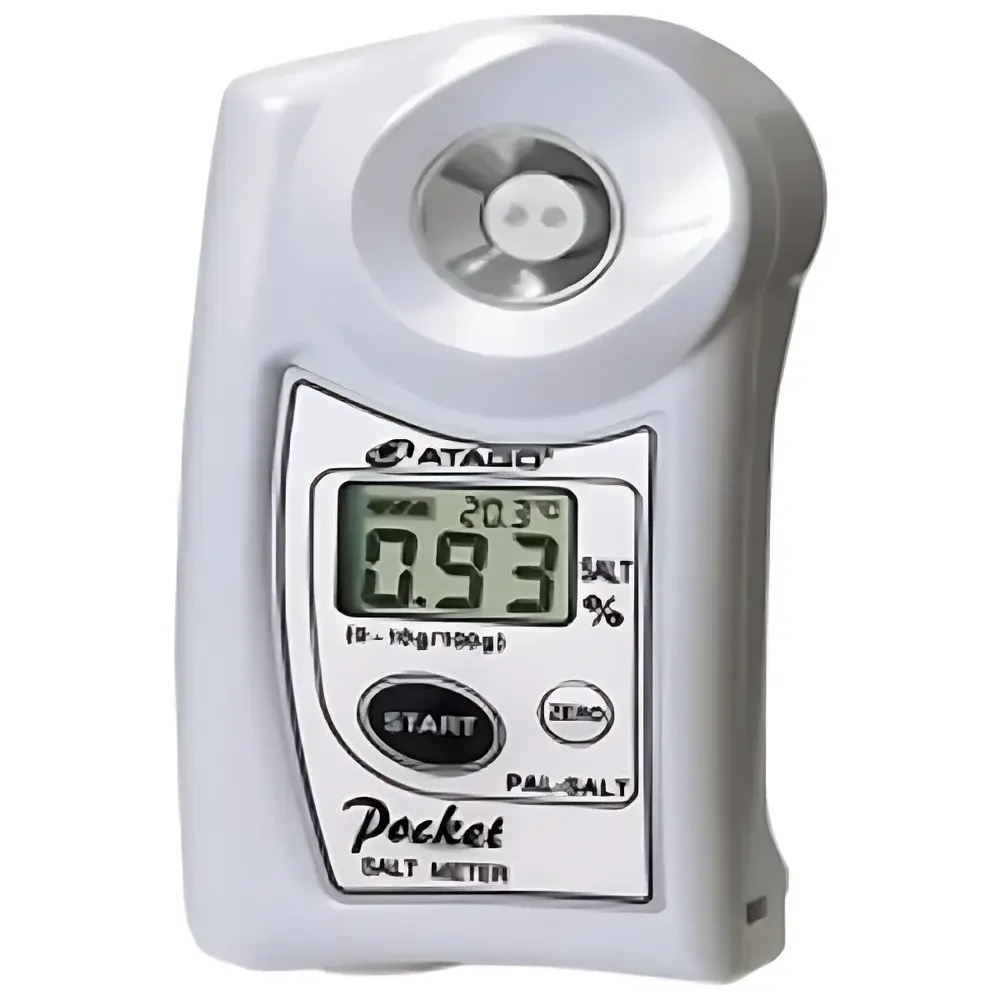
ATAGO PAL-SALT Digital Mini Handheld Refractometer
| Brand | ATAGO |
|---|---|
| Origin | Japan |
| Model | PAL-SALT |
| Product Type | Handheld Refractometer |
| Temperature Control | None |
| Digital Display | Yes |
| Measurement Range | 0.00–10.0% (NaCl, w/w) |
| Accuracy | ±0.05% (NaCl, w/w) |
Overview
The ATAGO PAL-SALT Digital Mini Handheld Refractometer is a compact, field-deployable optical instrument engineered for rapid, on-site determination of sodium chloride (NaCl) concentration in aqueous solutions. It operates on the principle of critical-angle refractometry: incident light passes through a prism-sample interface, and the resulting refraction angle—dependent on the solution’s refractive index—is converted into a salinity reading via a pre-calibrated algorithm specific to NaCl solutions at 20 °C. Unlike benchtop refractometers with Peltier temperature control (e.g., ATAGO RX series), the PAL-SALT relies on ambient temperature measurement and incorporates automatic temperature compensation (ATC) within the range of 10–40 °C to minimize thermal drift. Its optical path is sealed and optimized for high signal-to-noise ratio, ensuring stable readings even under variable lighting or moderate environmental vibration. Designed for routine quality verification—not research-grade metrology—the PAL-SALT meets the functional requirements of ISO 2173 (fruit and vegetable products), AOAC 982.12 (salt in processed foods), and ASTM D1152 (salinity in industrial brines) when used per manufacturer instructions.
Key Features
- Compact, pocket-sized form factor (102 × 53 × 27 mm) with ergonomic rubberized grip for one-handed operation
- LED-illuminated sapphire prism (hardness 9 Mohs) resistant to scratching and chemical corrosion from saline, acidic, or mildly alkaline samples
- High-contrast LCD with backlight for readability in low-light environments (e.g., production floors, cold storage rooms)
- Automatic temperature compensation (ATC) calibrated to the NaCl/water system between 10 °C and 40 °C
- No external power supply required: powered by two AAA batteries (typical life > 10,000 measurements)
- Zero calibration function using distilled or deionized water; no user-serviceable optics or alignment mechanisms
- IP65-rated enclosure for protection against dust ingress and water splashes during handling
Sample Compatibility & Compliance
The PAL-SALT is validated for homogeneous, non-viscous, non-turbid aqueous NaCl solutions—including brines, pickling solutions, seawater dilutions, and food processing rinse waters. It is not suitable for emulsions, suspensions, highly viscous syrups, or organic solvents (e.g., ethanol >10% v/v), as these distort the prism-sample interface and invalidate the NaCl-specific calibration. For regulatory contexts, the device supports documentation of measurement conditions (date/time stamp via optional PC interface software), traceable calibration records, and operator ID entry—enabling alignment with GLP and GMP documentation workflows. While it does not provide full 21 CFR Part 11 compliance out-of-the-box, its data export capability (via USB or Bluetooth adapter, sold separately) permits integration into validated LIMS environments where audit trails are managed externally.
Software & Data Management
The PAL-SALT itself is a standalone instrument with no onboard memory or internal data logging. However, when connected to ATAGO’s optional PAL-Link software (Windows/macOS) via USB or Bluetooth, users can export timestamped measurement records (value, date, time, operator ID, ambient temperature) in CSV or Excel format. The software enables batch reporting, statistical process control (SPC) charting (X-bar/R), and generation of calibration verification logs. All exported files retain metadata required for internal QA audits. No cloud synchronization or remote firmware updates are supported; firmware revisions require physical connection and manual upload via ATAGO’s authorized service centers.
Applications
- Food & Beverage Quality Control: Rapid verification of salt concentration in canned vegetables, cured meats, soy sauce, fish sauce, and ready-to-eat meal brines—ensuring consistency with HACCP critical limits
- Aquaculture & Marine Research: Field monitoring of salinity in hatchery tanks, recirculating aquaculture systems (RAS), and estuarine sampling sites
- Pharmaceutical Manufacturing: In-process checks of isotonic saline (0.9% NaCl) preparation prior to sterilization and filling
- Water Treatment: Estimation of chloride content in reverse osmosis reject streams and desalination plant feedwater
- Education & Training Labs: Teaching core principles of optical density, refractive index, and solution thermodynamics in undergraduate chemistry and food science curricula
FAQ
What is the measurement principle of the PAL-SALT?
It uses critical-angle refractometry, measuring the refractive index of an NaCl aqueous solution and converting it to %w/w concentration using a factory-established polynomial calibration curve.
Can the PAL-SALT measure other salts like KCl or CaCl₂?
No. Its calibration is strictly optimized for NaCl/water systems. Using it for other electrolytes introduces systematic bias exceeding ±0.5% error.
Is temperature control built into the instrument?
No. It features automatic temperature compensation (ATC), not active temperature regulation. Measurements assume sample equilibration to ambient temperature.
How often should I calibrate the instrument?
Calibrate before each measurement session using distilled water (0.00% reference); recalibrate if ambient temperature changes by >5 °C or after exposure to extreme humidity.
Does the PAL-SALT comply with ISO/IEC 17025 requirements?
As a Class II handheld refractometer, it supports ISO/IEC 17025 implementation when used within a documented calibration schedule, traceable standards, and trained personnel—but the instrument itself is not accredited.





