
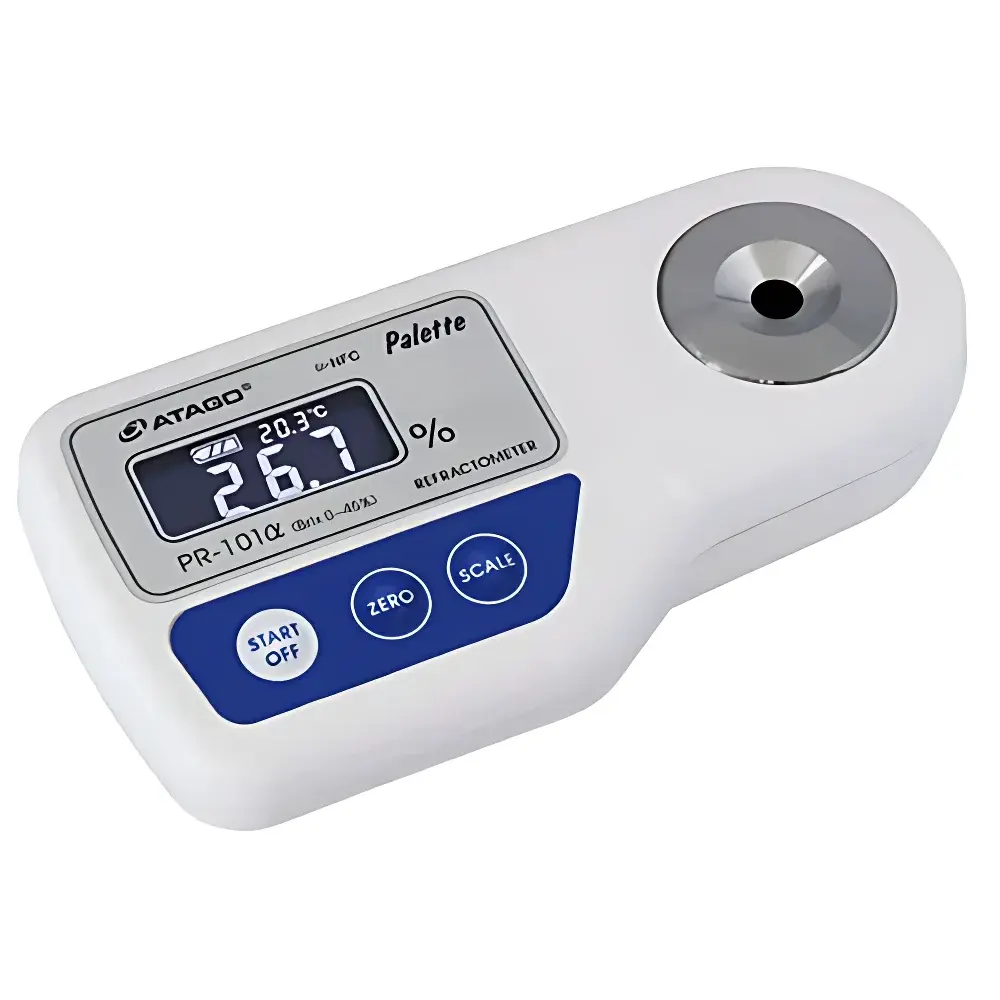
ATAGO PR-101α Portable Digital Refractometer for Low-to-Medium Brix Concentration
| Brand | ATAGO |
|---|---|
| Origin | Japan |
| Model | PR-101α |
| Measurement Range | Brix 0.0–45.0% |
| Minimum Display Resolution | 0.1% Brix |
| Accuracy | ±0.1% Brix |
| Temperature Compensation | Automatic (5–40°C) |
| IP Rating | IP64 |
| Power Supply | 9V Alkaline Battery (006P) |
| Dimensions | 170 × 90 × 40 mm |
| Weight | 300 g (body only) |
| Calibration Standards Available | 10%, 20%, 30%, 40% Sucrose Solutions (RE-110010/20/30/40) |
Overview
The ATAGO PR-101α is a handheld digital refractometer engineered for rapid, field-deployable measurement of aqueous sucrose solutions within the low-to-medium Brix concentration range (0.0–45.0%). It operates on the principle of critical angle refractometry: incident light passes through a high-refractive-index prism in contact with the sample, and the resulting refraction angle—directly correlated to the solution’s solute concentration—is detected by an internal linear CCD sensor array. This optical-electronic architecture enables real-time conversion of refractive index to Brix % (w/w), calibrated per the International Commission for Uniform Methods of Sugar Analysis (ICUMSA) standard reference tables. Designed for routine quality control in food production environments—including juice processing, syrup blending, fruit concentrate manufacturing, and beverage formulation—the PR-101α delivers laboratory-grade repeatability (±0.1% Brix) in a rugged, palm-sized form factor. Its automatic temperature compensation (ATC) algorithm corrects measurements across 5–40°C ambient conditions using an integrated thermistor, ensuring compliance with ISO 2173:2003 (fruit and vegetable products — determination of soluble solids content — refractometric method).
Key Features
- High-precision optical system with sapphire-coated prism surface for scratch resistance and long-term calibration stability
- Digital display with 0.1% Brix resolution and ±0.1% accuracy traceable to NIST-traceable sucrose standards
- IP64-rated enclosure: fully dust-tight and protected against water splashes from any direction—suitable for humid production floors and outdoor orchard use
- One-button START/OFF operation with 3-second stabilization and auto-hold function; measurement completes within <2 seconds after sample application
- Four scalable measurement modes: factory-default Brix scale plus three user-definable scales (Scale 2, 3, 4) with programmable linear conversion coefficients (default = 1.00)
- Zero calibration function with visual confirmation (stable “000” display) using distilled water; recommended before first daily use, after battery replacement, or following ambient temperature shifts >5°C
- Integrated temperature logging: simultaneous press of ZERO + SCAL keys recalls last calibration or measurement temperature for audit trail documentation
Sample Compatibility & Compliance
The PR-101α is optimized for homogeneous, non-viscous, non-opaque aqueous solutions containing sucrose, glucose, fructose, or mixed sugars—common in fruit juices, soft drink syrups, honey dilutions, and fermented musts. It is not intended for suspensions, emulsions, or highly viscous samples (e.g., molasses, jam pastes) without prior dilution and validation. All measurements conform to ASTM D1074–22 (Standard Test Method for Solids Content of Adhesives) and AOAC Official Method 932.12 (Refractometric Determination of Soluble Solids in Fruit Juices). The instrument supports GLP-compliant workflows via manual logbook entry of calibration dates, operator ID, and reference standard lot numbers (e.g., RE-110020, certified ±0.03% Brix at 20°C). No firmware-based electronic records or 21 CFR Part 11 compliance features are included—users requiring audit-ready digital data capture should integrate external logging protocols.
Software & Data Management
The PR-101α is a standalone, embedded-system device with no Bluetooth, USB, or PC connectivity. All configuration, scaling, and calibration functions are performed via front-panel button interface. User-defined scale coefficients are stored in non-volatile memory and persist through battery replacement. While the unit does not generate exportable files, its deterministic measurement output (Brix %, temperature, scale identifier) enables consistent manual transcription into LIMS or Excel-based QC spreadsheets. For traceability, operators are advised to record: date/time, sample ID, measured Brix, ambient temperature, calibration standard used, and operator initials. Firmware updates are not supported; hardware revision control is maintained via ATAGO’s global service network (model-specific part number: 3442).
Applications
- Routine Brix verification during juice extraction and pasteurization lines to ensure batch consistency against specification limits
- In-field ripeness assessment of citrus, grapes, and stone fruits pre-harvest using handheld sampling
- Concentrate blending control in dairy-based dessert mix production where sucrose/glucose ratios impact freezing point depression
- QC release testing of intermediate syrup batches in confectionery manufacturing prior to caramelization
- Teaching laboratories for principles of optical density, solution thermodynamics, and calibration traceability
- Cross-validation against benchtop Abbe refractometers (e.g., ATAGO RX-5000α) in method transfer studies
FAQ
What is the recommended calibration frequency?
Calibration verification using a certified sucrose standard (e.g., RE-110020) is recommended at the start of each shift when used in continuous production; otherwise, once per day under intermittent use.
Can the PR-101α measure non-sugar solutes like sodium chloride or organic acids?
No—it reports values exclusively in Brix %, which assumes a sucrose-equivalent refractive index. Measurements of salt solutions or citric acid will yield inaccurate, non-quantitative readings unless empirically re-correlated via multi-point calibration.
Why does the display show “000” after zeroing but then drift?
Residual moisture or detergent film on the prism surface causes refractive index instability; re-clean with ethanol-dampened lint-free tissue and repeat zeroing with fresh distilled water.
Is battery life affected by ambient temperature?
Yes—alkaline 9V batteries exhibit reduced capacity below 10°C; users operating in cold storage environments should carry spares and allow instruments to equilibrate to room temperature before measurement.
How does IP64 rating impact operational hygiene in food plants?
The sealed optical path and dust/water-resistant housing permit safe use in wet cleaning zones (e.g., CIP rinse areas), though submersion, steam sterilization, or abrasive scrubbing remains prohibited.





