
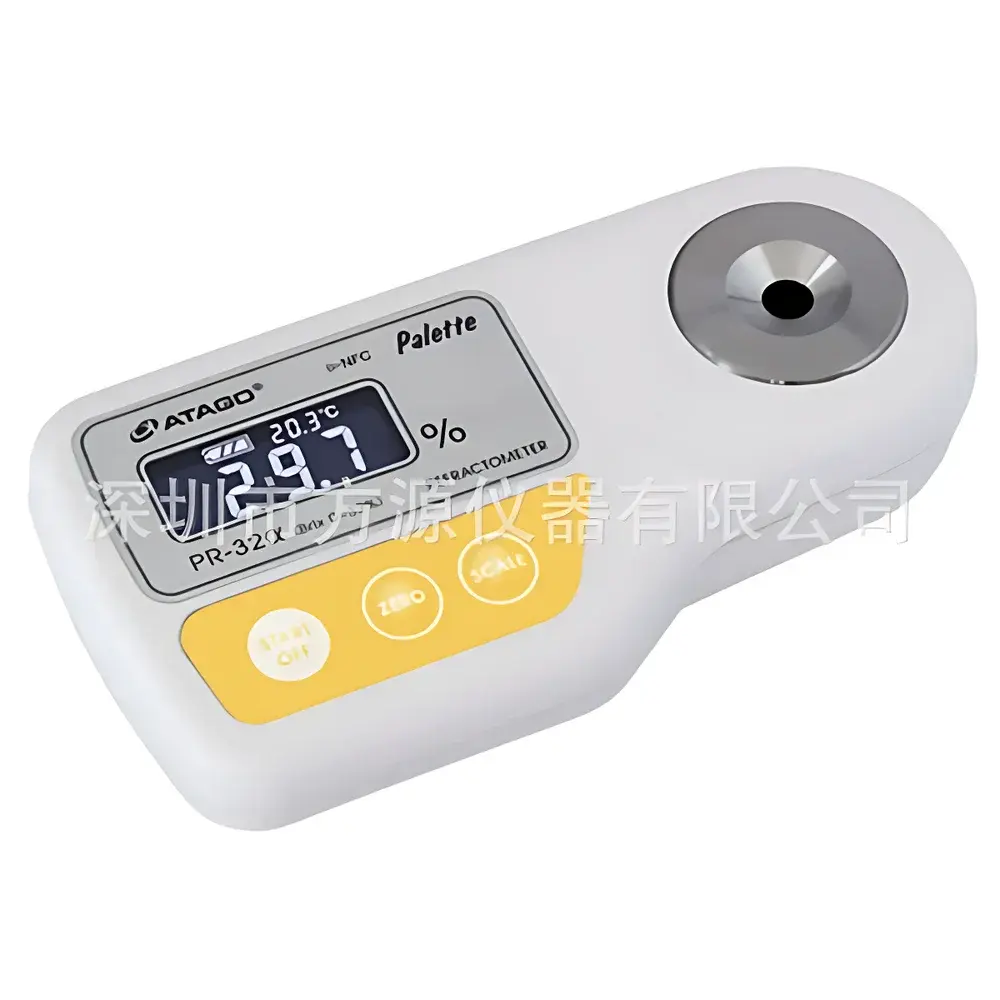
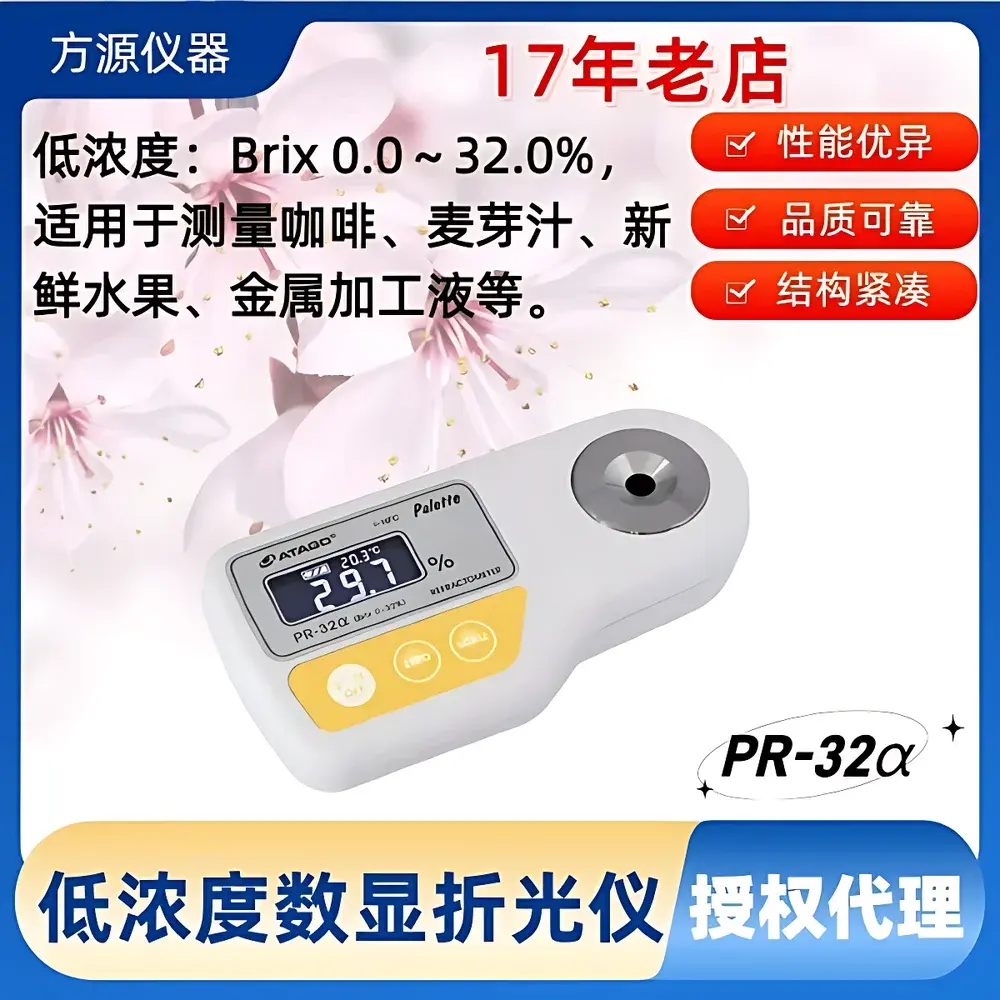
ATAGO PR-32α PALETTE Series Digital Low-Range Refractometer
| Brand | ATAGO |
|---|---|
| Origin | Japan |
| Model | PR-32α |
| Type | Benchtop Refractometer |
| Display | Digital LCD |
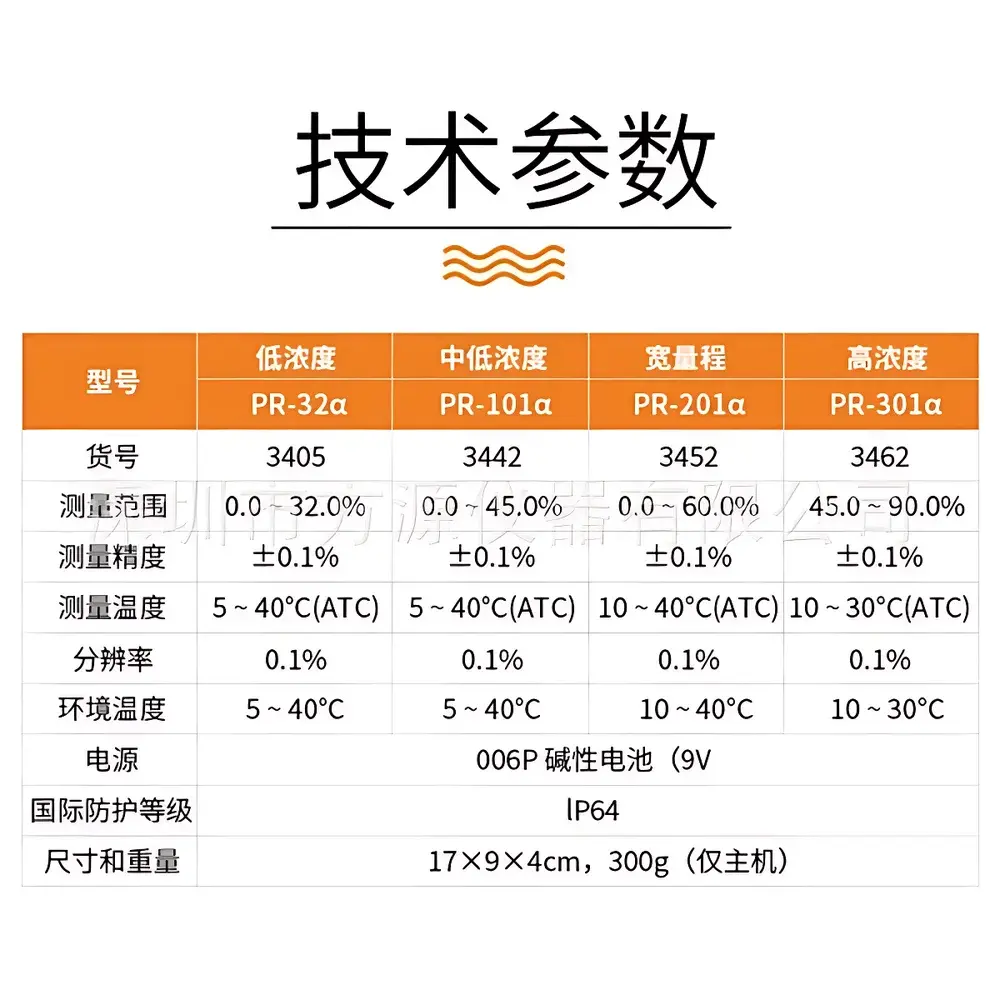
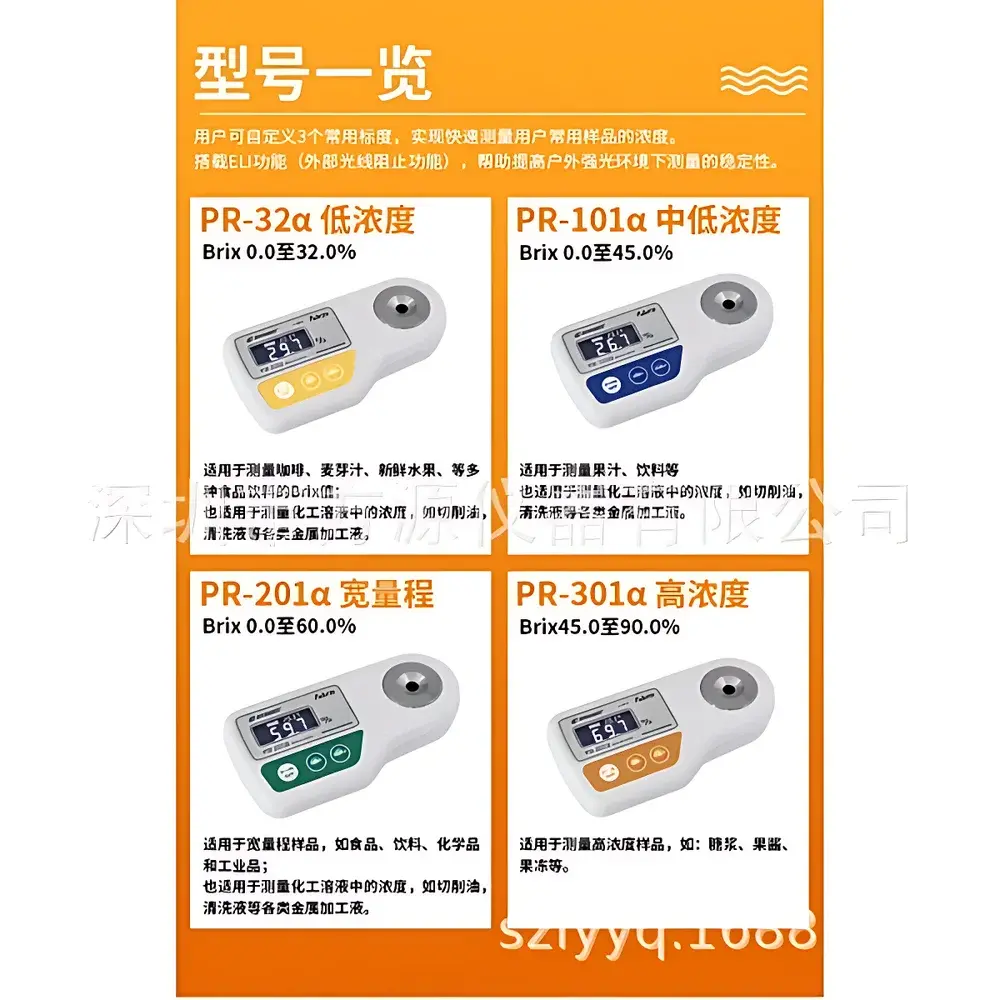
| Measurement Range | 0.0–32.0% Brix |
| Temperature Range for Calibration/Operation | 5.00–40.00 °C |
| Temperature Compensation | Automatic (ATC, 10–30 °C ambient) |
| Compliance | JIS K 0064, ISO 2173, AOAC 932.12 |
| Power | 2×AAA batteries (included) |
| Dimensions | 128 × 64 × 115 mm |
| Weight | 240 g |
Overview
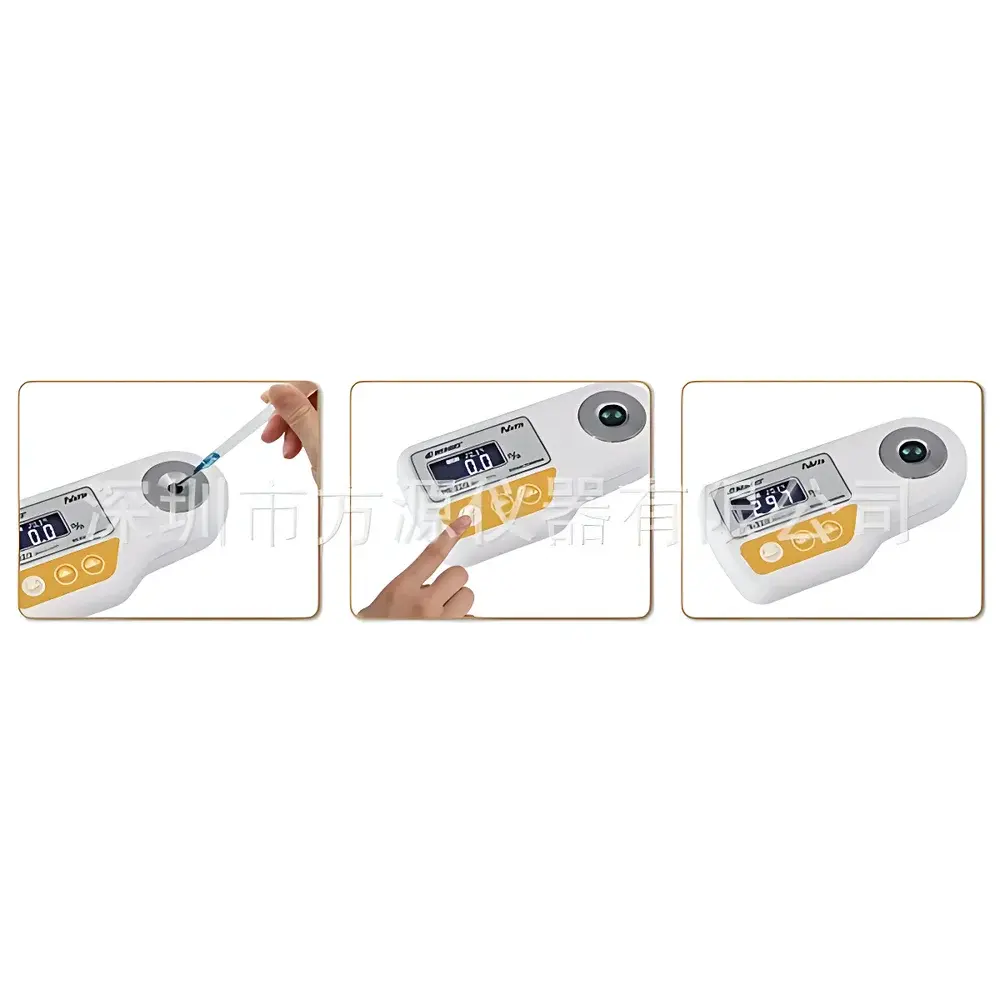
The ATAGO PR-32α PALETTE Series Digital Low-Range Refractometer is a precision benchtop instrument engineered for rapid, reliable quantification of soluble solids concentration—expressed as % Brix—in low-sugar or low-refractive-index aqueous solutions. Based on the principle of total internal reflection at the prism-sample interface, the device measures the critical angle of light refraction and converts it into a digital Brix reading via an embedded optical sensor and temperature-compensated algorithm. Unlike high-range refractometers optimized for syrups or fruit concentrates, the PR-32α is specifically calibrated for samples with subtle refractive index gradients—such as wort, cold-brew coffee extracts, fresh fruit juices, coolant emulsions, and metalworking fluids—where resolution below 1.0% Brix is essential for process consistency and quality control. Its compact monoblock design integrates a sapphire-coated measuring prism, LED illumination source, and CMOS photodetector array within a thermally stable housing, minimizing drift during sequential measurements.
Key Features
- Digital LCD display with 0.1% Brix resolution and automatic backlight for low-light lab environments
- Automatic Temperature Compensation (ATC) across 10–30 °C ambient range, referencing internal thermistor data to correct for thermal expansion effects on refractive index
- Sapphire-coated glass prism (Vickers hardness ≥2000 HV) resistant to abrasion from particulate-laden or abrasive industrial fluids
- No external power supply required: operates on two standard AAA alkaline batteries (up to 10,000 measurements per set)
- Zero-point calibration using distilled water only—no certified sucrose standards needed for routine verification
- IP65-rated enclosure for protection against dust ingress and incidental liquid splashes during workshop or production-floor use
Sample Compatibility & Compliance
The PR-32α accommodates viscous, non-homogeneous, and mildly turbid liquids without filtration, provided sample volume exceeds 0.3 mL and surface tension permits uniform prism wetting. It is validated for use with aqueous-based systems where dissolved solids contribute linearly to refractive index—including maltose-rich wort (pre-fermentation), clarified apple or orange juice, aqueous glycol coolants, alkaline cleaning agents, and semi-synthetic metal removal fluids. The instrument conforms to international standard methods for refractometric analysis: JIS K 0064 (Japanese Industrial Standard for sugar content determination), ISO 2173 (fruit and vegetable products), and AOAC Official Method 932.12 (refractometric Brix in beverages). While not FDA 21 CFR Part 11 compliant out-of-the-box (lacking audit trail or electronic signature functionality), its measurement traceability supports GLP-aligned documentation when paired with laboratory-controlled calibration logs and operator ID protocols.
Software & Data Management
The PR-32α operates as a standalone instrument with no proprietary software dependency or USB/Bluetooth connectivity. All measurement data remain local to the unit’s display; no internal memory or export capability is provided. This architecture prioritizes operational simplicity, electromagnetic immunity, and compliance with air-gapped environments common in regulated manufacturing facilities. For laboratories requiring data capture, users may integrate the PR-32α into existing LIMS or ELN workflows via manual entry or third-party vision-based OCR tools trained on its fixed-format LCD output. Calibration records and daily verification checks are maintained externally in accordance with ISO/IEC 17025 Clause 7.7 (measurement traceability) and ASTM E2917 (standard practice for refractometer verification).
Applications
- Quality assurance of wort gravity in craft brewing prior to yeast inoculation
- Monitoring sugar depletion kinetics during coffee cold-brew extraction
- Verifying dilution ratios of water-miscible metalworking fluids on CNC machine tool sumps
- Batch release testing of freshly pressed fruit juices before pasteurization
- In-process control of alkaline cleaner concentration in parts-washing lines
- Field validation of antifreeze glycol concentration in HVAC closed-loop systems
FAQ
Does the PR-32α require recalibration before each use?
No—calibration is performed only when ambient temperature shifts beyond ±2 °C from the last zero-point verification or after extended storage. Distilled water verification is recommended at the start of each shift.
Can it measure non-aqueous solvents such as ethanol or acetone?
No. The ATC algorithm and Brix scale are mathematically derived for sucrose-water systems. Measurements in organic solvents yield non-linear, non-quantitative outputs and are outside specification.
Is the prism surface cleanable with isopropyl alcohol?
Yes—use lint-free wipes dampened with >99% IPA; avoid abrasive pads or chlorinated solvents that degrade the sapphire coating adhesion layer.
What is the minimum sample temperature for accurate reading?
Samples must be equilibrated to within ±0.5 °C of ambient room temperature (10–30 °C) prior to measurement; rapid thermal transients induce transient prism condensation and optical scatter.
Does ATAGO provide NIST-traceable calibration certificates?
Yes—optional factory-issued certificates (traceable to NMIJ/AIST SRM 84e sucrose solutions) are available upon request at time of order, fulfilling ISO/IEC 17025 Clause 6.6 requirements for accredited labs.




