
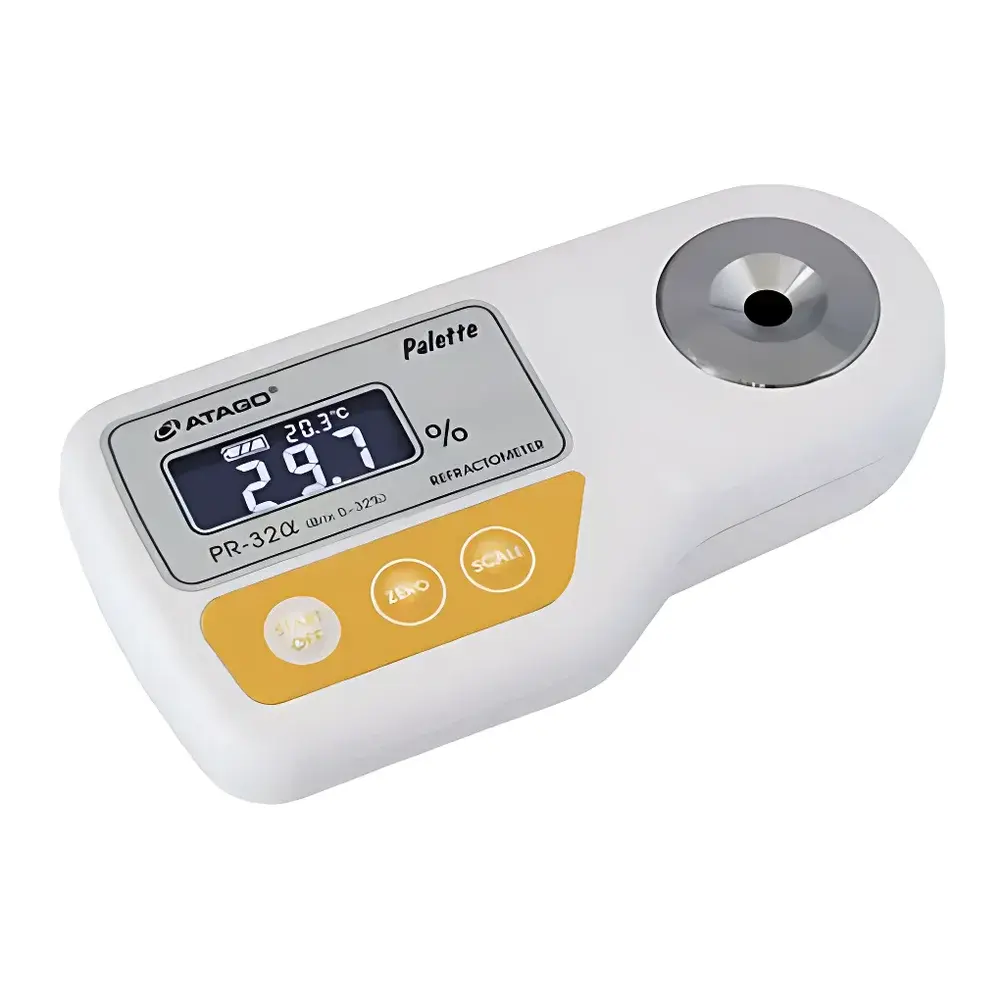
ATAGO PR-32α Portable Digital Refractometer for Cutting Fluid and Antifreeze Concentration Measurement
| Brand | ATAGO |
|---|---|
| Origin | Japan |
| Model | PR-32α |
| Measurement Range | 0.0–32.0% Brix |
| Minimum Display Resolution | 0.1% Brix |
| Accuracy | ±0.1% Brix |
| Temperature Compensation | Automatic (5–40°C) |
| Operating Ambient Temperature | 5–40°C |
| Power Supply | 9V Alkaline Battery (006P) |
| IP Rating | IP64 |
| Application-Specific Scales | Customizable concentration scale via user-defined coefficient (Concentration = Brix × Coefficient) |
| Optical Interference Mitigation | External-Light-Interference (ELI) compensation technology |
| Instrument Type | Portable handheld refractometer |
| Compliance | Designed for industrial QC environments requiring repeatable, field-deployable liquid concentration verification |
Overview
The ATAGO PR-32α is a precision-engineered portable digital refractometer specifically optimized for rapid, on-site concentration assessment of industrial process fluids—including metalworking cutting oils, engine coolants/antifreeze solutions, cleaning agents, and water-glycol mixtures—as well as food-grade liquids such as fruit juices and soft drinks. It operates on the fundamental optical principle of refractive index measurement: light refraction at the interface between the sample and prism surface varies predictably with solute concentration. The instrument employs Abbe-type critical-angle detection with high-stability sapphire-coated prism optics and a thermally compensated photodiode array to deliver consistent readings across ambient temperature fluctuations (5–40°C). Unlike benchtop laboratory refractometers, the PR-32α integrates automatic temperature compensation (ATC) without external calibration baths—enabling reliable field use in machine shops, maintenance bays, and production lines where environmental conditions are variable.
Key Features
- High-resolution digital display with 0.1% Brix minimum increment and ±0.1% Brix accuracy—validated per ATAGO internal metrology protocols aligned with JIS Z 8806 and ISO 21747 standards for refractometric analysis.
- User-configurable concentration scale: Operators define a linear conversion factor (e.g., % glycol = Brix × 1.05 or % triethanolamine = Brix × 0.92), allowing direct readout of application-specific units without manual calculation.
- External-Light-Interference (ELI) optical compensation system—actively suppresses measurement drift caused by ambient sunlight or overhead LED lighting, ensuring stability during window-side or outdoor inspections.
- Ruggedized housing rated IP64: Dust-tight and protected against water splashes from any direction—suitable for deployment in oily, humid, or vibration-prone industrial environments.
- Single-button operation with auto-power-off after 3 minutes of inactivity; powered by a standard 9V alkaline battery (006P) providing >5,000 measurements per charge.
- No moving parts or fluidic pathways—eliminates risk of cross-contamination or clogging when switching between coolant, quench oil, and aqueous cleaning solutions.
Sample Compatibility & Compliance
The PR-32α is validated for aqueous-based and water-miscible industrial fluids with refractive indices within the instrument’s optical design envelope (nD ≈ 1.33–1.42). Typical compatible matrices include ethylene glycol/water and propylene glycol/water antifreeze blends, semi-synthetic and synthetic cutting fluids, alkaline cleaners, rust inhibitors, and phosphate-free corrosion inhibitors. It is not intended for pure hydrocarbons (e.g., mineral oil base stocks), highly viscous emulsions (>100 cSt), or suspensions containing particulates >5 µm. While not certified to ISO/IEC 17025, its performance characteristics support routine QC testing under GLP-aligned procedures and satisfy common OEM coolant specification requirements (e.g., ASTM D1176, SAE J1085, Ford WSS-M97B44-D). Calibration verification is performed using ATAGO-certified sucrose reference standards traceable to NIST SRM 84d.
Software & Data Management
As a standalone field instrument, the PR-32α does not feature onboard data logging or USB connectivity. However, its deterministic analog-to-digital conversion architecture ensures measurement repeatability <0.05% RSD (n=10) under controlled conditions—facilitating integration into paper-based or LIMS-linked quality records. Users may document results manually or via mobile device capture (e.g., barcode-scanned batch IDs paired with timestamped photos of the display). For enterprises requiring electronic audit trails, ATAGO recommends pairing the PR-32α with the optional PAL-ES data transfer kit (sold separately), which enables serial output to spreadsheet-compatible formats compliant with FDA 21 CFR Part 11 Annex 11 requirements when deployed with validated software infrastructure.
Applications
- Preventive maintenance: Rapid verification of antifreeze concentration in automotive, marine, and HVAC cooling systems to ensure freeze/boil protection and corrosion inhibition efficacy.
- Metalworking fluid management: Monitoring sump concentration of soluble oil emulsions to maintain optimal lubricity, cooling capacity, and microbial control—reducing tool wear and part rejection.
- Process validation: Confirming dilution ratios of alkaline cleaners prior to parts washing cycles, supporting IATF 16949 clause 8.5.1.2 on process control.
- Supplier quality inspection: On-receipt verification of incoming coolant or additive concentrates against purchase specifications before blending or dispensing.
- Regulatory documentation: Generating auditable concentration records for ISO 9001 Clause 8.6 release checks or AS9100D section 8.6.2 traceability requirements.
FAQ
Can the PR-32α measure pure ethylene glycol or undiluted antifreeze concentrate?
No—the instrument’s 0.0–32.0% Brix range corresponds to typical working dilutions (e.g., 30/70 glycol/water). Undiluted glycol exceeds the upper refractive index limit and will yield saturation error.
Is temperature compensation applicable to non-aqueous samples like neat cutting oils?
ATC is calibrated for aqueous systems only. For non-aqueous or high-viscosity oils, measurements must be conducted at 20°C ±1°C using a thermostatic bath, and results interpreted with caution.
How often should the prism surface be cleaned between different sample types?
Wipe thoroughly with lens tissue and reagent-grade isopropyl alcohol after each sample—especially when transitioning between glycol-based and amine-containing fluids—to prevent residue-induced refractive index hysteresis.
Does ATAGO provide calibration certificates with NIST traceability?
Yes—certified reference standards (e.g., 10.00 ±0.02% Brix sucrose solution, Lot-coded) are available with full NIST-traceable calibration reports meeting ISO/IEC 17025 criteria upon request.





