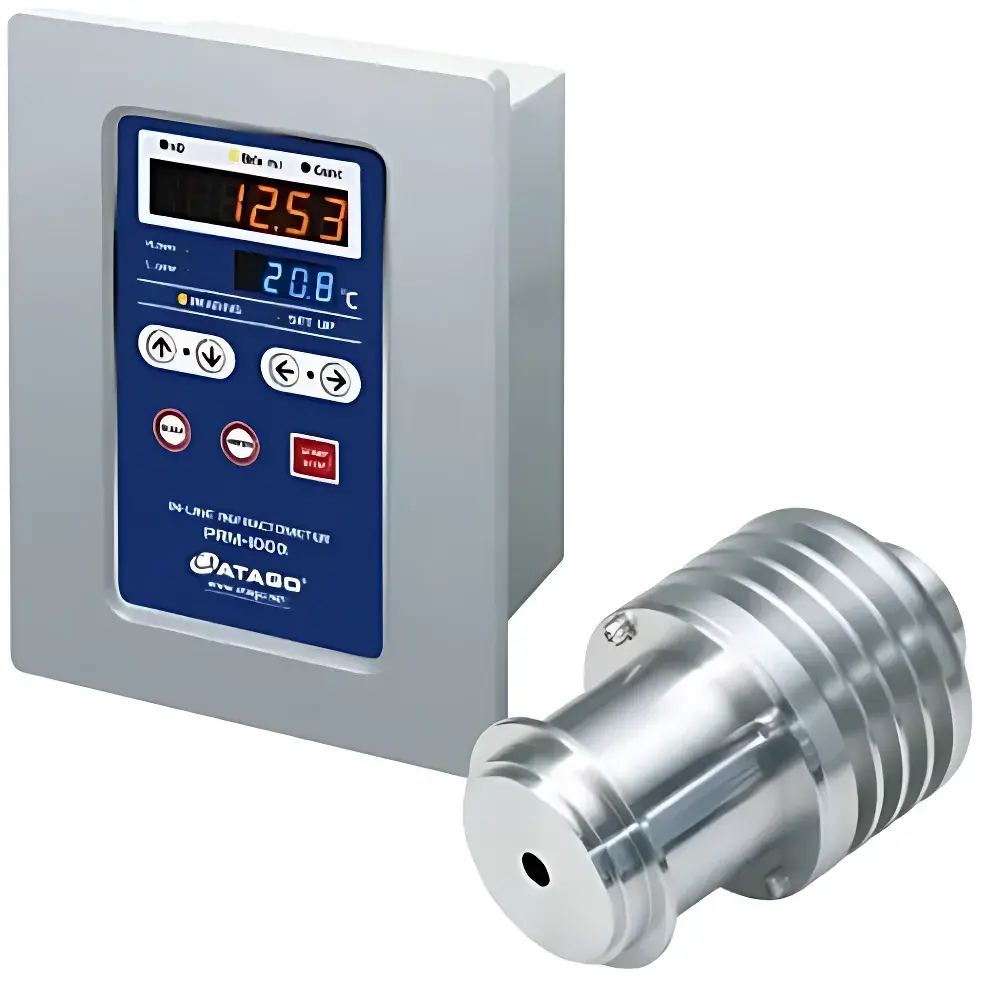
ATAGO PRM-100α DX Full-Range In-Line Refractometer
| Brand | ATAGO |
|---|---|
| Origin | Japan |
| Model | PRM-100α DX Full-Range In-Line Refractometer |
| Measurement Range | Brix 0.00–100.00% (ATC), Refractive Index (nD) 1.32000–1.55700 |
| Accuracy | ±0.00010 (nD), ±0.05% (Brix, under stable temperature with standard solution) |
| Temperature Compensation | 5–100 °C (ATC) |
| Operating Temp. (Sample) | –5.0 to 160.0 °C |
| Pressure Rating | 0.98 MPa (10 kgf/cm²) |
| IP Rating | IP67 |
| Sample Cell Material | SUS316L |
| Prism Material | Sapphire |
| Output Options | 4–20 mA (optional cable), RS-232C (optional cable) |
| Display | 7-segment LED |
| Measurement Interval | ~1 s |
| Power Supply | AC 100–240 V, 50–60 Hz |
| Detector Dimensions | 10.8 × 17.26 × 10.8 cm, 2.6 kg |
| Display Unit Dimensions | 19.2 × 10 × 24 cm, 3.3 kg |
| Standard Cable Length | 15 m (extendable to 200 m) |
Overview
The ATAGO PRM-100α DX Full-Range In-Line Refractometer is an industrial-grade process analytical instrument engineered for continuous, real-time measurement of refractive index (nD) and concentration—expressed as Brix (%)—in flowing liquid streams. Based on the fundamental optical principle of critical-angle refraction, the device employs a sapphire prism interface in direct contact with the process fluid; incident light undergoes total internal reflection at the prism–sample boundary, with the critical angle directly correlated to the sample’s refractive index. This relationship is calibrated against internationally traceable sucrose standards (ISO 21542, AOAC 932.12) to derive Brix values under Automatic Temperature Compensation (ATC) across 5–100 °C. Designed for permanent installation in sanitary or industrial piping systems, the PRM-100α DX operates without sampling, reagents, or moving parts—ensuring long-term stability, minimal maintenance, and compliance with hygienic design principles per EHEDG Doc. 8 and 3-A SSI 08-03.
Key Features
- Full-scale Brix measurement range from 0.00 to 100.00%, enabling universal deployment across low-concentration wash solutions and high-solids syrups, polymer emulsions, or pharmaceutical concentrates.
- High-resolution optical detection with ±0.00010 refractive index accuracy and ±0.05% Brix repeatability (verified using NIST-traceable sucrose reference standards at controlled thermal equilibrium).
- Sapphire prism (Mohs hardness 9) and SUS316L wetted materials ensure chemical resistance to aggressive solvents, caustics, acids, and CIP/SIP media—validated per ASTM G152 for corrosion performance in alkaline cleaning cycles.
- Robust pressure rating of 0.98 MPa (10 kgf/cm²) supports integration into pressurized process lines without bypass loops or pressure-reduction hardware.
- IP67-rated detector housing and thermally isolated electronics permit operation in humid, dusty, or washdown environments typical of food, pharma, and fine chemical production floors.
- Dual-output capability: isolated 4–20 mA analog signal for PLC/DCS integration and RS-232C serial interface for direct PC logging, configuration, and firmware updates.
- Configurable display resolution (0.01% Brix / 0.00001 nD default; 0.1% / 0.0001 selectable) supports both operational visibility and laboratory-grade data capture.
Sample Compatibility & Compliance
The PRM-100α DX is validated for homogeneous, optically transparent to mildly turbid liquids—including aqueous sugar solutions, organic solvent blends (e.g., ethanol/water, acetone/water), glycol-based heat transfer fluids, detergent formulations, and API suspensions stabilized below 5 µm particle size. It is not suitable for opaque slurries, highly viscous non-Newtonian fluids (>5000 mPa·s), or samples containing air entrainment or phase separation. The instrument complies with electromagnetic compatibility requirements per IEC 61326-1 (industrial environment) and meets functional safety guidelines for Category 2 monitoring per IEC 61508. For regulated industries, its fixed calibration architecture—without user-adjustable slope/offset—and audit-ready configuration logs support alignment with FDA 21 CFR Part 11 (when paired with compliant SCADA software), EU GMP Annex 11, and ISO/IEC 17025 data integrity expectations.
Software & Data Management
While the PRM-100α DX operates autonomously via its integrated LED display, its RS-232C port enables bidirectional communication with host systems using ASCII protocol. Configuration parameters—including ATC algorithm selection, output scaling, alarm thresholds, and unit preference—are stored in non-volatile memory and can be backed up/exported. When interfaced with validated LIMS or MES platforms (e.g., Siemens Desigo CC, Rockwell FactoryTalk), measurement timestamps, raw nD, compensated Brix, and process temperature are recorded with system-generated audit trails. Optional analog output signals may feed into safety instrumented systems (SIS) for concentration-triggered interlocks during CIP validation or blend endpoint detection—fully documented per ISA-84.00.01.
Applications
- Real-time Brix control in juice concentration, syrup blending, and dairy evaporation—reducing over-concentration waste and ensuring batch-to-batch consistency per Codex Alimentarius STAN 1.1.
- In-line monitoring of cleaning solution strength (e.g., NaOH % in CIP return lines) to verify minimum effective concentration prior to equipment reuse—supporting ISO 14644-1 cleanliness verification protocols.
- Continuous tracking of solvent recovery ratios in pharmaceutical extraction (e.g., ethanol recovery from botanical extracts), enabling precise distillation endpoint detection.
- Concentration feedback control in metalworking fluid management—maintaining optimal lubricity and corrosion inhibition across multi-shift operations.
- Final-fill concentration verification for ophthalmic solutions, vaccine diluents, and parenteral nutrition formulations where osmolality correlates strongly with refractive index.
FAQ
Does the PRM-100α DX require periodic recalibration?
No routine recalibration is required. The sapphire prism and solid-state optical path provide inherent long-term drift stability (<0.00002 nD/year). Verification against certified reference standards (e.g., ATAGO SRM-100 series) is recommended quarterly for GMP applications.
Can it measure non-sucrose-based solutions?
Yes—provided a custom Brix-equivalent calibration curve is established using representative reference materials (e.g., NaCl, glycerol, PEG) and stored in the device’s application-specific mode.
Is steam sterilization (SIP) supported?
The detector is rated for intermittent exposure up to 160 °C, compatible with saturated steam SIP cycles when installed with appropriate thermal expansion accommodation and condensate drainage.
What is the minimum flow velocity required for accurate measurement?
A laminar-to-turbulent transition flow (Re > 2300) is recommended to ensure uniform prism wetting; typical minimum velocity is 0.3 m/s in 1-inch pipe—verified via computational fluid dynamics modeling included in ATAGO’s installation guide.
How is temperature compensation implemented?
A Pt100 RTD embedded adjacent to the prism measures sample temperature in real time; compensation uses a fifth-order polynomial derived from empirical nD/T data across 5–100 °C, conforming to ISO 1042 and DIN 51757.
Related Products