
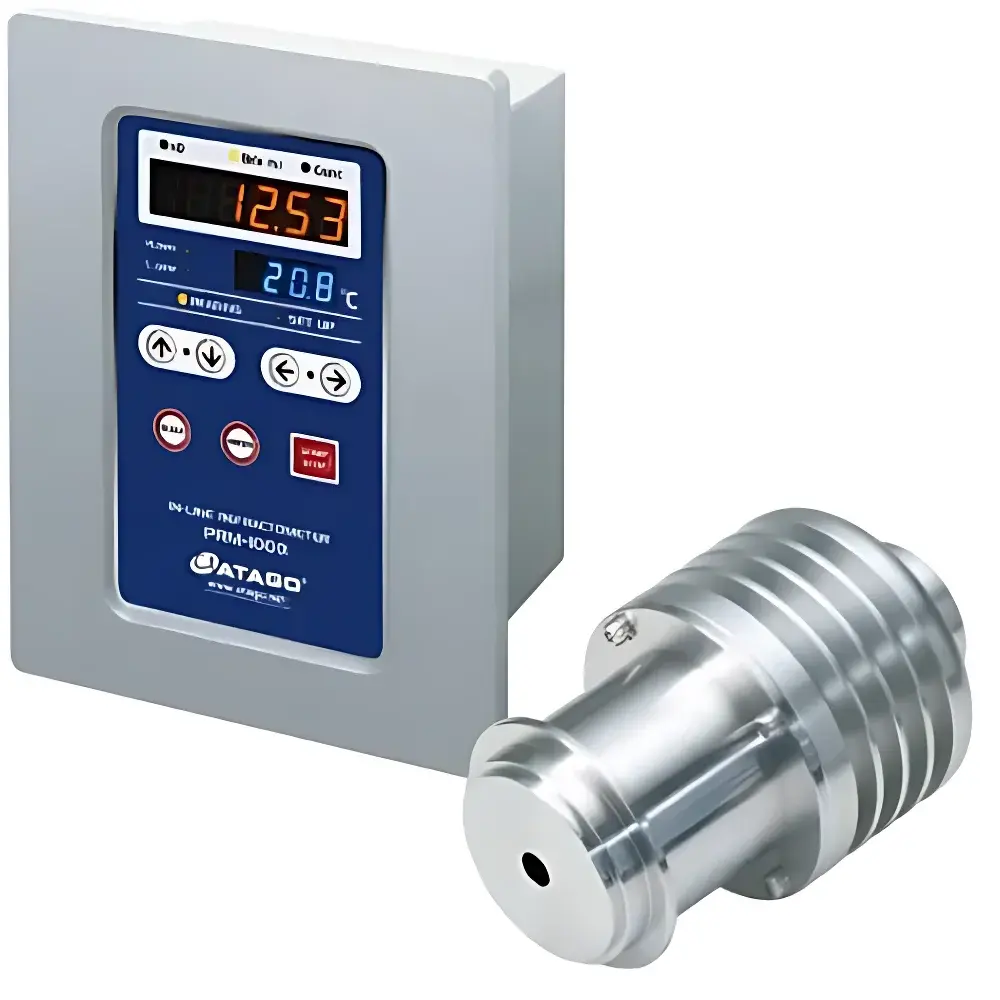
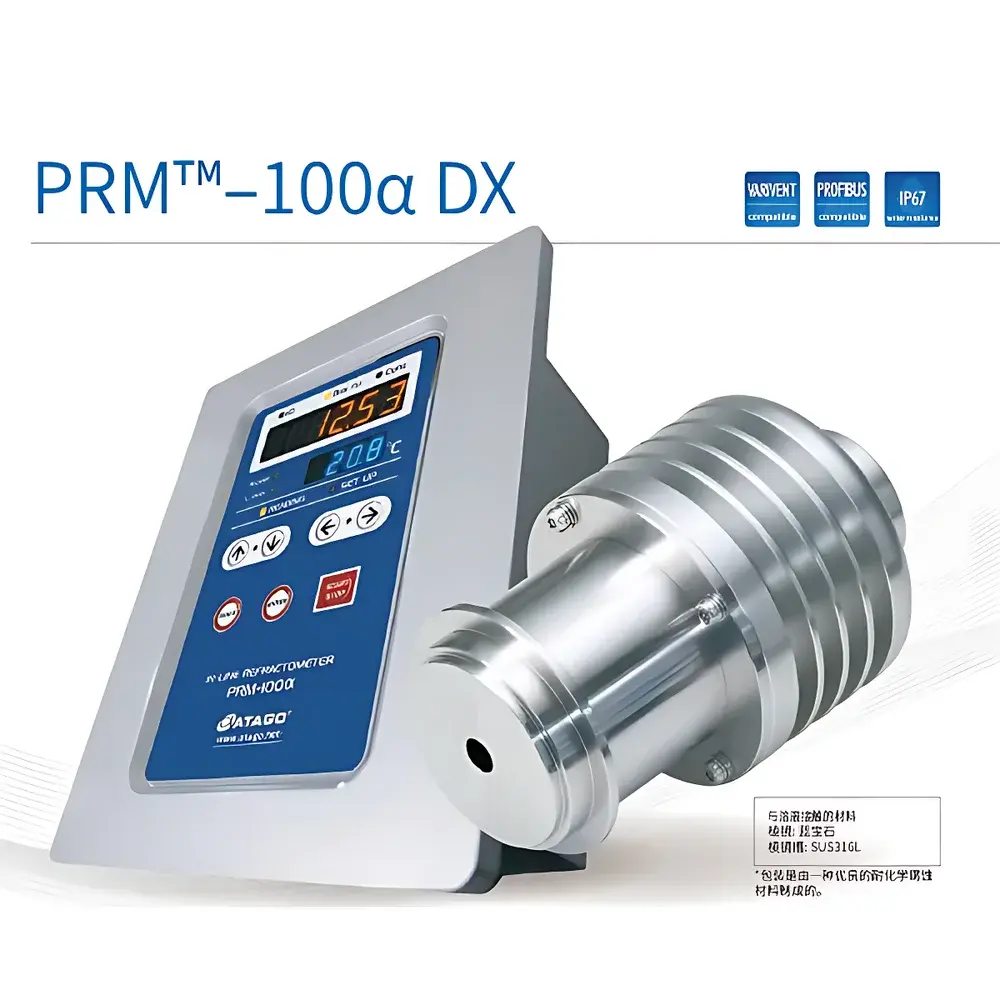
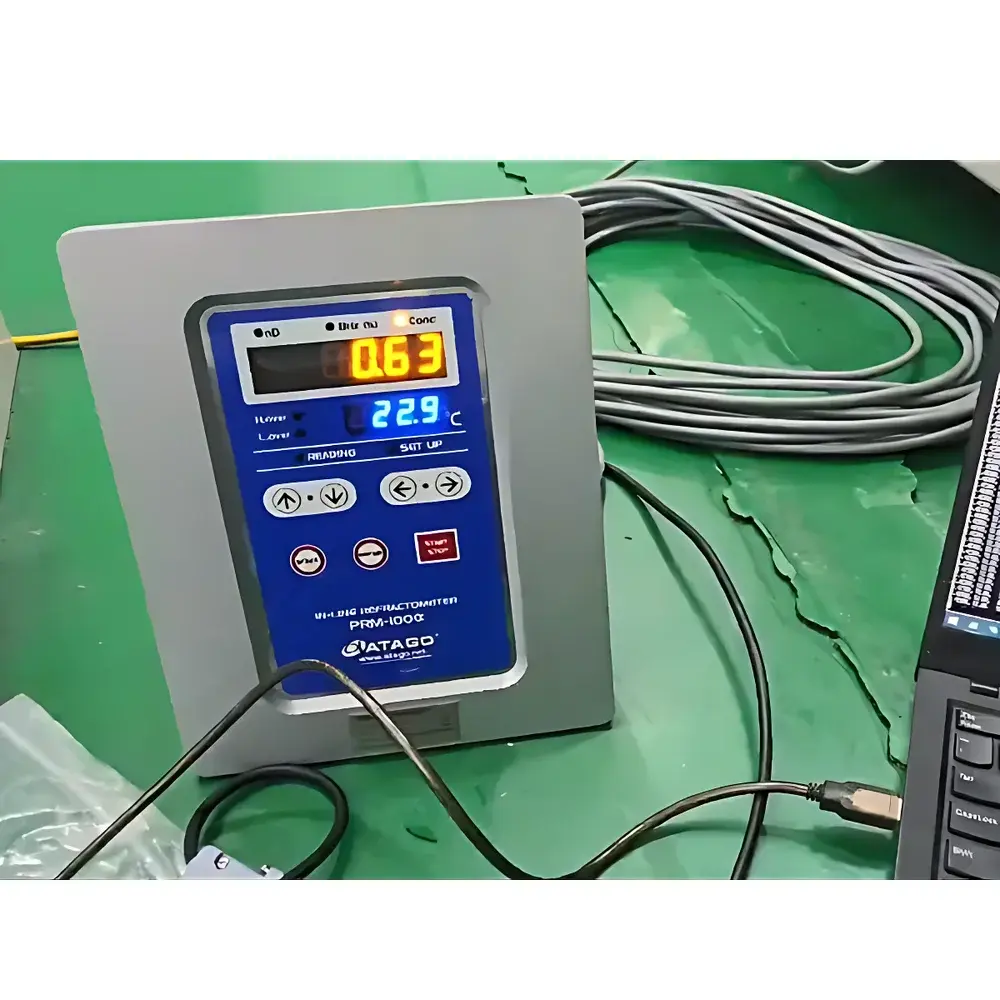
ATAGO PRM-100α DX High-Precision In-Line Refractometer
| Brand | ATAGO |
|---|---|
| Origin | Japan |
| Model | PRM-100α DX |
| Measurement Range | nD 1.32000–1.55700, Brix 0.00–100.00%, Temp −5.0–160.0°C |
| Resolution | nD ±0.0001 or ±0.00001, Brix ±0.01% or ±0.1% (selectable) |
| Accuracy | nD ±0.00010, Brix ±0.05% (at stable temp, using sucrose standard) |
| Temperature Compensation | 5–100°C |
| Output | RS-232C, 4–20 mA |
| Response Time | ~1 sec/reading |
| Prism Material | Synthetic Sapphire |
| Wetted Parts | SUS316L |
| Pressure Rating | 0.98 MPa |
| IP Rating | IP67 (both sensor & display unit) |
| Power | AC 100–240 V, 50/60 Hz, 30 VA |
| Cable Length | Standard 15 m (up to 200 m optional) |
| Dimensions (Sensor) | 10.8 × 17.26 × 10.8 cm, 2.6 kg |
| Dimensions (Display Unit) | 19.2 × 10 × 24 cm, 3.3 kg |
Overview
The ATAGO PRM-100α DX High-Precision In-Line Refractometer is an industrial-grade process analytical instrument engineered for continuous, real-time measurement of refractive index (nD), Brix (% w/w sucrose equivalent), and temperature in flowing liquid streams. Based on the principle of critical-angle refractometry, the device employs a high-stability LED light source and precision synthetic sapphire prism to deliver traceable, temperature-compensated optical measurements under dynamic process conditions. Unlike laboratory benchtop refractometers, the PRM-100α DX integrates seamlessly into sanitary or industrial piping systems—enabling direct, non-invasive monitoring without sample extraction, flow diversion, or reagent consumption. Its dual IP67-rated housing ensures reliable operation in humid, washdown, or chemically aggressive environments typical of food, beverage, pharmaceutical, and fine chemical manufacturing.
Key Features
- Synthetic sapphire prism with exceptional hardness (Mohs 9), chemical inertness, and long-term optical stability—resistant to abrasion, corrosion, and thermal shock.
- High-resolution detection: selectable resolution of ±0.00001 or ±0.0001 for refractive index; ±0.01% or ±0.1% for Brix—configurable to match process control requirements.
- Automatic Temperature Compensation (ATC) across 5–100°C, referencing built-in Pt1000 RTD for accurate Brix conversion per ISO 21527-1 and ICUMSA methods.
- Robust pressure rating of 0.98 MPa (10 bar) at the sensor head—suitable for pressurized pipelines, CIP/SIP loops, and high-flow applications.
- Fast response time (~1 second per reading) with configurable output update intervals—optimized for closed-loop feedback control integration.
- Dual-output interface: isolated 4–20 mA analog signal for PLC/DCS integration and RS-232C serial communication for configuration, diagnostics, and data logging.
- Wide operating temperature range (−5 to +160°C) and extended cable option (up to 200 m) support installation flexibility in remote or hazardous zones.
Sample Compatibility & Compliance
The PRM-100α DX is compatible with homogeneous aqueous solutions containing soluble solids—including sucrose, glucose, fructose, sodium chloride, organic acids, glycols, surfactants, and water-miscible coolants. It is validated for use with clean-in-place (CIP) and sterilize-in-place (SIP) protocols, meeting hygienic design principles per EHEDG Doc. 8 and 3-A Sanitary Standards 74-01. All wetted parts are constructed from electropolished SUS316L stainless steel and sapphire—fully compliant with FDA CFR Title 21 Part 11 for electronic records when paired with audit-trail-capable SCADA or MES systems. The instrument supports calibration verification per ASTM D1218 and ISO 21527-1, and its measurement uncertainty is traceable to NIST-certified sucrose reference standards.
Software & Data Management
While the PRM-100α DX operates autonomously via its local display unit, it supports full parameter configuration and historical data retrieval through ATAGO’s proprietary PC-based software (PRM-Link). This application enables real-time graphing, alarm threshold setting, batch export to CSV/Excel, and synchronization with time-stamped process events. When integrated into validated manufacturing environments, the system supports 21 CFR Part 11-compliant user access control, electronic signatures, and immutable audit trails—facilitating compliance with GMP, GLP, and HACCP documentation requirements. Data integrity is preserved via cyclic redundancy check (CRC) validation on all serial transmissions and non-volatile memory storage of calibration history.
Applications
- Continuous Brix monitoring during juice concentration, syrup blending, and dairy evaporation—reducing over-concentration waste and ensuring consistent product specification.
- Real-time control of dilution ratios in beverage carbonation, flavor dosing, and ready-to-drink (RTD) formulation lines.
- In-process verification of cleaning solution concentration (e.g., NaOH, nitric acid, peracetic acid) during CIP cycles—supporting automated pass/fail criteria per SOPs.
- Monitoring of coolant, quench oil, and cutting fluid concentrations in metalworking operations to maintain lubricity and prevent tool wear.
- Batch release testing of pharmaceutical excipient solutions (e.g., dextrose IV fluids, PEG formulations) prior to filling—replacing offline titration or density checks.
- Reaction endpoint detection in hydrolysis, fermentation, or polymerization where soluble solids correlate directly with conversion yield.
FAQ
What is the maximum allowable process pressure for the PRM-100α DX sensor?
The sensor housing is rated for continuous operation at up to 0.98 MPa (10 bar); short-term surges up to 1.5 MPa are permissible per manufacturer specifications.
Can the instrument measure non-sucrose-based solutions accurately?
Yes—the device reports true refractive index (nD) as a primary physical property. Brix values are calculated using user-defined conversion coefficients or preloaded tables for common solutes (e.g., NaCl, ethanol, glycerol) to ensure accuracy beyond sucrose-equivalent assumptions.
Is calibration required before each use?
No—factory calibration is stable for extended periods. However, periodic verification using certified sucrose standards (e.g., 10.00%, 40.00%, 60.00% w/w) is recommended per ISO/IEC 17025 internal quality procedures, typically every 7–30 days depending on process severity.
How does the PRM-100α DX handle air bubbles or suspended particles?
The sensor requires optically clear, particle-free flow. Installation must include upstream filtration (≤5 µm) and degassing where necessary. Turbid or aerated streams will compromise measurement validity and may trigger automatic error flags.
Does the display unit support multiple language interfaces?
The native interface is English-only; however, numeric data and alarm statuses are fully interoperable with multilingual SCADA/HMI platforms via Modbus RTU (via RS-232 converter) or 4–20 mA scaling.
Related Products



