
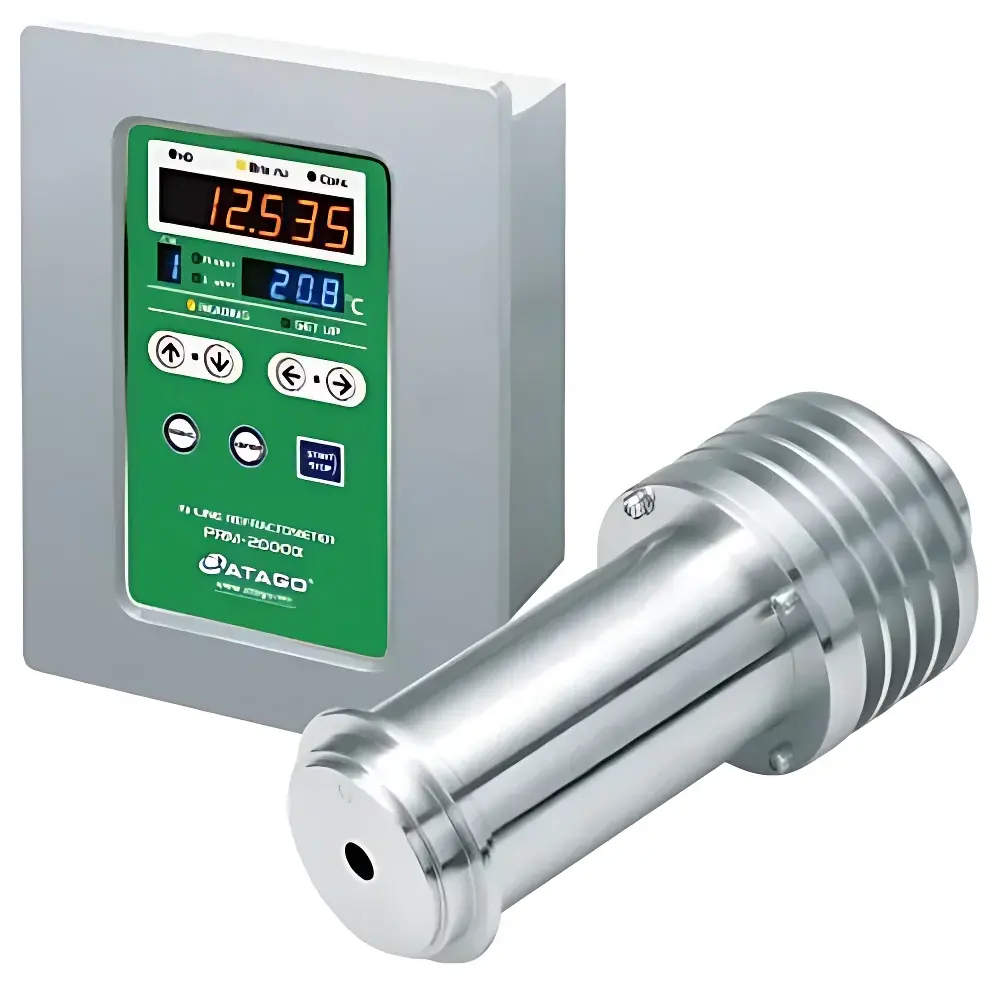
ATAGO PRM-2000α DX Online Refractometer for Sodium Hypochlorite (NaOCl) Concentration Monitoring
| Brand | ATAGO |
|---|---|
| Origin | Japan |
| Model | PRM-2000α DX (NaOCl-specific) |
| Product Type | Online Refractometer |
| Display | Digital |
| Measurement Range | Refractive Index (nD) 1.32069–1.36500, Brix 0.000–20.000% |
| Accuracy | ±0.00001 (nD), ±0.007% (Brix) |
| Temperature Control | Not integrated |
| Compliance | Designed for industrial process environments requiring ISO/IEC 17025-aligned measurement traceability |
Overview
The ATAGO PRM-2000α DX is a high-precision, in-line refractometer engineered specifically for real-time, non-invasive concentration monitoring of sodium hypochlorite (NaOCl) aqueous solutions in continuous industrial processes. Operating on the principle of critical-angle refractometry, the instrument measures the refractive index (nD) of the process stream as it flows through a sapphire prism interface mounted directly in the pipeline. This optical property exhibits a highly linear and stable correlation with NaOCl mass fraction across the validated range of 0.000–20.000% w/w (equivalent to 0–20% Brix scale), enabling robust, calibration-stable quantification without chemical reagents or sample extraction. Unlike offline titration or spectrophotometric methods—which introduce analytical lag, operator variability, and safety risks associated with handling corrosive, unstable oxidants—the PRM-2000α DX delivers second-by-second data with ±0.00001 nD resolution, supporting proactive process control in chlorine dosing, electrolytic NaOCl generation, and disinfectant formulation.
Key Features
- Optimized optical path design with temperature-compensated sapphire sensing prism for long-term stability in aggressive chemical environments
- Digital output via 4–20 mA analog signal and Modbus RTU RS-485 interface, fully compatible with DCS, SCADA, and PLC-based automation systems
- IP65-rated stainless steel housing (SUS316L wetted parts) suitable for washdown and CIP/SIP-integrated installations
- Factory-calibrated for NaOCl-specific Brix-to-concentration conversion; optional user-defined calibration curves available via configuration software
- No moving parts, zero consumables, and maintenance intervals exceeding 12 months under typical water treatment or chemical manufacturing conditions
- Real-time temperature monitoring (PT100 embedded) used for dynamic nD correction—critical for accurate NaOCl quantification given its strong thermal expansion coefficient
Sample Compatibility & Compliance
The PRM-2000α DX is validated for direct in-line measurement of aqueous sodium hypochlorite solutions containing up to 20% active chlorine (as NaOCl), including formulations with stabilizers (e.g., NaOH, Na₂CO₃) commonly used in municipal water treatment, food processing sanitation, and pharmaceutical clean-in-place systems. It is incompatible with suspensions, emulsions, or highly turbid streams where light scattering exceeds the instrument’s optical tolerance. The device conforms to IEC 61000-6-2 (EMC immunity) and IEC 61000-6-4 (EMC emission) standards. While not intrinsically safe certified, it meets ATEX Category 3G (Zone 2) installation requirements when deployed with appropriate barrier configurations. Data integrity complies with ALCOA+ principles; audit trail functionality (via optional software module) supports adherence to FDA 21 CFR Part 11 and EU Annex 11 when integrated into GMP-regulated environments.
Software & Data Management
Configuration, diagnostics, and trend analysis are managed via ATAGO’s proprietary PC-based PrismLink™ software (Windows OS). The software enables remote parameter adjustment—including zero/span calibration, temperature compensation coefficients, and alarm thresholds—and logs timestamped nD, Brix, and temperature values at user-defined intervals (1 sec to 10 min). Export formats include CSV and Excel-compatible .xlsx for integration with LIMS or MES platforms. All configuration changes generate immutable electronic records with operator ID and timestamp, satisfying GLP/GMP documentation requirements. Optional OPC UA server integration allows seamless data federation into enterprise analytics stacks without custom middleware.
Applications
- Real-time control of on-site electrochlorination systems to maintain target free chlorine residual (e.g., 0.2–5.0 mg/L Cl₂ equivalent) in potable water distribution networks
- Concentration verification during NaOCl blending and dilution in pharmaceutical-grade sanitizing solution preparation (USP compliant)
- Process validation and batch release monitoring in contract manufacturing of EPA-registered disinfectants (EPA Reg. No. required)
- Preventive safety interlocking: automatic shutdown trigger when NaOCl concentration exceeds 15% w/w—mitigating thermal runaway and decomposition risk during storage or transfer
- Quality consistency assurance in dairy plant CIP cycles, where NaOCl concentration drift directly impacts microbial log-reduction efficacy (AOAC 990.11 validated)
FAQ
Does the PRM-2000α DX require periodic recalibration with standard solutions?
Yes—ATAGO recommends quarterly verification using NIST-traceable sucrose reference standards (e.g., 5.000%, 10.000%, and 15.000% w/w) or certified NaOCl reference materials. Full recalibration is advised after prism cleaning or mechanical impact.
Can the instrument measure NaOCl in the presence of sodium hydroxide (NaOH) carryover from electrolysis cells?
Yes—the refractive index response is dominated by NaOCl concentration within the specified range; typical NaOH residuals (<2% w/w) introduce negligible bias (<±0.02% Brix) due to cross-sensitivity compensation embedded in the NaOCl-specific algorithm.
Is the prism susceptible to corrosion or scaling in hard-water feed lines?
No—sapphire (Al₂O₃) exhibits exceptional resistance to oxidation, alkali attack, and mineral deposition. Routine CIP with 2% citric acid at 60°C effectively removes any minor surface fouling without affecting optical performance.
What is the minimum flow rate required for stable measurement?
A laminar, bubble-free flow of ≥0.3 m/s is recommended to ensure consistent prism wetting and eliminate air entrapment artifacts. Flow conditioning inserts are available for low-velocity pipelines.
How does temperature fluctuation in the process line affect accuracy?
Internal PT100 sensing enables real-time nD correction using the built-in NaOCl-specific temperature coefficient (−0.00045 /°C), reducing thermal drift to <±0.002% Brix over 15–45°C operating range.





